
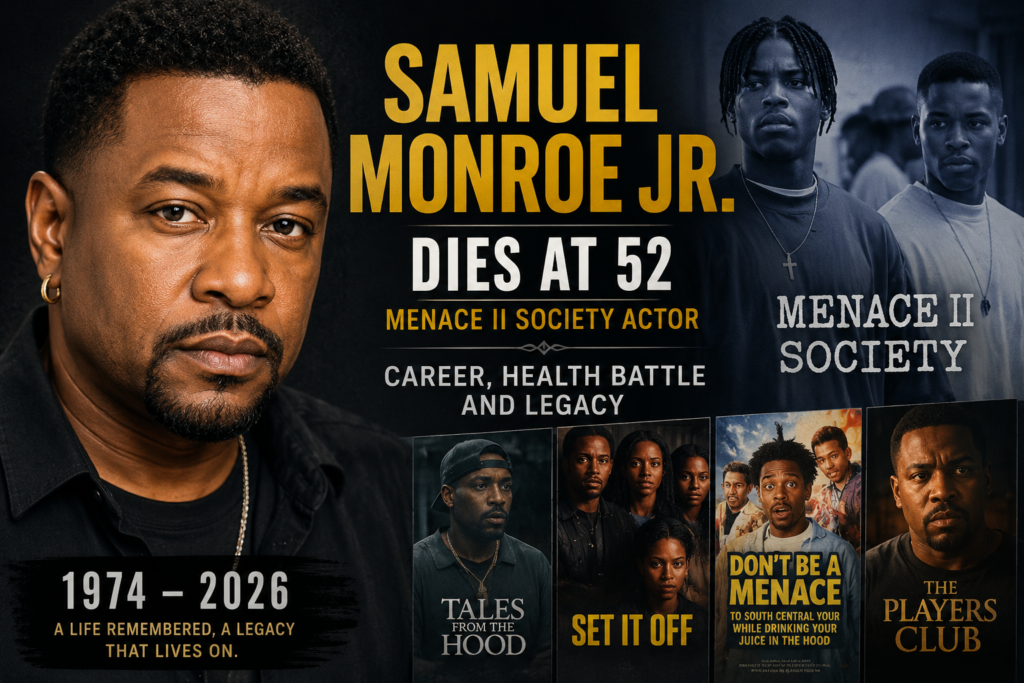
Samuel Monroe Jr., the actor remembered for his appearances in Menace II Society, Tales from the Hood, Set It Off, and The Players Club, has died at 52. His family confirmed the news on August 27, 2026, following months of serious health problems that left him hospitalized and fighting multiple complications.
Monroe’s death closes the story of an actor whose career became closely connected with some of the most recognizable Black films of the 1990s. Although many viewers first remember him from Menace II Society, his work extended across movies and television for years. He continued appearing in screen projects after his best-known 1990s roles, building a career largely through memorable supporting performances.
The news also follows a difficult medical battle that had drawn increasing concern from his family and supporters. Monroe had spent months dealing with severe illness, including meningitis and MRSA pneumonia, before his condition deteriorated further. His final months became a period of repeated medical procedures, neurological complications, and family appeals for prayers and support.
Samuel Monroe Jr. Dies at 52 After a Prolonged Health Battle
Samuel Monroe Jr. died on August 26, 2026, according to current reports, and his mother, Joyce Patton, publicly confirmed his death the following day. He was 52. Patton’s announcement thanked people who had prayed for her son and asked supporters to continue praying for the family, particularly his three children.
The circumstances surrounding his death followed months of serious illness. Reports say Monroe had been hospitalized since April after developing severe meningitis and MRSA pneumonia. His health problems later became more complicated, affecting his neurological condition and kidney function. He also required intensive medical treatment during the prolonged hospitalization.
The exact medical circumstances surrounding his final hours have not been described consistently in every report. Some accounts have cited information from his wife and family about his condition and final treatment, while other reporting has raised questions about his hospital status shortly before his death. For that reason, it is important to separate confirmed family announcements from details that remain unclear.
What is clear is that Monroe’s death came after a prolonged and devastating health crisis. His passing has prompted renewed attention to a career that began in the early 1990s and included several films that remain influential among fans of 1990s Black cinema.
What Happened to Samuel Monroe Jr.?
Samuel Monroe Jr.’s final months were marked by a severe illness that progressed into a complicated medical crisis. His family said he had been battling meningitis, while later reports described additional problems involving pneumonia, kidney function, seizures, and serious neurological complications.
The Meningitis Diagnosis and Hospitalization
Monroe’s health battle became public earlier in 2026 when his family began asking supporters to pray for him. Reports said he had been hospitalized in April with severe meningitis and MRSA pneumonia. His condition required intensive treatment, including dialysis for kidney problems and, at points, life support.
According to reports based on statements from his family, the illness had caused serious complications before doctors could stabilize him. Some family accounts also alleged that the meningitis had gone undiagnosed for an extended period, allowing the infection to become increasingly severe. Those details come from family accounts and should therefore be treated as reported claims rather than independently established medical findings.
The prolonged hospitalization became a major concern for Monroe’s relatives and supporters. A fundraising campaign was also established during his illness to help with medical expenses and the possibility of long-term care. His family continued sharing updates as his condition changed over the following months.
Later Complications and Medical Crisis
Monroe’s condition reportedly worsened during the summer. His wife, Shawna Stewart, said he experienced more than 20 seizures around the end of July, followed by severe swelling in his brain. Reports also said he underwent multiple brain surgeries as doctors attempted to manage the neurological complications.
The situation eventually became critical. The Hollywood Reporter reported that Monroe had been placed on life support following his lengthy hospitalization, while other reports described a medically induced coma and continuing neurological problems. His family continued seeking prayers as doctors worked to manage his deteriorating condition.
His medical battle was therefore far more complicated than a single diagnosis. Meningitis formed the central part of the family’s account, but the illness was followed by other serious complications that affected multiple parts of his health. Reports have described MRSA pneumonia, kidney problems, seizures, brain swelling, and repeated surgeries.
By the time his family announced his death, Monroe had spent months fighting an illness that had dramatically changed his health and placed enormous emotional and financial pressure on those closest to him.
Samuel Monroe Jr.’s Acting Career
Samuel Monroe Jr.’s acting career began in the early 1990s, with his first widely documented screen credit coming in the 1993 crime drama Menace II Society. That film introduced him to audiences during a period when a new generation of filmmakers and performers was reshaping American Black cinema.
Early Career and Menace II Society
Born in Los Angeles, Monroe entered the industry at a time when films centered on urban life, family, identity, violence, and community were gaining major attention. His appearance in Menace II Society became the first major association many viewers had with him, even though his role was relatively small.
The Hughes Brothers’ 1993 film developed a lasting reputation and became one of the defining titles of its era. Monroe’s participation gave him an early connection to a movie that continued to be discussed and revisited decades after its release.
Rather than becoming known through a single starring role, Monroe developed his career through a series of supporting appearances. That path became a defining feature of his work. He repeatedly appeared in recognizable productions, often sharing the screen with established performers while building his own filmography.
His subsequent credits included Tales from the Hood, Set It Off, and Don’t Be a Menace to South Central While Drinking Your Juice in the Hood. He also appeared in The Players Club, another notable title from the period.
Those roles helped establish Monroe as a familiar face within 1990s Black cinema. While he was not always the central character, his appearances placed him inside films that developed strong audiences and enduring cultural visibility.
Samuel Monroe Jr.’s 1990s Film Career
The 1990s became the defining period of Samuel Monroe Jr.’s screen career. After appearing in Menace II Society, he continued working in films that became familiar to audiences interested in Black cinema. His roles often placed him inside ensemble casts, where supporting performances helped strengthen the world and atmosphere of the story.
From Menace II Society to a Wider Filmography
Monroe followed his early success with appearances in several recognizable productions. His credits included Tales from the Hood, the horror anthology that blended supernatural stories with social commentary, as well as Set It Off, the crime drama starring Jada Pinkett Smith, Queen Latifah, Vivica A. Fox, and Kimberly Elise.
He also appeared in Don’t Be a Menace to South Central While Drinking Your Juice in the Hood, a comedy that parodied several popular urban films from the same era. Later, The Players Club added another notable title to his résumé. Together, these projects connected Monroe with a distinctive group of movies that continue to attract viewers decades after their original releases.
His career demonstrates how supporting actors can become familiar faces without always receiving top billing. Monroe’s filmography placed him alongside major performers and within productions that developed strong cultural followings. That visibility helped preserve his connection with audiences even as his work moved across different genres.
Why His 1990s Work Still Matters
The significance of Monroe’s 1990s career extends beyond the number of credits attached to his name. Many of the films he appeared in remain part of conversations about Black representation, independent filmmaking, crime dramas, comedy, and genre cinema.
For viewers discovering these movies years later, his appearances offer another connection to an important period in American film. His career also illustrates the path of performers who built lasting recognition through repeated supporting roles rather than a single leading performance.
Samuel Monroe Jr. in Tales from the Hood
One of Samuel Monroe Jr.’s notable 1990s appearances came in Tales from the Hood, Rusty Cundieff’s 1995 horror anthology. The film combined horror with stories addressing racism, violence, corruption, and social problems, giving the genre a distinctly provocative edge.
His Role as Bulldog
Monroe appeared as Bulldog, one of the characters connected to the anthology’s interconnected framing story. While the role did not make him the central figure of the entire production, it became another recognizable credit in his growing filmography.
Tales from the Hood developed a devoted audience over time and became particularly notable for using horror as a vehicle for social commentary. Its willingness to tackle difficult subjects helped distinguish it from conventional anthology horror.
For Monroe, the film represented another opportunity to work within an ensemble production and broaden his range beyond the serious crime-drama environment associated with Menace II Society. His participation also placed him in a movie that eventually gained cult status.
The importance of this credit becomes clearer when viewed alongside his other work. Monroe repeatedly appeared in films that audiences continued to revisit. As a result, even smaller roles could contribute to a recognizable body of work.
Today, Tales from the Hood remains one of the titles most often associated with the wave of 1990s Black genre filmmaking. Monroe’s appearance forms one part of that larger cinematic record.
Samuel Monroe Jr. in Set It Off and The Players Club
Samuel Monroe Jr. also appeared in two films that became important parts of his 1990s résumé: Set It Off and The Players Club. Both films featured large ensembles and established Monroe as a dependable supporting performer.
Set It Off
Released in 1996, Set It Off followed four women who turn to bank robbery after facing difficult financial circumstances. The movie starred Jada Pinkett Smith, Queen Latifah, Vivica A. Fox, and Kimberly Elise.
Monroe’s involvement placed him within another high-profile ensemble. The film became especially notable for its performances and its portrayal of friendship, economic pressure, and desperation. It also helped establish a lasting connection between Monroe’s career and some of the most recognizable Black films of the decade.
The Players Club
Monroe later appeared in The Players Club, Ice Cube’s 1998 directorial debut. The film centered on a young woman working at a strip club while attempting to pursue a different future.
Once again, Monroe contributed as part of a broader cast rather than serving as the central protagonist. That pattern reflects much of his career: he consistently worked within recognizable productions and accumulated credits across different genres.
His filmography from this period therefore tells a larger story. Monroe did not need to headline every production to become part of movies that audiences remembered. His supporting work helped build a career connected to several enduring titles from 1990s Black cinema.
Samuel Monroe Jr. Movies and TV Shows
Samuel Monroe Jr.’s career extended beyond the films that made him most recognizable. He also accumulated television credits, demonstrating his ability to move between theatrical productions and episodic television.
Notable Movie Roles
Among his better-known film credits are Menace II Society, Tales from the Hood, Set It Off, Don’t Be a Menace to South Central While Drinking Your Juice in the Hood, and The Players Club. These projects span crime drama, horror, comedy, and drama.
That range matters because it shows that Monroe’s career did not depend on one particular genre. Instead, he worked across productions with very different tones and audiences.
His movie credits also reveal the strength of his professional network. Many of the films featured prominent directors and performers, while several became culturally significant long after their theatrical releases.
Television Career
Monroe also worked steadily in television. Reported credits include appearances on Out All Night, NYPD Blue, Murder One, Smart Guy, Southland, and Black Jesus.
Television gave Monroe another route to consistent screen work. Series television also allowed supporting actors to appear across multiple episodes or productions while reaching audiences who might not have encountered every film in their careers.
His television credits therefore complement his movie résumé. Taken together, they show a performer who remained active across multiple stages of the entertainment industry rather than being remembered solely for his early 1990s film work.
That broader career is important when considering Monroe’s legacy. Menace II Society may remain his most frequently mentioned credit, but his body of work stretched considerably further.
Samuel Monroe Jr. and Menace II Society
Samuel Monroe Jr. remains closely associated with Menace II Society, the 1993 crime drama directed by Albert and Allen Hughes. The film became one of the most discussed movies of its era and helped introduce audiences to a generation of actors and filmmakers working within a changing landscape of Black American cinema.
Monroe’s Connection to the Film
Monroe appeared in the movie during the early stage of his acting career. Although he did not play one of the film’s central characters, the credit became an important part of his professional history because of the movie’s lasting visibility.
Menace II Society followed Caine Lawson, a young man navigating violence, drugs, poverty, friendship, and family pressures in Watts, Los Angeles. Its unflinching approach gave the film a distinctive identity and helped establish it as a major 1990s crime drama.
For Monroe, the film represented more than an early credit. It connected him to a production that continued to influence conversations about filmmaking, representation, and urban storytelling long after its release.
Why the Film Remains Important to His Legacy
The continued popularity of Menace II Society has helped keep Monroe’s name visible among fans who revisit the film. When news of his death emerged, many viewers immediately recognized him through the movie and began revisiting his other credits.
That response highlights an important feature of Monroe’s career. Supporting actors can become permanently linked to films that develop long lives after their original release. A brief appearance can remain part of an actor’s public identity for decades when the production itself becomes culturally significant.
Monroe’s Menace II Society credit therefore provides a natural starting point for understanding his career, but it does not represent the full scope of his work.
Samuel Monroe Jr.’s Other Memorable Roles
Although Menace II Society generated much of the attention surrounding Monroe after his death, his résumé included several other recognizable productions. His career moved between crime dramas, horror, comedy, television, and later projects.
Tales from the Hood and 1990s Genre Cinema
His appearance in Tales from the Hood added a horror title to his growing list of credits. The 1995 anthology became known for combining frightening stories with themes involving racism, violence, police abuse, and social injustice.
Monroe’s role as Bulldog gave him another connection to a film that developed a dedicated following. The movie’s reputation grew over the years, and its cultural relevance helped keep the original cast visible to new generations.
He also appeared in Set It Off, which arrived in 1996. The film brought together four women facing financial and personal pressures before becoming involved in a series of robberies. Its cast included Jada Pinkett Smith, Queen Latifah, Vivica A. Fox, and Kimberly Elise.
Comedy, Drama and The Players Club
Monroe’s résumé also included Don’t Be a Menace to South Central While Drinking Your Juice in the Hood, the 1996 comedy that satirized several conventions associated with earlier urban films.
Two years later, he appeared in The Players Club. Directed by Ice Cube, the 1998 film focused on a young woman attempting to balance her work at a nightclub with ambitions for a different future.
These projects demonstrate the variety within Monroe’s film career. He moved between serious dramas, socially conscious horror, parody, and adult-oriented drama without becoming confined to one screen persona.
The Range of Samuel Monroe Jr.’s Screen Career
Samuel Monroe Jr.’s filmography is best understood as the work of a character and supporting actor who consistently contributed to larger productions. He rarely occupied the promotional center of the movies in which he appeared, yet his credits connected him to an unusually recognizable collection of 1990s titles.
From Crime Drama to Horror and Comedy
The contrast between his projects illustrates his versatility. Menace II Society presented a serious crime drama, while Tales from the Hood used horror to explore social issues. Set It Off combined crime and drama, and Don’t Be a Menace approached the same broad cinematic territory through comedy and parody.
That variety allowed Monroe to work with different directors, casts, and storytelling styles. It also meant that viewers could encounter him in very different kinds of productions.
His career illustrates an often-overlooked reality of Hollywood: recognition does not always come from starring roles. Some performers build their reputation through a collection of smaller appearances that become increasingly meaningful when audiences look back across an entire career.
His Television Work Expanded His Reach
Monroe also worked in television, with reported appearances including Out All Night, NYPD Blue, Murder One, Smart Guy, Southland, and Black Jesus.
Those credits broadened his presence beyond feature films. Television also gave him opportunities to work within different formats and reach audiences who may not have followed every movie in his career.
Taken together, his film and television credits show a performer who remained connected to the entertainment industry across multiple decades. That longevity adds important context to the public reaction following his death.
Why Fans Continue to Remember Samuel Monroe Jr.
The reaction to Samuel Monroe Jr.’s death reflects more than recognition of one film. For many viewers, his name represents a familiar face from a particular period of American cinema.
A Familiar Face From 1990s Black Cinema
Monroe appeared in several movies that became part of the cultural vocabulary of the 1990s. Those productions reached audiences through theaters, home video, television broadcasts, and later streaming services.
As a result, viewers encountered these films repeatedly. Each rewatch created another opportunity for supporting performers to become familiar, even when audiences did not immediately know their names.
Monroe benefited from that lasting visibility. His work appeared across films that continued to circulate long after their original theatrical runs.
A Career Bigger Than One Credit
It would be easy to define Monroe solely through Menace II Society, especially because that movie became the dominant reference point in reports about his death. However, his career tells a broader story.
He worked across multiple genres and appeared alongside prominent performers. His filmography includes titles that remain recognizable more than three decades after some of them first reached audiences.
That is an important part of his legacy. Monroe did not need to lead every production to leave a recognizable mark. His collection of supporting roles placed him inside a group of films that continue to be discussed, revisited, and introduced to younger audiences.
His passing therefore brings renewed attention not only to Menace II Society, but to the wider body of work he built throughout his career.
Samuel Monroe Jr.’s Family and Personal Life
Away from the screen, Samuel Monroe Jr.’s final months brought his family into the public spotlight. His mother, Joyce Patton, and Shawna Stewart, who described herself as Monroe’s wife, became involved in a legal dispute while the actor remained seriously ill.
His Wife and Children
Stewart was publicly identified as Monroe’s wife during his hospitalization. Reports say the couple shared children, and Monroe is survived by three children. His mother also specifically asked people to keep his children in their prayers when she announced his death.
Stewart also shared a tribute following Monroe’s death, remembering him not only as an actor but as a husband and father. Her public comments during his illness described him as someone who continued fighting through an extraordinarily difficult medical situation.
Because much of Monroe’s private life remained outside the entertainment press, relatively little verified information exists about his day-to-day family life. The public record became much more detailed only during his final hospitalization, when medical, financial, and legal concerns brought relatives into the news.
For that reason, his family story should be approached carefully. The most important confirmed point is that Monroe leaves behind children and family members who publicly mourned his death after months of uncertainty surrounding his health.
The Family Dispute During His Hospitalization
The final stage of Monroe’s illness also involved a dispute between his mother and Stewart over who should have authority over his affairs.
In August, Patton filed a petition seeking a conservatorship for her son. Court-related reporting said she questioned whether Monroe and Stewart were legally married and argued that she should have greater authority over his decisions. Patton also raised concerns about money collected through a GoFundMe campaign and Monroe’s film residuals.
Stewart disputed those claims. She said Monroe had chosen her to handle his financial and medical matters and denied misusing his money. She also challenged Patton’s account of their relationship, saying that she and Monroe had continued their relationship and shared children.
The dispute remained unresolved when Monroe died. An attorney had been appointed to represent his interests, while a probate investigator was examining relevant circumstances.
Samuel Monroe Jr.’s Final Health Battle
Monroe’s health crisis became one of the defining stories surrounding the final months of his life. According to family accounts and contemporary reporting, what began as a serious infection developed into a prolonged medical emergency involving multiple complications.
From Meningitis to Severe Complications
Reports said Monroe initially contracted meningitis while working in Las Vegas. His family and wife later alleged that the condition went undiagnosed for months. By April, he required hospitalization after the infection had progressed and reportedly affected his brain and spine.
The illness was accompanied by MRSA pneumonia and kidney problems. At different points, Monroe required dialysis and intensive medical care. His family continued providing updates as his condition changed, giving supporters a picture of a prolonged and unpredictable recovery attempt.
For a period, there were signs that Monroe might improve. Reports said he became more alert and was able to breathe independently for stretches of time, while dialysis was temporarily stopped. Those developments offered his family and supporters hope after weeks of severe illness.
That improvement did not last.
The Final Weeks
Monroe’s condition reportedly deteriorated again in July. His wife said he suffered more than 20 seizures, and reports described severe brain swelling that required multiple surgeries. His neurological condition became increasingly serious, eventually leading to life support and a medically induced coma.
The circumstances around his final hospitalization contain some conflicting reporting. TMZ reported that Monroe’s mother said he died at a hospital on August 26, while a hospital representative separately told TMZ that he had been discharged alive. Other reports, including coverage citing Stewart, identified Providence Saint Joseph Burbank Hospital as the location of his death.
Because those accounts do not completely align, the safest description is that Monroe died at 52 after a prolonged battle with meningitis and serious complications. His family confirmed the death, while some details surrounding his final hospital status remained unclear in early reporting.
Samuel Monroe Jr.’s Legacy
Samuel Monroe Jr.’s career offers a different kind of Hollywood legacy. He was not primarily known as a leading man, yet his supporting appearances placed him inside numerous films that continued to resonate with audiences long after their original releases.
His Impact on 1990s Film Culture
Monroe worked during an important period for Black filmmaking. The 1990s produced a wide range of movies that explored urban life, crime, family, friendship, identity, economic pressure, and social issues.
His credits connected him to several of those productions. Menace II Society, Tales from the Hood, Set It Off, Don’t Be a Menace to South Central While Drinking Your Juice in the Hood, and The Players Club each developed their own audiences and cultural reputations.
That collection of work gives Monroe’s career a significance that extends beyond individual screen time. He became part of an era whose movies continue to circulate through television, streaming, home video, and online discussion.
His work also demonstrates the importance of supporting performers. A character may appear for only part of a movie, but a recognizable performance can remain attached to that production for decades.
Why His Work Continues to Matter
The renewed attention following Monroe’s death has encouraged longtime fans to revisit his filmography. For viewers who knew him from Menace II Society, discovering credits such as Tales from the Hood, Set It Off, and The Players Club adds greater depth to his career.
His television work further shows that his career extended beyond the films most frequently mentioned in his obituary coverage. Reported television credits include NYPD Blue, Murder One, Smart Guy, Southland, and Black Jesus.
Ultimately, Monroe’s legacy rests on consistency. He contributed to recognizable productions across different genres and remained part of an entertainment landscape that shaped the viewing habits of an entire generation.
His death at 52 is therefore not only the loss of a performer remembered from one celebrated movie. It is the loss of an actor whose career became woven into a broader chapter of American film and television.
Remembering Samuel Monroe Jr.
Samuel Monroe Jr.’s death marks the end of a career that connected him to several memorable productions from the 1990s and beyond. He became especially recognizable to audiences through Menace II Society, but his body of work extended across horror, crime drama, comedy, and television.
For longtime movie fans, his career represents the importance of supporting performers in creating the atmosphere and identity of an entire production. Monroe worked alongside established actors and appeared in films that remained visible long after their original theatrical releases.
His passing also brings renewed attention to the difficult final months of his life. His family described a prolonged medical battle involving meningitis and serious complications, while supporters followed updates and hoped for his recovery. He ultimately died at 52 after months of severe illness.
Yet his legacy should not be defined solely by his final health crisis. Monroe spent decades building a screen résumé that connected him to a distinctive era of American entertainment.
Samuel Monroe Jr.’s Lasting Career Legacy
The strongest measure of Monroe’s professional legacy is the collection of films in which he appeared. Menace II Society, Tales from the Hood, Set It Off, Don’t Be a Menace to South Central While Drinking Your Juice in the Hood, and The Players Club remain recognizable titles, particularly among audiences who grew up with 1990s Black cinema.
More Than Menace II Society
Although Menace II Society is likely to remain the role most frequently associated with Monroe, reducing his career to that one credit overlooks the breadth of his work.
His filmography demonstrates a willingness to work across different genres and production styles. He moved from serious crime dramas into horror, comedy, and later television, building a career through repeated appearances rather than relying on one starring role.
That distinction matters. Hollywood history is filled with performers whose faces are instantly recognizable even when their names are less familiar. Monroe belonged to that group.
His performances helped populate films that audiences continued to revisit, allowing his work to remain visible across generations.
A Familiar Face Across Generations
The continued availability of 1990s films through television, physical media, streaming services, and online discussion has helped preserve Monroe’s screen presence.
For younger viewers discovering these movies today, his appearances provide a link to an earlier period of filmmaking. For longtime fans, his death serves as a reminder of how many supporting performers contributed to the movies that shaped their viewing experiences.
That is ultimately an important part of Samuel Monroe Jr.’s legacy: he was part of the fabric of films that people remembered.
Frequently Asked Questions About Samuel Monroe Jr.
Who was Samuel Monroe Jr.?
Samuel Monroe Jr. was an American actor known for appearances in films including Menace II Society, Tales from the Hood, Set It Off, Don’t Be a Menace to South Central While Drinking Your Juice in the Hood, and The Players Club. He also accumulated television credits during his career.
How old was Samuel Monroe Jr. when he died?
Samuel Monroe Jr. was 52 years old when he died in August 2026. His death was confirmed by his family following a prolonged period of serious illness.
What happened to Samuel Monroe Jr.?
Samuel Monroe Jr. experienced a prolonged medical crisis in 2026. Reports described meningitis as a major part of his illness, followed by additional complications including MRSA pneumonia, kidney problems, seizures, and severe neurological issues.
His condition reportedly required intensive medical treatment, including dialysis, brain surgeries, and life support during different stages of his hospitalization.
What was Samuel Monroe Jr.’s cause of death?
Reports surrounding Samuel Monroe Jr.’s death have primarily connected it to his prolonged battle with meningitis and the serious complications that followed.
Those complications reportedly included MRSA pneumonia, kidney problems, seizures, brain swelling, and neurological deterioration. Because early reports contained differing details about his final hospitalization, the most responsible description is that he died after a severe and prolonged medical battle rather than attributing his death to a single independently confirmed condition.
What role did Samuel Monroe Jr. play in Menace II Society?
Samuel Monroe Jr. appeared in Menace II Society, the 1993 crime drama directed by Albert and Allen Hughes. The film was one of the defining crime dramas of its era and became a major part of Monroe’s professional identity.
Although his role was not that of the film’s central protagonist, the credit remained one of his most recognizable associations throughout his career.
What movies was Samuel Monroe Jr. in?
Among Samuel Monroe Jr.’s notable film credits are Menace II Society, Tales from the Hood, Set It Off, Don’t Be a Menace to South Central While Drinking Your Juice in the Hood, and The Players Club.
His work across these films demonstrates the variety of genres in which he appeared, including crime drama, horror, comedy, and drama.
Was Samuel Monroe Jr. in Tales from the Hood?
Yes. Samuel Monroe Jr. appeared in Tales from the Hood, the 1995 horror anthology directed by Rusty Cundieff. He played Bulldog.
The film later developed a strong cult following and became notable for combining horror storytelling with themes involving racism, violence, corruption, and other social issues.
Who was Samuel Monroe Jr.’s wife?
Samuel Monroe Jr.’s wife was publicly identified as Shawna Stewart. She spoke publicly about his medical condition during his final illness and was involved in a family and legal dispute concerning his affairs while he was hospitalized.
Because the circumstances surrounding that dispute involved competing claims, those allegations should be treated as reported statements rather than established facts.
What happened during Samuel Monroe Jr.’s hospitalization?
Monroe reportedly spent months receiving medical treatment after developing severe meningitis and other complications.
Reports described MRSA pneumonia, kidney problems requiring dialysis, seizures, brain swelling, multiple brain surgeries, and periods of life support. His family and supporters followed his condition closely as doctors attempted to stabilize him.
His final medical circumstances were complicated by conflicting accounts concerning his hospital status shortly before his death.
Did Samuel Monroe Jr. have children?
Yes. Reports following his death identified Monroe as the father of three children. His mother, Joyce Patton, specifically asked people to remember his children in prayers when announcing his death.
What other TV shows did Samuel Monroe Jr. appear in?
Reported television credits include Out All Night, NYPD Blue, Murder One, Smart Guy, Southland, and Black Jesus.
These appearances demonstrate that his career extended beyond his best-known feature films and continued across television as well.
Final Perspective on Samuel Monroe Jr.
Samuel Monroe Jr. leaves behind a career that deserves to be remembered for more than the circumstances of his death.
His work connected him to a group of films that became especially influential among audiences who grew up with 1990s Black cinema. From Menace II Society to Tales from the Hood, Set It Off, and The Players Club, his credits placed him within productions that remain recognizable decades later.
His career also demonstrates the lasting importance of supporting actors. A performer does not always need a leading role to become part of a movie’s identity. Sometimes, appearing in the right collection of memorable productions is enough to create a legacy that lasts.
Monroe’s final months were marked by a devastating health battle, and his family faced difficult personal and legal circumstances alongside his illness. But those events should form only one part of the story.
The larger story is that of an actor who worked consistently, contributed to memorable movies and television productions, and became a familiar presence for generations of viewers.
Samuel Monroe Jr. was 52. His work, particularly within the films of the 1990s, ensures that his name will remain connected to an important chapter of American cinema.