
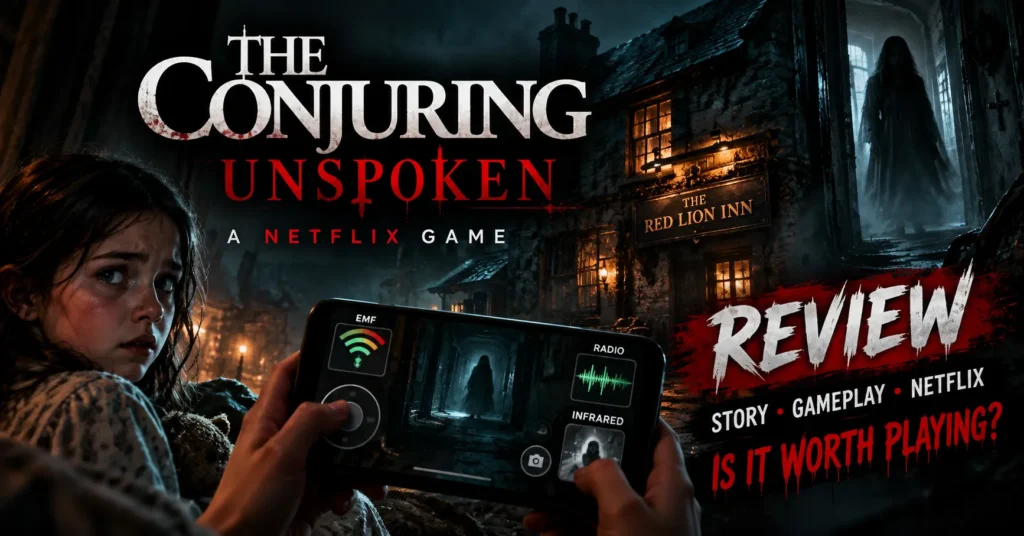
The Conjuring: Unspoken brings supernatural horror into an interactive experience where players investigate disturbing events instead of simply watching them unfold. Set within the world of The Conjuring, the game combines cinematic storytelling, paranormal investigation, and a mystery involving a troubled family.
Released on October 13, 2026, the game follows the Cooper family as frightening events lead to questions about the Red Lion Inn and the supernatural forces connected to it. Players explore the mystery through environmental clues, character interactions, and specialized ghost-hunting equipment.
However, the game stands apart from a traditional horror title because of its unusual control system. Players use a compatible smartphone or tablet to interact with the experience while viewing the main action on a television or computer browser.
This approach gives the game a different feel from conventional console horror adventures. It also raises several important questions for fans: What is The Conjuring: Unspoken about? How does its gameplay work? And does it deliver the frightening experience that horror enthusiasts expect?
Here is everything players should know about its premise, release, and central mystery.
What Is The Conjuring: Unspoken?
The Conjuring: Unspoken is a single-player, story-driven horror game developed by Supermassive Games and Warner Bros. Games for Netflix’s gaming platform. It adapts the franchise’s supernatural themes into an interactive adventure centered on investigation and storytelling.
Instead of following a film from beginning to end, players participate in the unfolding mystery. They examine their surroundings, discover clues, interact with characters, and use paranormal investigation tools to understand the strange events around them.
The game emphasizes atmosphere and narrative rather than action-heavy combat. Consequently, its appeal rests on the tension of exploring unsettling locations and uncovering information that gradually reveals the larger mystery.
One of its defining features is its smartphone-based control system. Players use a compatible mobile device to interact with the game while a television or computer browser displays the main experience.
The story introduces the Cooper family, whose personal tragedy becomes connected to a frightening supernatural mystery involving the Red Lion Inn. As players investigate, they encounter characters and paranormal forces that complicate the search for answers.
For fans of The Conjuring, the game offers an opportunity to experience paranormal investigation from a more direct perspective. Meanwhile, players who enjoy atmospheric horror and mystery can approach it as a narrative adventure rather than a conventional action game.
The Conjuring: Unspoken Release Date and Netflix Availability
The Conjuring: Unspoken launched on October 13, 2026, bringing an interactive horror experience to audiences during the Halloween season. Its release offers fans another way to explore supernatural storytelling beyond the franchise’s films.
Netflix serves as the game’s distribution platform. However, players should not confuse it with a conventional movie release. The experience requires interaction, and its intended setup uses more than one device.
Players need a compatible television or computer browser for the main display, along with a smartphone or tablet that acts as the controller. An internet connection is also necessary to access the experience through Netflix.
Before starting, players should check these requirements:
- Netflix access: Confirm that the game is available through Netflix in your region.
- Compatible display: Prepare a supported television or computer browser.
- Mobile device: Keep a compatible smartphone or tablet ready to use as the controller.
- Internet connection: Ensure the devices can connect reliably.
- Platform compatibility: Follow Netflix’s current setup instructions for your specific devices.
Availability and compatibility can vary by region and supported hardware. Therefore, checking the game’s current Netflix listing is the safest way to confirm whether you can play it.
The October launch also makes the game a timely option for horror fans looking for an interactive experience during Halloween.
Where Can You Play the Game?
Netflix designed The Conjuring: Unspoken around a connected-screen experience. Rather than relying on a conventional game controller, players use a smartphone or tablet to interact with the game.
The main display runs the experience through a supported television setup or computer browser. Meanwhile, the mobile device serves as the controller, allowing players to interact with the environment and access investigation tools.
This arrangement distinguishes the game from many traditional console horror titles. It also means that players should check device compatibility before assuming they can launch it on their preferred screen.
To get started, open Netflix and locate the game using the platform’s current instructions. Follow the connection and pairing steps for your devices, then use the mobile controller to navigate the experience.
The second device plays an important role in the intended gameplay. Players should therefore keep their phone or tablet available throughout the session rather than treating it as an optional accessory.
For households that already use Netflix on a compatible television or computer, this setup may provide a convenient way to explore interactive horror without a dedicated gaming console. However, the exact requirements depend on the supported configuration.
The Conjuring: Unspoken Story Explained
The story of The Conjuring: Unspoken revolves around the Cooper family and a series of disturbing events connected to the Red Lion Inn. Family tragedy and unexplained supernatural activity form the foundation of the mystery.
Rather than explaining everything immediately, the narrative encourages players to investigate their surroundings and piece together information. Environmental clues, character interactions, and discoveries gradually reveal more about the circumstances behind the haunting.
The Cooper family’s personal struggles give the story an emotional dimension. Their experiences are not simply a backdrop for frightening encounters; they help establish what is at stake as the supernatural mystery develops.
Francesca Noakes, a paranormal investigator, plays an important role in the investigation. Her involvement provides a way to approach the strange events, while the presence of Florrie and Vinea introduces additional questions about the forces behind the haunting.
The Red Lion Inn serves as a central location where the family’s experiences and the paranormal mystery intersect. As players explore the setting, they uncover clues that help connect individual events to the larger story.
The narrative combines family drama, mystery, and supernatural horror. As a result, the experience places considerable emphasis on discovery rather than relying solely on sudden scares.
For players who enjoy stories that reveal their secrets gradually, the central appeal lies in understanding what happened to the family and how the supernatural elements connect to their circumstances.
The Red Lion Inn and the Cooper Family
The Cooper family’s tragedy gives the game’s horror a personal foundation. Their circumstances raise questions about the events that preceded the investigation and the disturbing experiences that continue to affect them.
Bryony Cooper’s silence becomes a key element of the mystery. Her condition prompts questions about what the family has endured and whether ordinary explanations can account for what is happening.
Charlotte and Jack Cooper also contribute to the family dynamic. Their relationships and responses to the unfolding events help establish the emotional stakes beyond the paranormal investigation itself.
The Red Lion Inn connects these personal struggles with the wider supernatural narrative. Rather than functioning merely as a frightening location, it provides a setting in which clues, family history, and paranormal discoveries begin to intersect.
This emphasis on relationships gives the game a different focus from horror experiences built primarily around combat or survival mechanics. Players instead follow the investigation, examine the environment, and gradually develop a clearer understanding of the mystery.
The family drama also adds context to the supernatural threat. The frightening events matter because of their impact on the people involved, giving the story a human dimension alongside its unsettling atmosphere.
As the investigation progresses, the central question becomes not only what is haunting the family, but also how the events surrounding the Red Lion Inn fit together.
The Conjuring: Unspoken Characters Explained
The characters give The Conjuring: Unspoken much of its emotional weight. Although the supernatural mystery drives the plot, the story also examines how people respond to loss, fear, and responsibilities they never expected to carry.
The Cooper family stands at the center of the narrative. Jack Cooper struggles to raise his daughters after the death of his wife, Olivia. His grief complicates his ability to understand the frightening events surrounding his family, particularly because he initially doubts the supernatural explanation.
Bryony Cooper, his younger daughter, becomes a central target of the haunting. Since her mother’s death, she has stopped speaking, leaving her family struggling to understand what she experiences. Her silence also makes the paranormal threat more unsettling because the people closest to her cannot easily discover what she knows.
Charlotte Cooper, Bryony’s older sister, faces a different challenge. She must cope with her own grief while taking on additional responsibility for her younger sibling. Her situation creates tension between the ordinary pressures of adolescence and the extraordinary circumstances affecting her family.
Francesca Noakes brings a professional perspective to the crisis. As a demonologist and paranormal investigator, she approaches the case with specialized knowledge and equipment. However, her role extends beyond collecting evidence. She must also understand the family’s emotional circumstances to help them confront the threat.
Together, these characters give the game a human foundation. Their relationships make the haunting more personal, while their different reactions to grief and fear shape the investigation.
Bryony, Charlotte, and Jack Cooper
Bryony, Charlotte, and Jack Cooper represent three different responses to the same family tragedy.
Bryony’s silence makes her particularly vulnerable. At just eight years old, she struggles with the loss of her mother while experiencing disturbing supernatural events. Her inability to communicate normally increases the uncertainty surrounding the haunting, leaving others to interpret what she experiences.
Charlotte, meanwhile, faces the difficult position of becoming a caretaker for her younger sister while managing her own emotional needs. She wants some independence, yet her family’s circumstances place new responsibilities on her. This conflict makes her more than a supporting character in a conventional ghost story.
Jack’s struggle centers on grief, parenthood, and skepticism. Losing Olivia leaves him responsible for raising two daughters during an already painful period. His reluctance to accept a paranormal explanation initially creates another obstacle because the family needs him to recognize the seriousness of their situation.
These contrasting reactions strengthen the story. Bryony needs protection, Charlotte needs room to process her own feelings, and Jack must reconcile his beliefs with the evidence confronting him.
The result is a family drama in which the supernatural threat exploits existing emotional wounds. Rather than separating the haunting from the characters’ lives, the game connects the two, making the family’s relationships central to the investigation.
Francesca Noakes and Her Paranormal Investigation
Francesca Noakes provides the investigative perspective that helps players understand the events at the Red Lion Inn. As a demonologist with a connection to the wider Conjuring universe, she brings experience and specialized equipment to a case that quickly becomes more dangerous than an ordinary haunting.
Her investigation involves searching for evidence, examining unusual activity, and interpreting signs that the Cooper family cannot fully explain. Players experience parts of the story through Francesca’s perspective, using paranormal tools to investigate the environment.
However, her importance extends beyond technical expertise. Francesca must recognize the family’s grief and understand how their emotional circumstances affect the crisis. This personal dimension gives her a meaningful connection to Bryony and helps the narrative move beyond a straightforward battle between an investigator and a supernatural enemy.
Her role also establishes a link to the franchise’s familiar paranormal-investigation tradition without making Ed and Lorraine Warren the central protagonists of this particular story.
Francesca therefore serves two purposes: she guides the investigation and connects the player’s actions to the game’s larger mystery. Through her, the experience combines the practical process of gathering evidence with the emotional challenge of helping a family facing an extraordinary threat.
Who Are Florrie and Vinea?
Florrie and Vinea are two distinct supernatural threats in The Conjuring: Unspoken. Although their presence overlaps within the haunting at the Red Lion Inn, the game gives each a different identity and role in the Cooper family’s ordeal.
Florrie is a ghost rooted in English folklore. Her tragic history connects her to the inn’s well, where her body was reportedly thrown after her husband murdered her. This backstory gives the location a disturbing history that predates the Cooper family’s experiences.
Vinea, by contrast, is a demon associated with the well and the emotional vulnerability of the living. The game presents him as a force that feeds on grief and uses supernatural abilities to torment his victims. His methods include possession and interference with memories, making him a threat that reaches beyond physical appearances or frightening sounds.
The distinction between the two matters because the story is not simply about discovering one restless spirit. Players must investigate a situation involving both a ghost with a tragic past and a demon that exploits human suffering.
Their connection to the inn also creates a layered mystery. The location’s history, Florrie’s fate, and Vinea’s influence gradually become parts of the same supernatural problem.
Together, these entities give the game two different forms of horror: the unsettling presence of a spirit tied to past violence and the more calculated threat of a demon that uses grief as a means of control.
Florrie: The Ghost Connected to the Well
Florrie’s story gives the Red Lion Inn a connection to the past. According to the game’s lore, she lived during the period of the English Civil War and died at the hands of her husband after he discovered her infidelity. He then disposed of her body in the inn’s well.
This history establishes Florrie as more than an unexplained apparition. Her death provides a narrative reason for her association with the location, while the well becomes a physical link between the inn’s past and its present haunting.
Her role also draws on a familiar element of supernatural horror: a place that retains the consequences of an earlier tragedy. The inn’s disturbing history creates questions about why certain locations become associated with ghost stories and how past violence continues to shape the present.
Florrie’s presence should also be understood separately from Vinea’s demonic influence. Although their stories intersect, the game identifies them as different entities with different origins.
This distinction helps the mystery develop beyond a single explanation for every strange event. Players must consider the history surrounding Florrie while also investigating the more deliberate supernatural activity connected to Vinea.
Vinea: The Demon Feeding on Grief
Vinea represents the more threatening supernatural force in the game’s central mystery. Rather than functioning simply as a frightening presence, he targets emotional vulnerability and uses it to deepen the Cooper family’s suffering.
The demon’s connection to grief makes Bryony especially vulnerable following her mother’s death. Her emotional pain and paranormal sensitivity place her at the center of the haunting, creating a disturbing connection between the family’s personal tragedy and the supernatural danger.
Vinea also possesses abilities that complicate the investigation. The game’s official description associates him with possession, altered memories, and supernatural markings on his victims. These powers create uncertainty because characters cannot always rely on what they see, remember, or understand.
His connection to the well further links him to Florrie’s story and the inn’s history. As players uncover more information, they must consider how the ghost and demon contribute to the events surrounding the family.
The concept of a demon exploiting grief also reinforces one of the game’s central themes. The Cooper family’s loss is not merely background information; it becomes an important part of the threat they must confront.
By combining psychological vulnerability with supernatural manipulation, Vinea gives the investigation a more personal dimension than a haunting based only on unexplained noises or ghostly appearances.
How The Conjuring: Unspoken Connects to the Movies
The Conjuring: Unspoken expands the franchise through an original interactive story rather than retelling one of its existing films. It preserves the series’ focus on paranormal investigation, demonic threats, haunted locations, and the emotional consequences of supernatural events.
The central case revolves around Francesca Noakes and the Cooper family, setting it apart from stories led directly by Ed and Lorraine Warren. However, Francesca’s connection to the wider paranormal-investigation world helps the game feel consistent with the franchise’s established themes.
The game also includes references and familiar elements that longtime fans may recognize. These connections reward viewers who already understand the series, but the main story remains focused on its own characters and haunting.
This approach allows the experience to introduce new supernatural mythology without requiring players to revisit a particular film first. The Red Lion Inn, Florrie, and Vinea provide the foundation for a separate mystery, while the broader franchise supplies the context for its style of horror.
For existing fans, the appeal lies in seeing how the universe can support a different storytelling format. For newcomers, the game offers a more direct route into the franchise’s paranormal atmosphere without asking them to learn an extensive backstory before beginning the investigation.
Do You Need to Watch the Movies First?
No. You can play The Conjuring: Unspoken without watching the previous movies.
The game introduces its own central characters, supernatural threat, and investigation. The Cooper family’s story provides enough context to follow the main events without prior knowledge of the franchise.
However, familiarity with the films can make certain references and connections more meaningful. Fans who recognize the wider paranormal-investigation background may appreciate the additional context surrounding Francesca and the game’s place within the franchise.
Newcomers can simply approach it as a standalone horror mystery about a family facing a disturbing haunting. They do not need to understand every previous case or supernatural entity before starting.
If you already enjoy The Conjuring movies, the game offers another way to explore the universe. If you are unfamiliar with them, it can still serve as an entry point into the franchise’s blend of paranormal investigation and character-focused horror.
The Conjuring: Unspoken Gameplay Explained
The Conjuring: Unspoken combines third-person exploration, paranormal investigation, and cinematic storytelling. Players move through the Red Lion Inn, interact with objects, examine clues, and make decisions as the mystery surrounding the Cooper family unfolds.
The gameplay follows a straightforward pattern: explore an area, investigate suspicious activity, discover information, and decide how to respond to the characters and events around you. However, the experience becomes more engaging when players must interpret clues rather than simply follow the story.
The game also switches between different perspectives, including Bryony Cooper and demonologist Francesca Noakes. These sections create contrasting experiences. Bryony’s vulnerability heightens the sense of danger, while Francesca’s investigation gives players access to specialized paranormal equipment.
Dialogue and action choices add another layer to the experience. Some decisions have time limits, so players must respond before the opportunity disappears. These moments help maintain tension during important scenes.
Optional secrets also encourage careful exploration. Players who examine their surroundings can uncover additional details about the setting and its history rather than focusing exclusively on the main objectives.
Overall, the gameplay favors atmosphere, discovery, and narrative decisions over complex combat systems. It is designed for players who enjoy cinematic horror adventures and want to participate in a supernatural mystery without mastering a traditional action game’s controls.
Players interested in other upcoming gaming releases can also explore our coverage of Hogwarts Legacy 2: Release Date, News, Story and Latest Updates.
How the Smartphone Controller Works
The smartphone controller is one of the game’s most distinctive features. The television or computer displays the main game world, while the phone or tablet provides the controls and paranormal investigation tools.
Players use the mobile touchscreen to move their character and interact with objects. Depending on the situation, they can also rotate or tilt the device to examine objects or search for supernatural signals.
The controller becomes particularly important during investigations. Rather than merely pressing a button to reveal every clue, players must use the relevant tool and pay attention to its feedback.
For example, the EMF reader helps locate paranormal energy, while the radio requires players to move their device to find a clearer signal. The infrared camera offers another way to examine the environment for clues that remain hidden on the main display.
This setup creates a closer connection between the player’s actions and the investigation. Looking down at the phone becomes part of the experience, especially when a clue requires careful attention.
However, touchscreen movement may feel less precise than using a conventional gamepad. Players unfamiliar with phone-controlled games may need some time to adjust to the movement and interaction system.
Ghost-Hunting Tools and Investigation Mechanics
Paranormal equipment plays a central role in The Conjuring: Unspoken. Instead of relying entirely on visual clues, players use specialized tools to detect activity, investigate suspicious locations, and uncover evidence.
The game features three principal investigation tools:
| Tool | Main function |
|---|---|
| EMF reader | Detects paranormal energy and helps players locate activity. |
| Radio | Scans for frequencies associated with supernatural communication. |
| Infrared camera | Reveals hidden clues, markings, and entities through a thermal-style view. |
Each tool serves a different purpose, so players must pay attention to the objective and select the appropriate method of investigation.
The EMF reader provides directional feedback through changing colors. The radio similarly uses signal strength to help players locate a source, encouraging them to move the controller until the signal becomes clearer.
The infrared camera works differently. It reveals information that players might overlook when examining the ordinary environment. Dark areas on its display can indicate cold spots associated with paranormal energy, markings, or entities.
These mechanics give exploration a more active role in the story. Players must look for evidence, interpret feedback, and decide where to investigate next.
The tools also reinforce the game’s atmosphere. Rather than presenting every supernatural event directly, the game sometimes asks players to search for signs of something they cannot immediately see.
EMF Reader, Radio, and Infrared Camera
The three investigation tools provide different ways to uncover the mystery, and understanding their basic functions makes exploration easier.
EMF reader: This device helps detect paranormal energy. Its color indicators change as players move closer to or farther from a source. Red signals greater distance, while green or blue indicates that the player is getting closer. Following these changes helps narrow down the location of suspicious activity.
Radio: The radio scans for frequencies associated with supernatural communication. Players move their phone or controller around to find the clearest signal. When the signal strengthens, they can use that feedback to identify the direction of the source.
Infrared camera: This tool reveals information that the ordinary view may hide. Players examine the infrared display for dark areas, known as cold spots, which can indicate paranormal energy or other clues. Holding the camera over a relevant area for a short time allows the game to collect information.
The tools do not simply add decorative details to the interface. Each one supports a different investigative task, making observation and careful movement important parts of the experience.
For the best results, follow the objective shown by the game and pay attention to the feedback from the currently equipped tool. Rushing through an investigation can make it easier to overlook useful evidence.
Do Your Choices Change the Story?
Yes. Choices influence how The Conjuring: Unspoken unfolds, although players should not assume that every decision produces a dramatic change.
During conversations, players choose responses that reflect how their character reacts to other people and unfolding events. Some interactions also require action choices, creating moments when a quick decision matters.
Certain prompts are timed. Players may need to swipe and hold toward the left or right to select a response before the available window closes. If they do not choose in time, the game can select a response automatically.
These moments add urgency to scenes that might otherwise play out like a conventional cinematic sequence. Instead of watching characters react to every situation, players participate in deciding how they respond.
The choices also support the game’s focus on character relationships. How a character responds to another person can influence the tone of an interaction and contribute to the narrative’s development.
However, the exact consequences of individual decisions may not always be immediately apparent. Players should avoid assuming that every dialogue option changes the ending or creates a completely different storyline.
The most useful approach is to choose responses that reflect how you want the character to behave, while paying attention to the situation and the people involved.
Exploration, Puzzles, and Player Agency
Exploration in The Conjuring: Unspoken involves more than moving between story scenes. Players can examine glowing objects, collect clues, interact with characters, and uncover optional secrets that provide additional background.
Objects can reveal information or unlock story events. Some require players to approach them and rotate the mobile device or controller to examine them from different angles.
The game also marks certain objects with a yellow outline. These indicate points of no return, meaning that interacting with them can advance the story beyond an earlier section. Before proceeding, players should explore the current area and collect any optional information they want to discover.
Secrets offer another reason to look carefully. These optional interactions reveal additional lore and details about the setting, rewarding players who take their time rather than immediately following the main objective.
Although the game includes investigative tasks, it does not focus on elaborate puzzle-solving. Its main emphasis remains on narrative progression, environmental discovery, and decision-making.
This balance suits players who prefer a guided horror experience with opportunities to explore. Those looking for complex puzzles or extensive freedom may find the mechanics relatively simple, but the investigation tools help maintain the atmosphere and give the player an active role in uncovering the mystery.
The Conjuring: Unspoken Review — Is It Actually Scary?
The Conjuring: Unspoken builds its horror around an unsettling atmosphere, supernatural investigation, and the emotional struggles of a grieving family. However, while the game creates an effective setting, it does not always deliver the intense scares that fans might expect from the franchise.
The Red Lion Inn provides a suitable backdrop for the mystery. Its dark interiors, disturbing discoveries, and supernatural presence create a steady sense of unease. The investigation tools also encourage players to look closely at their surroundings, making ordinary exploration feel more uncertain.
Nevertheless, atmosphere and fear are not the same thing. Some encounters feel more mysterious than genuinely frightening, and the story occasionally moves forward without building enough tension beforehand.
The game performs better when it focuses on Bryony and her family. Their grief gives the haunting emotional weight, while Francesca’s investigation provides a reason to explore the supernatural threat. These elements help maintain interest even when the scares feel restrained.
Players should therefore approach the game as a cinematic horror mystery rather than a relentless nightmare. Fans who appreciate character development and paranormal investigation will find more to enjoy than players seeking constant jump scares, difficult survival sequences, or sustained psychological terror.
Ultimately, the experience delivers a recognizable Conjuring atmosphere, but its strongest moments come from storytelling and investigation rather than sheer fear.
Graphics, Performances, and Sound Design
The game’s presentation supports its cinematic approach to horror. Character models, facial expressions, and environmental details help establish a believable setting, while the performances give the Cooper family a convincing emotional presence.
Bryony’s vulnerability is particularly important because her silence limits how she communicates her distress. The performance must convey her fear through expressions and body language rather than relying on dialogue. Charlotte and Jack also benefit from the game’s focus on grief and family relationships.
Francesca provides a different presence. Her investigative role gives the story a practical center, allowing scenes to move between emotional conversations and the search for supernatural evidence.
Visually, the Red Lion Inn establishes an appropriate horror setting. Although the location does not always offer a distinctive visual identity, its detailed environments support exploration and maintain the atmosphere.
Sound also contributes to the experience. Paranormal signals, unsettling environmental effects, and changes in audio during investigations help players recognize suspicious activity. The radio mechanic makes sound especially important because players must listen for clearer supernatural signals.
However, strong presentation cannot compensate for every weakness in the horror design. Detailed graphics and convincing performances make the characters easier to connect with, but the game still needs effective tension and meaningful threats to produce a truly frightening experience.
Overall, its cinematic presentation is one of its strengths, particularly for players who enjoy narrative-focused horror.
Storytelling, Pacing, and Replay Value
The narrative moves at a relatively brisk pace, introducing the central mystery before spending too long on unnecessary background. This approach suits a compact horror experience because players can focus on the investigation and the family’s circumstances.
The Cooper family’s story provides a clear emotional direction. Bryony’s silence, Charlotte’s concern, and Jack’s struggle with grief give the characters understandable motivations. Francesca’s involvement then connects these personal problems to the supernatural investigation.
However, the game’s short runtime limits how deeply some ideas develop. The story introduces interesting supernatural elements, but certain aspects receive less exploration than players might expect from a larger horror adventure.
Player choices also have a complicated role. Dialogue decisions create the impression that the narrative could change substantially, yet some outcomes feel less consequential than their presentation suggests. This can reduce the sense of control that fans of branching horror games often enjoy.
Replay value consequently depends on what players want from the experience. Those who enjoy revisiting a short story, examining missed clues, and reconsidering dialogue choices may find reasons to return. Players expecting extensive branching paths or dramatically different outcomes may be disappointed.
The ending benefits from the story’s emphasis on its characters, bringing the emotional conflict toward a resolution. Although the narrative could offer more meaningful variations, its focused structure helps the experience remain accessible.
For more gaming updates and upcoming releases, explore our coverage of GTA 6 leaks: What’s Real, What’s Fake, and What We Know So Far.
What Works Best in the Game
Several elements make The Conjuring: Unspoken worth considering for horror fans.
- Character-focused storytelling: The Cooper family’s grief gives the haunting an emotional foundation.
- Distinctive smartphone controls: The phone becomes part of the investigation instead of functioning only as a conventional controller.
- Interactive ghost hunting: The EMF reader, radio, and infrared camera give players practical ways to investigate supernatural activity.
- Cinematic presentation: Detailed character models and performances support the story’s emotional moments.
- Accessible runtime: The relatively short experience suits players who want a complete horror story without committing to a lengthy game.
The investigation tools deserve particular credit. Using a mobile device to search for clues creates a stronger connection between the player and the fictional investigation. The infrared camera is especially effective at making hidden details feel important.
The game’s restrained length also works in its favor when the story stays focused. Rather than stretching the mystery across many hours, it concentrates on the family, the haunting, and Francesca’s investigation.
These strengths make the experience appealing to players who value atmosphere, narrative, and inventive interaction more than complex mechanics.
Where The Conjuring: Unspoken Falls Short
Despite its strengths, the game has several limitations that may affect how much players enjoy it.
- Limited scares: The atmosphere often works better than the actual frightening encounters.
- Simplified choices: Some decisions appear more consequential than their eventual outcomes suggest.
- Basic movement controls: Touchscreen navigation may feel less precise than a traditional gamepad.
- Limited exploration: The guided structure leaves less room for experimentation than some larger horror adventures.
- Short duration: Players looking for a lengthy campaign may finish the experience sooner than expected.
The limited sense of danger is the most significant concern. The story deals with demonic activity and a vulnerable child, yet some sequences fail to build enough suspense around those threats.
The smartphone controls are also a mixed success. They make paranormal investigation more immersive, but moving a character with touchscreen arrows can feel awkward at first.
Finally, the relatively linear structure may disappoint players who expect extensive branching narratives from an interactive horror developer. The choices contribute to character interactions, but they do not always create the dramatic consequences that the game appears to promise.
These shortcomings do not make the experience unsuccessful. They simply mean that players should understand its priorities before starting.
The Conjuring: Unspoken Pros and Cons
The game’s overall appeal depends on whether its investigative mechanics and character-driven story outweigh its limited scares and relatively guided progression.
| Pros | Cons |
|---|---|
| Engaging family drama | Horror sequences can feel restrained |
| Creative phone-based investigation | Touchscreen movement takes adjustment |
| Effective cinematic presentation | Some choices feel less meaningful |
| Interesting paranormal equipment | Limited narrative branching |
| Short, focused experience | Less content than a full-length horror game |
The strongest argument in the game’s favor is its use of the smartphone controller. The EMF reader, radio, and infrared camera make investigation feel like an active part of the experience rather than a sequence of ordinary menu interactions.
Its family-focused narrative also gives the haunting emotional context. Players have a reason to care about the people affected by the supernatural events, not simply the mystery itself.
On the other hand, horror fans who prioritize intense scares and meaningful branching choices should keep their expectations realistic. The experience offers a compact, cinematic investigation rather than a sprawling survival-horror adventure.
Looking for more gaming recommendations? Check out our roundup of PlayStation Plus October Games: F1 25, Hunt: Showdown 1896 & EDF World Brothers 2.
The verdict so far: The Conjuring: Unspoken is an interesting interactive expansion of the franchise, with its strongest qualities found in storytelling and phone-based ghost hunting. Its weaker scares and limited choice consequences prevent it from reaching its full potential, but the overall concept remains appealing for fans of narrative-driven horror.
How to Play The Conjuring: Unspoken on Netflix
Playing The Conjuring: Unspoken requires a compatible television or computer browser, an active Netflix membership, an internet connection, and a smartphone or tablet to use as the controller.
Unlike a conventional mobile game, the experience runs on the main screen while the mobile device handles movement, interactions, and paranormal investigation tools.
Follow these steps to get started:
- Open Netflix: Sign in on a compatible television or visit Netflix in a supported computer browser.
- Find the game: Search for The Conjuring: Unspoken and select the option to play if it appears in your region.
- Prepare your phone or tablet: Keep the device nearby and follow the on-screen instructions to connect it as the controller.
- Scan the QR code: When prompted, use your mobile device’s camera to scan the code and complete the connection process.
- Begin the investigation: Follow the opening instructions, learn the controls, and start exploring the Red Lion Inn.
Keep both screens available throughout your session. The game requires an internet connection, and physical gamepads are not supported according to Netflix’s current controller guidance.
If the game does not appear, check your region’s availability and your device’s compatibility with Netflix’s television and browser games.
Is The Conjuring: Unspoken Worth Playing?
The Conjuring: Unspoken is worth considering if you enjoy supernatural mysteries, character-driven storytelling, and interactive investigations. Its smartphone controls offer a distinctive way to use ghost-hunting equipment, while the Cooper family’s tragedy gives the haunting an emotional foundation.
However, the experience may not satisfy everyone. Players seeking constant jump scares, complex combat, extensive exploration, or a lengthy horror campaign should keep their expectations realistic.
The game’s strongest qualities lie in its cinematic presentation, paranormal investigation mechanics, and focused narrative. Its more limited scares and relatively guided structure may disappoint players who prefer deeper gameplay systems.
Consider the following recommendations:
- Play it if: You enjoy The Conjuring universe, atmospheric horror, paranormal mysteries, and interactive storytelling.
- Approach it cautiously if: You expect every decision to change the story dramatically or want an especially frightening survival-horror experience.
- Skip it if: You prefer traditional gamepad controls or want a large, open-ended horror adventure.
Netflix also lists content warnings for murder, blood, religious horror, and child possession. Consider these themes before playing, particularly if you are sensitive to depictions of supernatural harm involving children.
Overall, the game is best suited to players who value storytelling and investigation over mechanical complexity.
Final Verdict on The Conjuring: Unspoken
The Conjuring: Unspoken offers a fresh way to experience the franchise by combining paranormal investigation with cinematic horror storytelling. Its smartphone controller makes the ghost-hunting mechanics distinctive, while the Cooper family’s tragedy provides an emotional reason to investigate the haunting.
Nevertheless, its limited scares, straightforward exploration, and less consequential choices may prevent it from becoming a standout horror game for every player.
For fans who enjoy supernatural mysteries and interactive narratives, it is an interesting addition to the Conjuring universe. Players looking for intense survival horror or extensive branching stories may find the experience less satisfying.
Final recommendation: Give The Conjuring: Unspoken a try if you want a compact, story-driven horror investigation and already have access to Netflix’s supported gaming setup. Just approach it as an interactive supernatural mystery rather than a full-scale survival-horror adventure.
Frequently Asked Questions
When Did The Conjuring: Unspoken Release?
The Conjuring: Unspoken launched on October 13, 2026. Netflix released the single-player horror game as an interactive addition to the Conjuring universe.
Is The Conjuring: Unspoken a Movie or a Game?
It is a video game, not a feature film. Players investigate a supernatural mystery, interact with characters, and use paranormal equipment while following a cinematic story.
Is The Conjuring: Unspoken Available on Netflix?
Yes. Netflix distributes the game through its gaming platform. Availability depends on the region and supported device, so check your local Netflix listing before attempting to play.
How Long Does It Take to Finish the Game?
The supplied information does not establish an official completion time. Your playtime may depend on how quickly you progress through the story, investigate locations, and discover optional secrets.
Can You Play Without Watching The Conjuring Movies?
Yes. The game introduces its own characters and supernatural mystery, so prior knowledge of the films is not required. Familiarity with the franchise may add context to certain references.
Is The Conjuring: Unspoken a Single-Player Game?
Yes. Netflix identifies it as a single-player, story-driven horror experience focused on investigating supernatural events and uncovering the mystery surrounding the Cooper family.
What Devices Do You Need to Play?
You need a compatible television or computer browser, an active Netflix membership, an internet connection, and a smartphone or tablet to serve as the controller. Check Netflix’s current compatibility guidance for your devices.