
Stranger Things is a science-fiction horror series that transforms a quiet Indiana town into the center of a supernatural mystery. Created by Matt and Ross Duffer, the show combines horror, adventure, coming-of-age drama, mystery, and 1980s culture.
The story begins with the disappearance of Will Byers in Hawkins, Indiana. His friends and family search for him while a mysterious girl named Eleven enters their lives. Their investigation soon reveals secret government experiments, unusual psychic abilities, terrifying creatures, and a parallel dimension known as the Upside Down.
What starts as a missing-person mystery eventually becomes a much larger story about friendship, family, identity, trauma, sacrifice, and the supernatural forces threatening Hawkins.
The series ran for five seasons, with its final season bringing the main story to a conclusion in 2026. Netflix’s official coverage describes the finale as the end of the five-season story created by the Duffer Brothers.
What Is Stranger Things About?
Stranger Things begins on November 6, 1983, when 12-year-old Will Byers disappears after spending the evening playing Dungeons & Dragons with his friends. His disappearance sends his family, friends, and Hawkins Police Chief Jim Hopper searching for answers.
At the same time, Eleven escapes from Hawkins National Laboratory. She has psychic abilities and has spent much of her childhood inside the secret facility. Mike Wheeler, Lucas Sinclair, and Dustin Henderson discover her while searching for Will.
The central mystery gradually reveals several connected elements:
- Will has been taken into a dangerous alternate dimension.
- Hawkins National Laboratory has conducted secret experiments.
- Eleven has a connection to the laboratory and its research.
- A supernatural creature has entered Hawkins.
- The alternate dimension becomes known as the Upside Down.
The Upside Down looks like a dark, corrupted version of Hawkins filled with hostile creatures, strange growths, and dangerous conditions. Gates connect that realm with the ordinary world.
From that point, the story expands with every season. New threats appear, old mysteries receive new explanations, and the characters discover that the events in Hawkins are connected in ways they could not initially understand.
Even as the supernatural conflict grows, the emotional center remains personal. The characters repeatedly put themselves in danger to protect their friends and families.
How Stranger Things Began
Matt and Ross Duffer created Stranger Things around a combination of childhood adventure, supernatural horror, mystery, and science fiction. The series introduces those elements gradually instead of explaining its entire mythology at the beginning.
That approach allows viewers to discover Hawkins alongside the characters.
The first season establishes the show’s core ingredients:
- A missing child
- A mysterious girl with supernatural abilities
- A secret laboratory
- A group of close friends
- A frightening creature
- A hidden alternate dimension
- A growing mystery surrounding Hawkins
The series then expands those foundations across five seasons. Characters become older, relationships change, and the supernatural mythology becomes increasingly complex.
The Duffer Brothers have also emphasized the importance of practical elements in creating the show’s creatures and horror atmosphere. Their approach combines physical production techniques with visual effects to make supernatural threats feel tangible within the scenes.
That mixture of recognizable childhood experiences and increasingly strange events gives Stranger Things its distinctive identity.
The show can move from a basement Dungeons & Dragons game to a terrifying encounter with a monster without completely abandoning its original emotional perspective.
The Duffer Brothers and the Original Concept
The Duffer Brothers built Stranger Things around young characters who have to confront problems far beyond their everyday experiences.
Mike, Lucas, Dustin, and Will are not trained investigators. They are children who rely on friendship, curiosity, imagination, and whatever information they can find.
That perspective becomes important because the supernatural world initially makes little sense to them.
Instead of immediately understanding the creatures and dimensions around Hawkins, the characters create explanations using the ideas they already know. Dungeons & Dragons becomes especially useful because its fantasy terminology gives the group a way to describe unfamiliar threats.
Eleven provides another connection between the ordinary world and the supernatural mystery. Her abilities allow the characters to investigate situations that they could not understand through normal methods.
The emotional foundation remains just as important as the supernatural mythology. Will’s disappearance affects Joyce, Jonathan, Mike, Lucas, Dustin, and Hopper in different ways. Eleven, meanwhile, is searching for safety and a sense of belonging after growing up inside Hawkins Laboratory.
As the series develops, those individual stories become part of the larger conflict surrounding Hawkins.
Netflix describes the completed series as a five-season story in which the Hawkins characters ultimately confront Vecna and the larger supernatural threat.
The 1980s Setting
The 1980s setting plays an important role in Stranger Things. The series begins in 1983, long before smartphones, social media, modern messaging apps, and constant internet access.
That changes how the characters investigate problems.
When Will disappears, his friends cannot instantly contact one another through a phone app or search online for information. Instead, they use bicycles, walkie-talkies, telephones, maps, libraries, and direct conversations.
This makes Hawkins feel both smaller and more isolated.
The setting also shapes the show’s visual identity. Several locations become closely associated with the series:
- Hawkins Middle School
- The Byers family home
- Hawkins National Laboratory
- The Wheeler basement
- Starcourt Mall
- Hawkins streets and surrounding woods
Music adds another layer to the period atmosphere. Songs help establish the emotional tone of individual scenes while reinforcing the show’s connection to the decade.
However, Stranger Things does not simply present the 1980s as nostalgia. The period setting also creates limitations. Information travels more slowly, technology offers fewer solutions, and young characters often have to solve problems without immediate adult or institutional support.
That combination of freedom and vulnerability helps the setting serve the story rather than merely decorate it.
Stranger Things Story Explained
The story begins when Will Byers disappears in Hawkins, Indiana. His friends search for him while his mother Joyce and Police Chief Hopper investigate the strange circumstances surrounding his disappearance.
Like Lost TV Series, Stranger Things gradually reveals the secrets behind its central mystery while expanding the story through different characters and discoveries.
At the same time, Eleven escapes from Hawkins National Laboratory and joins Will’s friends. Their investigation eventually reveals secret experiments and a dangerous alternate dimension called the Upside Down.
The story expands across five seasons:
- Season 1: The Demogorgon and Will’s disappearance introduce the Upside Down.
- Season 2: The Mind Flayer becomes a larger threat.
- Season 3: The supernatural conflict returns through Starcourt Mall.
- Season 4: Vecna’s identity and connection to Eleven are revealed.
- Season 5: The Hawkins group faces the final battle against Vecna.
As the story grows, the characters also face friendship, family, grief, and personal struggles. By the final season, Hawkins has been severely affected by the supernatural conflict, leading the characters toward their final confrontation with Vecna.
At its core, Stranger Things combines supernatural adventure with a story about friendship, family, and growing up.
The Core Story Elements of Stranger Things
Several elements remain central throughout the entire series.
| Story Element | Importance |
|---|---|
| Hawkins | The main town where the supernatural events unfold |
| Will Byers | His disappearance launches the original mystery |
| Eleven | A powerful character connected to Hawkins Laboratory and the supernatural conflict |
| Upside Down | The alternate realm connected to Hawkins |
| Hawkins Laboratory | The site of experiments that help trigger the central conflict |
| Dungeons & Dragons | A shared language the characters use to understand supernatural threats |
| Vecna | The major antagonist of the later story |
| Friendship and family | The emotional foundation behind the characters’ decisions |
These elements allow Stranger Things to operate on several levels at once. It is a supernatural adventure, but it is also a story about people growing up while facing circumstances they never expected.
The show’s mythology becomes increasingly elaborate, yet its most important conflicts often return to simple motivations: finding someone who is missing, protecting a friend, saving a family member, or refusing to leave someone behind.
That balance between large-scale supernatural stakes and personal relationships remains one of the defining characteristics of the series.
Stranger Things Season-by-Season Story
The story of Stranger Things unfolds across five seasons, with each chapter expanding the supernatural mythology while following the characters as they grow from children into young adults.
The scale changes dramatically over time. Season 1 centers on one missing boy and a mysterious laboratory. Season 2 explores the continuing connection between Hawkins and the Upside Down. Season 3 moves the conflict into Starcourt Mall and introduces a Soviet operation. Season 4 reveals the history behind Vecna and connects him to Eleven’s past. Finally, Season 5 brings the Hawkins story to its conclusion.
Despite those changes, the seasons remain connected through several recurring elements:
- Eleven’s supernatural abilities
- Will Byers’ connection to the Upside Down
- Hawkins National Laboratory
- The creatures from the alternate realm
- The friendships among the Hawkins group
- The growing threat behind the supernatural events
The result is a continuous story rather than five completely separate adventures. Each season answers some earlier questions while creating new ones.
Season 1 — The Disappearance of Will Byers
Season 1 introduces Hawkins as an apparently ordinary small town hiding a dangerous secret.
Will Byers disappears on November 6, 1983, after leaving his friends following a Dungeons & Dragons game. His mother Joyce immediately begins searching for him, while Hopper investigates the disappearance from the police side. At the same time, Mike, Lucas, and Dustin encounter Eleven, a mysterious girl who has escaped from Hawkins National Laboratory.
Eleven’s abilities convince the boys that she may help them locate Will. Their investigation gradually reveals the existence of the Upside Down and the Demogorgon.
The adults and teenagers follow their own clues. Joyce discovers that Will can communicate through electrical signals, while Nancy Wheeler investigates the disappearance of her friend Barb. Hopper eventually uncovers evidence that Hawkins Laboratory has concealed information about what happened.
The season builds toward a confrontation with the Demogorgon and the rescue of Will.
However, the ending makes clear that the danger has not completely disappeared. Will returns home, but he experiences disturbing visions connected to the Upside Down. Eleven also disappears after confronting the Demogorgon, leaving questions about her fate.
Season 1 therefore establishes almost every major foundation of the series: Hawkins, Eleven, the Upside Down, the laboratory, the Demogorgon, and the importance of the characters protecting one another.
Season 2 — The Mind Flayer
Season 2 begins after the events of the first season, but Will’s connection to the Upside Down creates a new threat.
Although Will has returned to Hawkins, he continues experiencing visions of the alternate dimension. His condition eventually reveals that something much larger than the Demogorgon is influencing him. The characters come to understand that the Mind Flayer represents a major supernatural force connected to the Upside Down.
Meanwhile, Eleven is living in hiding with Hopper. Their relationship develops as Hopper attempts to protect her while helping her understand her past.
The season also introduces Max Mayfield, who becomes an important member of the group. Her arrival changes the group’s friendships, while her relationship with Lucas becomes significant in later seasons.
Dustin discovers a strange creature that he initially treats like a harmless pet. His discovery eventually connects to the larger creature network spreading beneath Hawkins.
The season’s central conflict involves freeing Will from the Mind Flayer’s influence and closing the gate between Hawkins and the Upside Down.
Eleven ultimately uses her powers to close the gate at Hawkins Laboratory. The immediate threat is contained, but the final image shows that the Mind Flayer remains present on the other side.
The victory therefore feels temporary. Hawkins has survived another supernatural attack, but the larger enemy is still waiting.
Season 3 — Starcourt and the Russian Connection
Season 3 moves the story into the summer of 1985 and gives Hawkins a new landmark: Starcourt Mall.
The mall becomes a popular gathering place for the characters, but beneath it, Soviet scientists are secretly attempting to reopen a gateway to the Upside Down. Dustin, Steve Harrington, Robin Buckley, and Erica Sinclair uncover the operation after intercepting a coded Russian transmission.
At the same time, a separate threat develops in Hawkins.
Billy Hargrove becomes connected to the Mind Flayer, which uses him and other infected people to build a physical form in the real world. Nancy, Jonathan, Mike, Eleven, Lucas, Max, Will, and their allies eventually realize that the supernatural threat has returned.
The season divides the characters into several groups, creating parallel investigations that eventually converge at Starcourt.
Eleven also struggles with her powers and her changing relationship with Mike. Hopper tries to protect her while dealing with his increasingly complicated relationship with Joyce.
The final battle takes place at the mall as the characters attempt to stop the Mind Flayer and close the Soviet-created gateway.
Billy ultimately resists the Mind Flayer’s control long enough to protect Eleven, sacrificing himself in the process. Hopper appears to die while Joyce closes the machine opening the gate.
The aftermath changes the group permanently. Eleven loses her powers, Hopper is presumed dead, and Joyce moves to California with Will, Jonathan, and Eleven.
The original Hawkins group is separated for the first time.
Season 4 — Vecna Arrives
Season 4 expands Stranger Things beyond Hawkins while introducing its most important supernatural antagonist: Vecna.
The story takes place in 1986. The characters are separated across different locations, and Eleven has lost access to her powers. Meanwhile, a series of horrifying murders begins in Hawkins. The victims appear to die through supernatural attacks, leading the group to investigate a new threat.
The investigation identifies Vecna as the entity responsible.
Vecna attacks people through their memories, fears, and emotional vulnerabilities. Max becomes one of his targets, creating one of the season’s most important character stories.
At the same time, Eleven returns to a hidden facility where she revisits memories from her childhood at Hawkins Laboratory. Those memories reveal crucial information about the laboratory massacre and her connection to Henry Creel.
The season eventually reveals that Henry Creel became the figure known as One and later transformed into Vecna.
This revelation changes the understanding of the series’ mythology. Eleven and Vecna are connected through their shared history at the laboratory, making their conflict much more personal.
The season ends with the heroes seriously injuring Vecna, but they fail to stop him completely. Multiple supernatural gates open across Hawkins, creating a massive rupture between the two worlds.
Hawkins is left transformed, setting up the final confrontation.
Season 5 — The Final Chapter
Season 5 brings the main Stranger Things story to its conclusion.
The final chapter returns the focus to Hawkins after the events of Season 4. The town has been devastated by the supernatural conflict, while the remaining heroes prepare for their last confrontation with Vecna. Netflix describes the final season as the conclusion to the five-season story created by Matt and Ross Duffer.
The characters reunite around a shared objective: find Vecna and stop the threat once and for all.
The final season also brings the story back to several ideas introduced at the beginning of the series. Friendship, family, Dungeons & Dragons, Eleven’s identity, Will’s connection to the supernatural world, and the fate of Hawkins all become important to the conclusion.
The final episodes resolve the central conflict between the Hawkins group and Vecna. Netflix’s post-finale coverage confirms that the heroes defeat Vecna and destroy the Upside Down.
The series then returns to the basement where the original group once played Dungeons & Dragons. Mike, Dustin, Lucas, Max, and Will complete one final campaign before closing the door.
That ending deliberately mirrors the beginning of the series. The story started with children playing a game together before the supernatural mystery interrupted their lives. It ends by returning them to that same space, giving the five-season story a circular structure.
How the Five Seasons Connect
Although each season has its own central conflict, the overall story follows a clear progression.
| Season | Main Threat | Major Development |
|---|---|---|
| Season 1 | Demogorgon | Will disappears and the Upside Down is discovered |
| Season 2 | Mind Flayer | Will becomes connected to the larger supernatural force |
| Season 3 | Mind Flayer | Starcourt becomes the site of a major supernatural battle |
| Season 4 | Vecna | Henry Creel’s connection to Eleven and the Upside Down is revealed |
| Season 5 | Vecna and the final supernatural conflict | Hawkins’ story reaches its conclusion |
The progression is important because the series gradually changes the audience’s understanding of what happened in Hawkins.
At first, the danger appears to come from individual monsters. Later, the characters discover that these creatures are part of a much larger supernatural system.
The same pattern applies to Eleven.
She initially appears to be a mysterious child with unusual powers. Later seasons reveal her history, her connection to Hawkins Laboratory, and her relationship with Henry Creel.
Will’s role also develops beyond being the missing child who starts the story. His experiences in the Upside Down leave a lasting connection that continues to matter throughout the series.
Meanwhile, the original group grows older. Their problems shift from childhood adventures toward relationships, identity, grief, family responsibilities, and the consequences of everything they have experienced.
That combination makes the five seasons feel like one long coming-of-age story surrounded by supernatural horror.
From Hawkins Mystery to Final Battle
The evolution of Stranger Things can be understood as a gradual expansion of its central mystery.
The story begins small
Season 1 focuses on one town, one missing child, and one mysterious laboratory.
The mythology expands
Season 2 reveals that the threat has a deeper connection to Will and the Upside Down.
The conflict becomes international
Season 3 introduces the Soviet operation beneath Starcourt Mall and shows that other forces want access to the supernatural gateway.
The past becomes important
Season 4 connects Eleven’s childhood, Henry Creel, Hawkins Laboratory, and Vecna.
The story returns to its original characters
Season 5 brings the focus back to the Hawkins group and their final confrontation with the supernatural threat.
This progression gives Stranger Things a distinctive structure. The supernatural mythology grows larger, but the emotional stakes remain centered on the same group of characters.
The series ultimately moves from “Where is Will?” to much larger questions about who created the supernatural conflict, why Hawkins became its center, and whether the characters can finally end it.
That long progression is what turns the original missing-person mystery into the complete story of Stranger Things.
Stranger Things Characters Explained
The characters are the emotional core of Stranger Things. As the supernatural conflict grows, the characters also face friendship, family, grief, identity, and growing up.
The main characters include:
- Eleven: A powerful girl connected to Hawkins Laboratory.
- Mike Wheeler: One of the original members of the Hawkins friend group.
- Will Byers: His disappearance starts the main story.
- Dustin Henderson: A curious and clever problem-solver.
- Lucas Sinclair: A loyal and practical member of the group.
- Max Mayfield: A confident skateboarder who joins the group.
- Jim Hopper: Hawkins’ police chief and Eleven’s father figure.
- Joyce Byers: Will and Jonathan’s determined mother.
- Steve Harrington: A former popular student who becomes a protector.
- Nancy Wheeler: A determined investigator.
- Jonathan Byers: Will’s older brother and family protector.
- Robin Buckley: Steve’s close friend and a key member of the team.
Together, these characters keep the supernatural story grounded in personal relationships and emotional stakes. Netflix’s official character guide covers their journeys through the final season.
Readers interested in supernatural stories centered on young characters can also explore Wednesday Season 3, another series that combines teen drama, mystery and darker supernatural elements.
Eleven
Eleven is one of the most important characters in Stranger Things. Her supernatural abilities connect her directly to the experiments conducted at Hawkins National Laboratory.
She was raised under Dr. Martin Brenner, whom she called “Papa,” as part of a secret program involving children with unusual abilities. After escaping the laboratory, she meets Mike, Lucas, and Dustin while they search for Will.
Her story develops far beyond her abilities.
At first, Eleven struggles with ordinary experiences because she has spent much of her childhood isolated from normal society. Her relationships with Mike, Hopper, Joyce, and the rest of the group gradually give her a sense of family.
Her connection to Henry Creel also becomes central to the mythology. Eleven’s confrontation with Henry as a child ultimately sends him away from the human world and contributes to the creation of the supernatural conflict that follows.
Across the series, Eleven repeatedly faces the question of whether her powers define her identity. Her journey instead becomes increasingly connected to choice, friendship, family, and personal agency.
In the finale, Eleven makes a major sacrifice intended to prevent the supernatural cycle from continuing. The Duffer Brothers deliberately leave her ultimate fate open to interpretation, allowing the characters and audience to decide what her disappearance means.
Her character therefore represents more than supernatural power. She embodies the series’ broader movement from childhood isolation toward connection and chosen family.
Mike, Will, Dustin and Lucas
Mike Wheeler, Will Byers, Dustin Henderson, and Lucas Sinclair form the original friendship group at the heart of Stranger Things.
Their friendship begins before the supernatural events of the series. They spend time together playing Dungeons & Dragons, riding bicycles, and exploring Hawkins. Will’s disappearance changes their lives and forces them into a mystery they never expected to solve.
Mike often acts as an emotional leader. His determination to find Will also becomes closely connected to his relationship with Eleven.
Will occupies a unique position because his disappearance introduces the central mystery. His experiences leave him connected to the supernatural world long after his rescue.
Dustin frequently contributes scientific curiosity and problem-solving skills. He also develops important friendships with characters outside the original group, particularly Steve and Eddie Munson. Netflix’s character guide notes his discoveries involving the Upside Down and his grief over Eddie’s death.
Lucas balances skepticism with loyalty. His relationship with Max becomes an important emotional storyline, particularly after the events involving Vecna.
The four characters also represent the show’s coming-of-age structure. They begin as children who see their adventures as extensions of their games. Eventually, the stakes become real, and their friendship becomes a source of strength during situations involving death, supernatural danger, and major personal loss.
Hopper and Joyce
Jim Hopper and Joyce Byers provide the adult perspective on the supernatural events in Hawkins.
Hopper begins the series as Hawkins’ police chief. Will’s disappearance forces him to investigate the town’s secrets, eventually leading him toward Hawkins Laboratory and the Upside Down.
Joyce approaches the mystery differently. Her determination to find Will allows her to recognize clues that others dismiss. In Season 1, she uses Christmas lights to communicate with her missing son, helping prove that Will remains alive somewhere beyond the ordinary world.
Their relationship develops gradually as they continue investigating supernatural threats together.
Hopper also becomes an important father figure for Eleven. He shelters her during Season 2 and eventually becomes her adoptive father.
Joyce’s family expands as well. She becomes a foster mother to Eleven while continuing to protect Will and Jonathan.
Their stories also involve major sacrifices. Hopper appears to die while stopping the Russian machine beneath Starcourt Mall, only for Season 4 to reveal that he survived and was imprisoned in Russia. Joyce and Murray eventually rescue him.
By the final season, Hopper and Joyce remain central members of the group preparing for the final supernatural battle.
Max, Steve, Nancy, Jonathan and Robin
The older teenagers give Stranger Things another perspective on the supernatural conflict.
Max Mayfield joins the Hawkins group in Season 2. Her confidence, skateboarding ability, and arcade skills quickly make her an important member. After Billy’s death in Season 3, she struggles with grief and later becomes one of Vecna’s targets. Vecna’s attack leaves her severely injured and in a coma at the end of Season 4.
Steve Harrington undergoes one of the show’s most visible character transformations. He begins as a popular high-school student but gradually becomes a reliable protector. His friendship with Dustin and partnership with Robin become particularly important.
Nancy Wheeler develops into a determined investigator. Her search for answers repeatedly places her near supernatural danger, including the investigation into Vecna.
Jonathan Byers remains strongly connected to Will and Joyce. His family experiences shape many of his decisions throughout the series.
Robin Buckley joins the story in Season 3 while working with Steve at Scoops Ahoy. She becomes involved in the Russian investigation beneath Starcourt and later joins the fight against Vecna. Netflix’s character guide describes her as an important member of the final-season group.
Together, these characters broaden the story beyond the original children’s group while preserving its focus on friendship and loyalty.
What Is the Upside Down in Stranger Things?
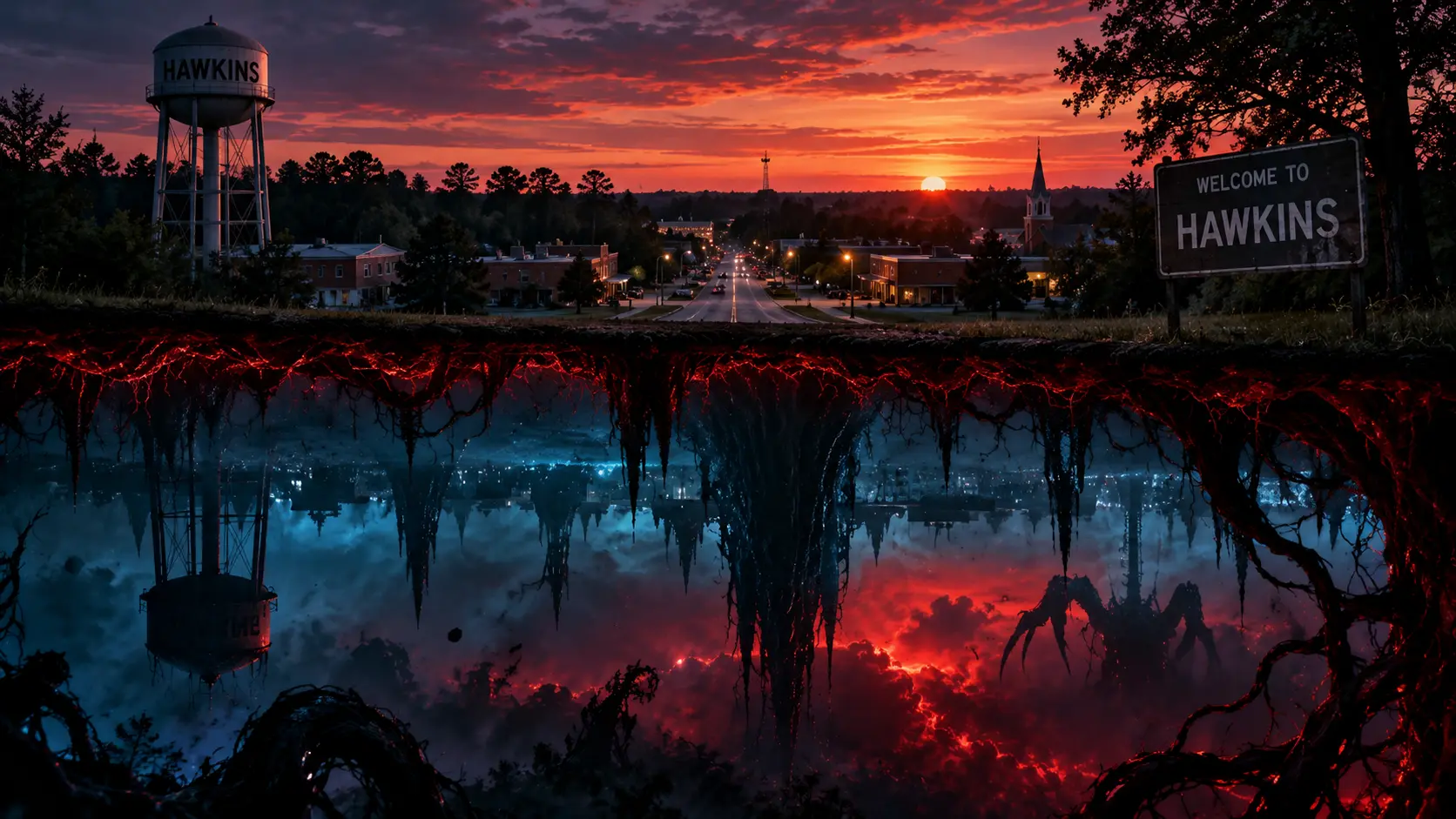
The Upside Down is one of the central mysteries of Stranger Things. In the early seasons, the characters understand it as a dark parallel version of Hawkins.
Fans of layered science-fiction mysteries can also explore Dark TV Series, which builds its story around hidden connections, supernatural mysteries and unusual realities.
It contains familiar locations, but the environment is covered with strange organic growth, spores, vines, and dangerous creatures. Gates allow movement between the ordinary world and the alternate realm.
The name itself comes from the characters. Eleven identifies the mysterious realm as the “Upside Down” after the boys compare it with the fantasy concept of a dark reflection of the normal world.
The Upside Down becomes increasingly important as the series progresses because it provides a pathway between Hawkins and the supernatural forces threatening the town.
Several major creatures are associated with it, including:
- Demogorgons
- Demodogs
- Demobats
- Mind Flayer-related entities
- Other supernatural organisms
However, the final season changes the audience’s understanding of the mythology.
The characters discover that the Upside Down is not simply the original supernatural dimension where everything began. Instead, it functions as a bridge connecting Earth to another realm called the Abyss.
That distinction becomes essential to understanding the final conflict.
How the Upside Down Works
The Upside Down initially appears to be a shadow copy of Hawkins.
The environment contains recognizable places from the human world, but they exist in a dark and hostile state. Gates can connect the two worlds, allowing creatures and supernatural forces to cross between them.
In earlier seasons, the characters gradually discover these connections through direct encounters.
The final season provides a deeper explanation. Netflix’s official mythology guide states that Eleven banished Henry Creel to the Abyss, rather than directly sending him to the Upside Down. When Eleven later made remote contact with the Abyss, the Upside Down was formed as a bridge between that realm and Earth.
This revelation changes the way the earlier seasons can be understood.
The Upside Down is therefore not simply a separate copy of Hawkins. It becomes part of a larger supernatural system connecting:
Earth → Upside Down → Abyss
Henry and the creatures associated with him use the Upside Down to move toward Hawkins.
This also explains why the supernatural conflict repeatedly centers on gateways and breaches. The characters are not simply fighting creatures inside a strange world; they are trying to stop the connection between different realms from destroying their own.
The final conflict ultimately focuses on breaking that connection and preventing the darkness surrounding Henry from continuing to reach Earth.
The Upside Down and the Abyss
The distinction between the Upside Down and the Abyss becomes one of the most important mythology revelations in Season 5.
The Abyss is a separate hostile realm with a very different appearance from the familiar dark version of Hawkins. Netflix describes it as a dangerous landscape of steep canyons, sharp rock formations, and a storm-filled sky.
The Upside Down, by contrast, resembles Hawkins and functions as a bridge between Earth and the Abyss.
This creates a clearer structure for the supernatural mythology:
| Realm | Function |
|---|---|
| Earth | The ordinary human world, including Hawkins |
| Upside Down | A supernatural bridge connected to Hawkins |
| Abyss | The deeper realm where Henry is sent and where major supernatural forces reside |
The distinction also changes how viewers can interpret the earlier seasons.
The characters initially believe they have discovered another dimension that mirrors their town. Later revelations show that their understanding was incomplete.
Henry’s history becomes the key to connecting these pieces. Eleven’s confrontation with him sends him into the Abyss, while the later creation of the Upside Down provides a route between that realm and Earth.
By the end of the series, the goal is no longer simply to close one gate. The characters must eliminate the larger connection that allows the supernatural threat to reach Earth.
This mythology gives the final conflict a direct connection to the events that began with Eleven and Henry at Hawkins Laboratory.
Who Is Vecna in Stranger Things?
Vecna is the central supernatural antagonist of the later Stranger Things storyline.
Before becoming Vecna, he was Henry Creel, a child with unusual abilities who became the first numbered subject at Hawkins Laboratory. Dr. Brenner designated him as One.
Henry eventually developed a destructive worldview and used his abilities against his family. His history later becomes connected to Eleven and the experiments at Hawkins Laboratory.
During a confrontation with Eleven, Henry is defeated and sent away from the human world. That event eventually leads to his transformation into Vecna. Netflix’s official character guide identifies Henry, One, and Vecna as different stages of the same character.
Vecna’s importance extends beyond his personal conflict with Eleven.
His actions connect several mysteries introduced earlier in the series, including:
- Hawkins Laboratory
- Eleven’s childhood
- The supernatural dimensions
- The deaths investigated in Season 4
- The Rifts that open across Hawkins
- The larger threat facing Earth
His attacks also differ from the physical attacks associated with creatures such as the Demogorgon. Vecna targets victims through their memories, fears, and emotional vulnerabilities.
That makes his conflict with the Hawkins characters deeply personal.
Henry Creel and Vecna
Henry Creel’s transformation into Vecna connects the supernatural story directly to Eleven’s past.
At Hawkins Laboratory, Henry became the first numbered subject, known as One. Under Dr. Brenner’s control, he eventually manipulated Eleven into helping him escape.
Their confrontation takes place in the Rainbow Room. Instead of defeating Henry through a conventional physical fight, Eleven uses her powers to send him into another realm. The final mythology identifies this destination as the Abyss, where Henry eventually transforms into Vecna.
This history creates a direct connection between Eleven and Vecna.
While Eleven escapes the laboratory and builds a life through friendship and family, Henry chooses a different path. He embraces his powers and uses them to impose his worldview on others.
Their conflict has two sides:
- Supernatural: Both possess extraordinary abilities and become connected to different realms.
- Personal: Their shared history at Hawkins Laboratory shapes the larger conflict.
Vecna’s transformation also connects several major mysteries involving Eleven, Hawkins Laboratory, and the supernatural world.
Vecna’s Connection to Hawkins
The connection between Vecna and Hawkins goes beyond his attacks in Season 4.
His history begins with the Creel family and Hawkins Laboratory. After transforming into Vecna, he becomes a central force behind the supernatural conflict threatening the town.
During Season 4, several Hawkins residents become his targets as he exploits their fears and painful memories. These attacks eventually contribute to the opening of multiple Rifts across Hawkins.
By Season 5, severe supernatural damage has left the town under extraordinary restrictions. Meanwhile, the remaining characters search for Vecna and prepare for their final battle. Netflix’s final-season guide describes Hawkins as scarred by the Rifts and placed under lockdown.
More than individual victims are at risk because Vecna’s actions threaten the boundary between Earth and the supernatural realms.
The final confrontation brings Eleven, Will, Max, Mike, Dustin, Lucas, Hopper, Joyce, Steve, Nancy, Jonathan, Robin, and their allies together.
Ultimately, Vecna is defeated and the Upside Down is destroyed. This closes the central supernatural conflict that began with Henry’s connection to Hawkins Laboratory and continued throughout the five-season story.
The Monsters of Stranger Things
The creatures of Stranger Things change as the mythology expands.
The Demogorgon is the first major monster. It enters Hawkins from the supernatural realm and becomes directly connected to Will’s disappearance.
The Demodogs appear later as younger versions of the Demogorgon-like creatures. Dustin’s discovery of Dart gives the characters an early opportunity to understand that these creatures can develop through different stages.
The Mind Flayer represents a larger supernatural force. It becomes especially important in Seasons 2 and 3 and influences creatures and people in Hawkins.
The Demobats appear during the Season 4 storyline and become part of the dangerous ecosystem surrounding the supernatural realm. Fans of darker horror stories can also explore Crystal Lake, which returns to the world of Friday the 13th and brings another classic horror setting to television.
Vecna is different from these creatures because he is a human being transformed by his own abilities and experiences.
| Threat | Major Role |
|---|---|
| Demogorgon | The first major monster encountered by the Hawkins group |
| Demodogs | Younger creatures connected to the Demogorgon species |
| Mind Flayer | A major supernatural force influencing the Hawkins conflict |
| Demobats | Flying creatures encountered in the Upside Down |
| Vecna | Henry Creel’s transformed identity and the central later antagonist |
Rather than functioning as unrelated monsters, these threats form part of the larger supernatural mythology.
That is one reason the show’s creature design becomes more complicated over time. The characters gradually move from fighting individual creatures to understanding the system connecting those creatures, the Upside Down, the Abyss, and Vecna.
Why Dungeons & Dragons Matters in Stranger Things
Dungeons & Dragons is more than a hobby in Stranger Things. It provides the characters with a shared language for understanding a supernatural world they cannot fully explain.
The series opens with Mike, Will, Lucas, and Dustin playing D&D in the Wheeler basement. That opening immediately establishes their friendship and shows how important the game is to their childhood.
When supernatural events begin, the characters use D&D terminology to describe what they encounter. The Demogorgon becomes the name for the first monster they face, while later threats receive names based on creatures or concepts from the game.
The Duffer Brothers have explained that the characters use D&D as a form of shorthand when confronting supernatural events. The game also reflects their personalities and the way they approach challenges.
D&D serves several purposes within the series:
- A friendship ritual: It brings the original group together.
- A storytelling tool: It gives the characters names for unfamiliar threats.
- A character mirror: The way someone plays can reveal aspects of their personality.
- A symbol of childhood: The game represents the group’s early years.
- A narrative framework: The characters often approach supernatural problems like a party facing a campaign.
The connection becomes especially important in Season 4, when Eddie Munson leads the Hellfire Club and the characters encounter a supernatural enemy they call Vecna.
The finale completes the circle by returning the surviving friends to the Wheeler basement for one final D&D campaign.
Dungeons & Dragons and the Show’s Monsters
The names of several Stranger Things creatures come from Dungeons & Dragons, but the series does not simply reproduce the game’s mythology.
Instead, the characters borrow familiar names to describe things they encounter in their own world.
The Demogorgon is the clearest early example. The boys use the name after comparing the creature they are dealing with to a monster from their game.
The same approach continues with the Mind Flayer and Vecna. These names help the characters communicate complicated ideas quickly.
However, the supernatural beings in Stranger Things have their own identities and histories. The show’s Demogorgon is not simply the same entity as the D&D creature. Likewise, Vecna’s identity in the series is connected to Henry Creel and the mythology of Hawkins.
Netflix’s coverage explains that the Duffer Brothers deliberately used D&D as a reference point for the characters’ understanding of supernatural events.
This distinction matters because the game provides a language, not a complete explanation.
The characters may recognize a creature’s resemblance to something from D&D, but they still need to investigate what the real creature can do.
That creates an interesting storytelling pattern:
D&D gives the characters a hypothesis → experience tests that hypothesis → the characters discover the real rules of their supernatural world.
The approach also reinforces the idea that imagination can help people understand frightening situations, even when their first explanation is incomplete.
The Major Themes in Stranger Things
Beneath its supernatural story, Stranger Things explores familiar human experiences.
The characters deal with friendship, family, growing up, grief, isolation, identity, fear, and the consequences of difficult choices.
The supernatural elements make those problems larger, but they do not replace them.
One reason the story remains character-driven is that major threats often affect relationships directly. A supernatural attack can separate friends, change families, create grief, or force someone to confront a painful part of their past.
The major themes include:
- Friendship and loyalty
- Growing up and changing identity
- Family and chosen family
- Fear and trauma
- Isolation and belonging
- Sacrifice
- Courage under pressure
These themes also change meaning as the characters age.
The early seasons focus heavily on childhood friendship and adventure. Later seasons introduce more complicated relationships, romantic feelings, grief, personal insecurity, and the challenge of leaving childhood behind.
The final season brings many of those ideas together. Netflix’s coverage of the finale emphasizes the characters saying goodbye to their childhood, with the final D&D game serving as a symbolic return to where their journey began.
That structure helps explain why the series can combine monsters and supernatural dimensions with stories about ordinary emotional experiences.
Friendship and Loyalty
Friendship forms the foundation of Stranger Things.
Mike, Will, Dustin, and Lucas begin the series as a close group of children. Their friendship becomes the reason they search for Will instead of simply accepting that he has disappeared.
The same principle continues as new characters join them.
Eleven becomes part of the group. Max develops close friendships with Lucas and the others. Steve becomes a trusted protector despite initially having little connection to the original children. Robin becomes part of Steve’s circle and eventually joins the wider fight.
These relationships matter because the characters repeatedly choose to help one another despite personal disagreements.
The supernatural danger also tests friendships.
Characters become separated across different locations, experience grief, develop romantic relationships, and sometimes struggle to communicate. Yet the larger group repeatedly reconnects when Hawkins faces another threat.
The final season returns to this idea. The heroes reunite because defeating the supernatural threat requires cooperation rather than individual strength. Netflix’s final-season coverage describes Eleven’s motivation in terms of protecting the friends she considers her chosen family.
The show therefore treats friendship as an active choice.
It is not simply about spending time together. It means showing up when someone is frightened, believing someone when others do not, and accepting personal risk to protect another person.
That idea remains central from Will’s disappearance in Season 1 through the final confrontation.
Growing Up and Identity
The characters of Stranger Things change because the story follows them over several years.
At the beginning, the original group is made up of middle-school children whose biggest concerns include games, school, friendship, and family.
As they grow older, their lives become more complicated.
They encounter:
- Romantic relationships
- Jealousy and insecurity
- Family conflict
- Social pressure
- Grief
- Questions about identity
- Fear of losing childhood friendships
Eleven experiences one of the most significant identity journeys. She begins as a child whose entire life has been controlled by adults at Hawkins Laboratory. Her later experiences with Mike, Hopper, Joyce, and the rest of the group help her develop an identity beyond her powers.
Will’s journey is different. His connection to the supernatural remains tied to experiences that began when he was a child, while his relationships and personal feelings become increasingly important as he grows older.
The older characters face similar transitions.
Steve moves away from his earlier popularity-focused identity and becomes a dependable protector. Nancy develops from a high-school student investigating Barb’s disappearance into a determined participant in the supernatural conflict.
The final season makes this theme explicit by returning to the characters’ childhood game before closing the story. The Duffer Brothers described that final D&D scene as a way of saying goodbye to the characters’ childhood.
Family and Found Family
Family operates on several levels in Stranger Things.
The Byers family provides one of the earliest examples. Joyce’s determination to find Will drives much of the first season, while Jonathan repeatedly protects his younger brother.
The Wheeler family provides another setting, especially through Mike and Nancy.
Hopper and Eleven represent a different form of family. Hopper becomes Eleven’s father figure and eventually her adoptive father, giving her a home outside the laboratory where she was raised.
Joyce also becomes part of Eleven’s broader family network.
The show therefore distinguishes between biological family and chosen family.
Chosen family becomes particularly important because many characters find belonging outside their original homes. The Hawkins group itself functions like an extended family, with older and younger characters protecting one another.
Steve’s relationship with Dustin demonstrates this particularly well. They are not related, but Steve gradually becomes a dependable older figure in Dustin’s life.
The same pattern appears across the wider group.
Characters may disagree, separate, or struggle with one another, but their relationships often survive because they share experiences that outsiders cannot fully understand.
That idea becomes especially meaningful in the final season, when the characters come together despite everything that has changed since the first season.
Fear, Trauma and Survival
Fear is one of the defining elements of Stranger Things, but the series often connects supernatural horror to personal trauma.
Characters do not simply fight monsters. They also deal with memories, guilt, grief, loss, and experiences that continue affecting them after the immediate danger ends.
Season 4 makes this especially clear through Vecna’s attacks. He targets people through painful memories and emotional vulnerabilities, turning psychological suffering into part of the supernatural threat.
Max’s storyline demonstrates how grief can affect a character long after the original event.
Other characters face different forms of trauma. Will’s experiences in the Upside Down affect him long after he returns. Eleven carries memories of Hawkins Laboratory. Hopper struggles with loss and guilt. Joyce repeatedly faces the fear of losing her children.
The series uses supernatural horror to externalize those internal struggles.
However, it also repeatedly shows that characters can survive difficult experiences with support from others.
Music, friendship, family, memories, and personal determination become important sources of resistance.
This approach gives the horror story an emotional dimension. The monsters are dangerous, but the characters’ greatest struggles often involve confronting what those monsters represent in their own lives.
Why Stranger Things Became a Cultural Phenomenon
Stranger Things grew from a television series into a large entertainment franchise with influence beyond the show itself.
Several factors contributed to its cultural reach:
- Its recognizable 1980s setting
- A large ensemble of memorable characters
- A mixture of horror, science fiction, adventure, and coming-of-age storytelling
- Strong music choices
- Dungeons & Dragons references
- Distinctive creature design
- A mythology that encouraged fan discussion
- Netflix’s global distribution
The show’s relationship with music provides a particularly visible example.
Kate Bush’s “Running Up That Hill” gained major attention after its use in Season 4, while Metallica’s “Master of Puppets” also experienced a major resurgence after appearing in the series. Netflix reported that “Running Up That Hill” reached the Billboard Hot 100 decades after its original release, while Metallica’s song generated millions of downloads following its appearance in Season 4.
Dungeons & Dragons also benefited from the show’s visibility. Netflix reported significant growth in the broader D&D universe during the period between the first and fourth seasons, although the show’s creators have noted that Stranger Things was only one factor behind that growth.
The franchise also expanded into merchandise, games, comics, live experiences, and additional stories.
That expansion reflects how the show’s characters and imagery became recognizable beyond the original television series.
Stranger Things Cast and Creators
The ensemble cast is one of the defining features of Stranger Things.
The series combines established performers with younger actors who grew alongside their characters.
| Actor | Character |
|---|---|
| Millie Bobby Brown | Eleven |
| Finn Wolfhard | Mike Wheeler |
| Noah Schnapp | Will Byers |
| Gaten Matarazzo | Dustin Henderson |
| Caleb McLaughlin | Lucas Sinclair |
| Sadie Sink | Max Mayfield |
| Winona Ryder | Joyce Byers |
| David Harbour | Jim Hopper |
| Joe Keery | Steve Harrington |
| Natalia Dyer | Nancy Wheeler |
| Charlie Heaton | Jonathan Byers |
| Maya Hawke | Robin Buckley |
| Jamie Campbell Bower | Vecna / Henry Creel |
Matt and Ross Duffer created the series and served as major creative forces throughout its five-season run.
The show’s ensemble expanded considerably after Season 1. Characters such as Max, Steve, Robin, Eddie Munson, Murray Bauman, Erica Sinclair, and others became important parts of the wider story.
That expanding cast allowed the series to divide characters into smaller groups while keeping their stories connected.
Netflix’s final-season coverage describes the show as an ensemble built around a decade of collaboration between the Duffer Brothers and its cast.
The cast’s growth also became part of the show’s identity. Viewers watched several of the younger performers grow from child actors into young adults while their fictional characters experienced similar transitions.
Stranger Things Reception and Legacy
Stranger Things has received substantial critical and audience attention throughout its run.
Rotten Tomatoes currently lists the series at 90% from critics and 82% from audiences, based on its displayed aggregate data. The site lists all five seasons and identifies the series as a drama, science-fiction, horror, mystery, and thriller production.
Its individual seasons have also received strong aggregate scores on the platform:
| Season | Rotten Tomatoes Tomatometer |
|---|---|
| Season 1 | 97% |
| Season 2 | 94% |
| Season 3 | 89% |
| Season 4 | 89% |
| Season 5 | 83% |
These figures reflect Rotten Tomatoes’ current displayed aggregates and can change as the site’s database updates.
The show’s legacy extends beyond review scores.
It helped bring 1980s-inspired supernatural storytelling into mainstream television while introducing a large international audience to Dungeons & Dragons references, genre filmmaking traditions, and older music.
Netflix reported that the series had reached five seasons and 42 episodes, while also highlighting its broader cultural and commercial impact.
Perhaps the most notable aspect of its legacy is the way the series combines a large supernatural mythology with a relatively simple emotional idea: a group of friends growing up together.
That idea remains visible in the finale, which returns to the same basement and game that introduced the characters to audiences nearly a decade earlier.