
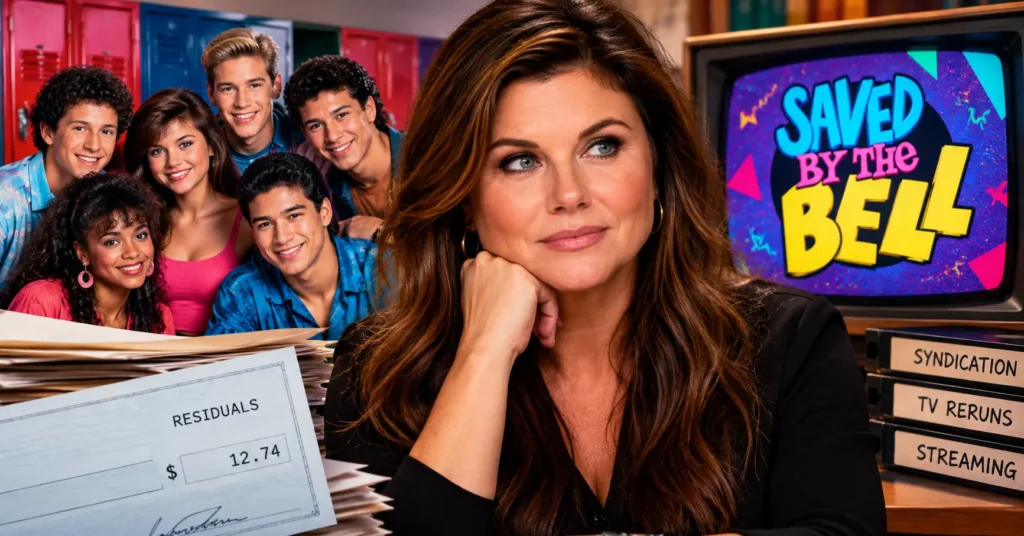
Tiffani Thiessen’s recent comments about Saved by the Bell residuals have raised a question many viewers rarely consider: what happens financially when a show stays popular for decades after its original run?
Thiessen played Kelly Kapowski on the sitcom. She said the cast did not earn substantial money from the show. She also indicated that her residual income from the series has effectively dried up.
That may seem surprising for a sitcom with such a lasting cultural presence. However, a show can remain popular without generating significant residual income for every original performer. Contracts, exhibition rules and changes in the television industry can all affect those payments.
Saved by the Bell Residuals: What Tiffani Thiessen Said
In a September 2026 interview with SiriusXM’s Page Six Radio, Thiessen discussed the compensation she and her young co-stars received during the original run of Saved by the Bell. She described their pay as limited. She also said she did not start making what she considered significant money until she later joined Beverly Hills, 90210.
Thiessen also said she no longer receives meaningful residual income from Saved by the Bell. Her comments have attracted attention because the sitcom remains closely linked to 1990s television and still has an audience decades after its original run.
However, Thiessen described her own experience. Her comments do not provide a complete financial history for every cast member. Each performer could have had different contracts, payment terms and career circumstances.
Her comments also connect with earlier discussions about the show’s financial arrangements. Mark-Paul Gosselaar has previously spoken about the deals surrounding the series. His remarks provide another perspective on the compensation received by the young cast.
The discussion also reflects how television’s financial model has changed as older shows move between traditional television, syndication and streaming. For example, The Walking Dead Netflix coverage highlights how major streaming deals can change the way audiences access established television franchises.
For readers searching for Saved by the Bell residuals, the main point is simple: Thiessen says the sitcom’s long-term financial return has not matched its lasting visibility.
Why Saved by the Bell Residuals Became a Story
The renewed interest in Saved by the Bell residuals comes from a striking contrast: the sitcom has maintained cultural recognition, while Thiessen describes receiving little ongoing financial benefit from it.
Saved by the Bell became a defining teen sitcom of its era. Its characters and cast remain familiar to audiences, and the series has continued to attract attention long after its original broadcast period. Yet a show’s continued popularity does not automatically determine how much an individual performer receives.
Thiessen’s comments highlight the difference between a show’s commercial or cultural success and an actor’s contractual compensation. A program can remain valuable to audiences while the financial terms attached to an individual performer remain relatively limited.
The story also offers a window into how television economics have changed. During the original Saved by the Bell era, audiences primarily watched programs through broadcast television, reruns and syndication. Today, viewers encounter older shows across television networks, cable channels, digital platforms and streaming services.
Those distribution models can operate under different contractual arrangements. Therefore, understanding the financial history of Saved by the Bell requires more than asking how successful the sitcom became.
The more useful question is how the performers’ original agreements interacted with the ways the series was later exhibited and distributed.
What Are TV Residuals?
Residuals are additional payments performers can receive when a television program or film receives qualifying uses beyond the original exhibition covered by their initial compensation.
For television productions, the circumstances can vary. Residuals may apply to certain reruns, syndication, cable exhibitions and other qualifying forms of distribution, depending on the applicable agreement.
Several factors can affect how a residual payment is calculated:
- The performer’s original compensation
- The type of production
- The applicable union agreement
- Where and how the program is exhibited
- The contractual terms governing later uses
Therefore, residuals do not simply represent a fixed percentage of everything a successful television show earns.
For viewers, the basic distinction is easier to understand when separated into two categories:
| Original salary | Residual payment |
|---|---|
| Compensation for performing in the production | Additional compensation tied to qualifying later uses |
| Connected to the actor’s original work | Connected to later exhibition or distribution |
| Governed by the original employment arrangement | Governed by applicable residual rules and agreements |
This distinction matters when examining Saved by the Bell. The show’s popularity decades later does not, by itself, reveal what its original performers were contractually entitled to receive.
How Saved by the Bell Residuals Differ From a Salary
An actor’s salary and residual income represent different parts of television compensation. The original salary compensates the performer for working on the production. Residuals, when applicable, provide additional compensation when that performance receives qualifying later uses.
This helps explain why a successful show does not automatically produce large residual checks for every actor.
A television program can generate commercial value through advertising, licensing or distribution while an individual performer’s payment remains tied to the applicable residual formula. The show’s overall revenue and an actor’s personal residual income are therefore not interchangeable figures.
For Saved by the Bell, the historical context also matters. The series originated in a television environment that differed significantly from today’s streaming-driven market.
Salary vs. Residuals: The Key Difference
The simplest way to understand the distinction is:
- Salary: Payment for the actor’s original work on the production.
- Residuals: Additional compensation that may arise from qualifying later uses.
- Show revenue: Money generated by the program or its distribution.
- Actor’s residual income: The amount the performer receives under the applicable agreement.
These figures can vary considerably.
So, when discussing Saved by Bell residuals, the show’s continued popularity should not be confused with an actor’s contractual entitlement. Understanding that distinction sets up the next part of the story: how the original Saved by the Bell cast was compensated and why those early financial arrangements became important to their long-term earnings.
How Much Did the Saved by the Bell Cast Make?
The available reporting suggests that the young Saved by the Bell cast earned relatively modest salaries compared with the show’s growing commercial success. The exact contracts for every performer have not been made public, so individual figures should be treated carefully rather than as a complete salary record for the ensemble.
One documented example comes from the 2026 docuseries Hollywood Demons: After the Bell. Child-star manager Denise Simon said Mario Lopez started at approximately $1,500 per episode. She contrasted that figure with the show’s advertising performance, saying Saved by the Bell was generating roughly $15 million in advertising revenue by its second season in 1991.
That comparison helps explain why the cast’s compensation has attracted renewed attention. A $1,500 episode fee could represent meaningful money for a young performer at the time, but it did not necessarily grow in proportion to the show’s commercial success.
The documentary also described a broader challenge faced by young actors. Simon explained that inexperienced performers and their families could have limited negotiating leverage when receiving their first major television opportunity.
Therefore, the available figures illustrate the financial environment surrounding the series, but they should not be used to calculate the exact earnings of every cast member.
Tiffani Thiessen’s Earnings During the Original Series
Tiffani Thiessen’s own account provides the clearest explanation for why the Saved by Bell residuals discussion matters to her.
Thiessen joined the franchise as Kelly Kapowski and became one of its most recognizable young stars. Yet she recently recalled that the cast did not have much influence over the production and said they essentially worked, appeared on the finished program and watched the episodes when they aired.
She described the compensation as extremely limited, although she recalled receiving somewhat more when the show moved into primetime for one season. According to Thiessen, her first experience of making what she considered “real money” came later, when she joined Beverly Hills, 90210 in 1994.
Her comments provide an important distinction between career value and immediate financial value. Saved by the Bell helped establish Thiessen as a recognizable television performer, but she says the financial rewards from the sitcom itself were much smaller than audiences might expect.
She has also connected the show’s residual payments to the broader experience of actors receiving very small checks from older television work. Thiessen said she does not think she receives meaningful Saved by the Bell residuals anymore and joked that the payments had effectively dried up.
That statement describes Thiessen’s current experience. It does not establish the precise residual history of her co-stars.
Why Thiessen’s Later 90210 Role Matters
Thiessen’s comparison with Beverly Hills, 90210 is useful because it shows how the economics of an actor’s career can change between productions.
After Saved by the Bell, Thiessen joined Beverly Hills, 90210 as Valerie Malone. She has identified that later role as the point when she began making substantially more money.
That does not mean Beverly Hills, 90210 followed exactly the same compensation structure or that every performer on either series had identical terms. Instead, the comparison demonstrates how an actor’s bargaining position can change as their profile and experience grow.
For Thiessen, the contrast is particularly notable because Saved by the Bell had already made her widely recognizable. Yet the financial benefits she describes from that early success appear much smaller than the compensation she associated with her later career.
The comparison also reinforces why residual income should not be viewed in isolation. An actor’s financial outcome can depend on the original salary, later contract negotiations, career leverage and the terms governing subsequent uses of a program.
Mark-Paul Gosselaar’s Earlier Comments About the Deals
Thiessen is not the only Saved by the Bell performer to discuss the financial arrangements surrounding the series.
In 2019, Mark-Paul Gosselaar, who played Zack Morris, described the cast’s original agreements as “really bad deals” during an appearance on Watch What Happens Live. His comments were retrospective and reflected his own assessment of the contracts the young cast accepted at the time.
Gosselaar’s remarks matter because they provide another cast member’s perspective on the financial side of the show’s early years. However, they should not be treated as a detailed breakdown of every contract. Public reporting does not establish identical compensation or residual arrangements for every performer.
The comments from Gosselaar and Thiessen nevertheless point toward the same broader issue: the young actors were working on a successful series at a stage when they had far less negotiating experience than established television stars.
The 2026 documentary reporting adds another layer. Denise Simon described young actors as vulnerable during first-job negotiations because turning down an offer could mean losing an important opportunity.
That context helps explain why a show’s later success cannot simply be projected backward onto the original cast contracts. The financial terms were established at the beginning of their careers, before the long-term cultural value of Saved by the Bell could be known.
Why a Successful TV Show Does Not Guarantee Huge Residual Checks
The Saved by the Bell residuals story becomes easier to understand when the show’s commercial success is separated from individual performer compensation.
A successful television series can generate money through advertising, licensing, distribution and other business arrangements. An actor’s residual income, however, depends on the contractual and union rules applicable to that performer and the specific later use of the program.
| Factor | What it means |
|---|---|
| Original salary | Payment for the actor’s work during production |
| Show revenue | Money generated through the program’s commercial activity |
| Residuals | Additional performer compensation for qualifying later uses |
| Contract terms | Determine important aspects of compensation and later payments |
| Distribution market | Can affect how qualifying reuse is handled |
This distinction explains why the reported $15 million advertising figure from 1991 cannot be converted directly into an actor’s residual income. The two figures represent entirely different financial categories.
Likewise, Thiessen saying that her residual payments have effectively disappeared does not mean the franchise has no commercial value. It describes the financial outcome of her participation under the arrangements applicable to her.
The larger lesson is that television success and performer income do not always move together. A show’s audience may continue growing long after the contracts that govern its original cast were negotiated.
For Saved by the Bell, that historical disconnect sits at the heart of the residuals story.
Why Saved by the Bell Stayed Valuable After Its Original Run
The financial story surrounding Saved by the Bell residuals becomes more complicated when the show’s long afterlife is taken into account. The sitcom originally aired from 1989 to 1993, but its episodes continued to circulate through reruns and syndication after the original broadcasts ended. The program is still part of the television library distributed in the United States and internationally.
That continued availability helps explain why viewers may assume the original cast should still be receiving substantial payments. However, the existence of a long-running television library does not automatically reveal how much an individual performer receives.
SAG-AFTRA explains that residuals are tied to qualifying uses beyond the original exhibition covered by a performer’s initial compensation. The applicable agreement and the market in which the program appears can affect whether and how residuals are calculated.
For Saved by the Bell, that distinction is particularly important. The show’s continued presence demonstrates that the series retained distribution value, but Thiessen’s recent comments concern the payments reaching her personally.
In other words, a show’s long life and an actor’s long-term residual income are related, but they are not the same measurement.
Saved by the Bell Residuals and Syndication Are Not the Same Thing
Syndication describes a way a television program can be distributed to additional broadcasters or markets outside its original network exhibition. Residuals, by contrast, are payments made to qualifying performers when their work receives certain additional uses under the applicable agreement.
The two concepts can therefore overlap without being interchangeable.
| Term | Meaning |
|---|---|
| Syndication | Distribution of a television program through additional television markets or outlets |
| Residuals | Performer compensation associated with qualifying later uses |
| Original salary | Payment for the actor’s work during the production |
| Program revenue | Money generated through advertising, licensing, distribution or other commercial activity |
SAG-AFTRA specifically lists syndication as one of the markets that can trigger residual payments for qualifying television productions. The organization also notes that the timing and calculation can vary according to the applicable agreement and circumstances.
That distinction matters when discussing Saved by the Bell. Saying that the series entered syndication does not, by itself, tell us how much any particular cast member received.
Likewise, the show’s commercial success cannot simply be divided among the performers. The money generated by a television property can flow through different business arrangements, while performers receive compensation according to their contracts and applicable union rules.
Therefore, Saved by the Bell residuals should be viewed as a performer-compensation issue rather than a direct measure of the show’s total financial success.
What SAG-AFTRA Says About Residual Payments
SAG-AFTRA describes residuals as additional compensation paid to performers when a production is shown beyond the original use covered by the initial compensation. The organization says residuals are negotiated through collective bargaining agreements rather than functioning as one universal payment system for every production.
Several factors can influence the calculation, including:
- The contract in effect during the relevant period
- The type of production
- The performer’s compensation
- The market where the program appears
- The form of later exhibition or distribution
SAG-AFTRA’s guidance also distinguishes between the initial release and later qualifying uses. Initial compensation covers the production’s original exhibition, while residuals can become payable when the production moves into markets or uses covered by the applicable residual provisions.
For television, the organization’s materials identify markets such as network reruns, syndication, basic cable and certain digital or streaming uses. The payment schedule can also differ depending on the market.
That framework helps put Thiessen’s comments into context. A small or nonexistent residual check does not necessarily mean the program has stopped generating value. It can instead reflect the specific contractual rules governing a performer’s compensation and the way a particular program is being exhibited.
Consequently, determining the exact Saved by the Bell residuals received by any actor would require access to the relevant contracts and payment records, which are not publicly available in full.
Why Streaming Changed the Residuals Conversation
The television industry now operates across streaming services that did not exist when Saved by the Bell began airing. That shift has led performers and studios to negotiate specific residual provisions for newer forms of distribution.
SAG-AFTRA’s current materials show that streaming residuals form part of modern television and theatrical agreements. Under the 2026 TV/Theatrical agreement, the union says residuals for certain television programs and theatrical pictures exhibited on subscription video-on-demand platforms are increasing by an average of 5%, with some provisions reaching back to productions that began on or after July 1, 2020.
Those modern provisions should not be automatically applied to a 1990s sitcom.
Saved by the Bell originated under earlier television agreements and a different distribution environment. Its original cast contracts were negotiated before today’s streaming economy existed, so the rules governing a contemporary streaming production cannot simply be assumed to describe the cast’s historical arrangements.
That distinction is important because viewers often see an older series on a modern streaming platform and assume the original actors must receive payments under today’s rules.
In reality, the applicable agreement, production history and contractual terms determine how later uses are treated.
The evolution from broadcast television to streaming therefore provides useful context for understanding why Saved by the Bell residuals may look very different from the residual arrangements negotiated for newer productions.
Did Other Saved by the Bell Stars Have Similar Residual Problems?
Tiffani Thiessen’s comments are not the only indication that the original Saved by the Bell cast received relatively little long-term income from the sitcom. Mark-Paul Gosselaar previously discussed the issue publicly, while a 2026 documentary brought renewed attention to Dustin Diamond’s residual checks.
These accounts come from different performers and different periods, so they should not be treated as evidence that every cast member had exactly the same contract. Still, they provide additional context for Thiessen’s recent remarks.
The available reporting points to a broader pattern: the show’s continued popularity did not necessarily translate into substantial residual payments for its young stars.
That distinction is important because audiences often associate a successful syndicated sitcom with major recurring income for its original cast. The Saved by the Bell experience shows why that assumption can be misleading.
Mark-Paul Gosselaar and the Cast’s Syndication Income
Mark-Paul Gosselaar, who played Zack Morris, discussed the cast’s financial arrangements during a 2019 appearance on Watch What Happens Live with Andy Cohen. He said the performers had made “really bad deals” and indicated that they were not receiving substantial money from the show’s syndication.
Gosselaar’s comments provide an important historical comparison with Thiessen’s 2026 remarks. Both actors have described the original financial arrangements as unfavorable, although neither statement provides a complete breakdown of every cast member’s contract.
The comments also challenge a common assumption about successful syndicated television. A show can continue appearing in new markets for years without its original actors receiving the kind of recurring income audiences might expect.
Gosselaar’s remarks were retrospective, meaning they describe his assessment of agreements made when the cast was much younger. They should therefore be read as his account of the situation rather than as a publicly available contractual record.
Nevertheless, his comments help establish that Thiessen’s recent experience was not the first time an original cast member had publicly discussed limited financial returns from the sitcom.
Dustin Diamond’s Reported Residual Check
Dustin Diamond’s experience provides one of the clearest publicly reported examples of how small a Saved by the Bell residual payment could become.
Diamond, who played Samuel “Screech” Powers, appeared in the original series from 1989 to 1993 and later continued the character in Saved by the Bell: The New Class. In a 2026 episode of Hollywood Demons: After the Bell, Diamond’s friend Dan Block showed a residual check and identified one payment as $12.74 from 2002. Us
The figure is striking because it came from a show that remained recognizable long after its original broadcast. However, one documented check cannot establish Diamond’s complete residual history or the payment history of the rest of the cast.
The documentary evidence does provide a concrete example of the broader issue discussed by Thiessen and Gosselaar: long-term residual payments could become extremely small under the arrangements associated with the series.
It also demonstrates why individual payment records are more useful than assumptions based solely on a show’s popularity.
The Difference Between Fame, Salary and Long-Term TV Income
The Saved by the Bell residuals story highlights three separate measures of an actor’s career:
| Measure | What it represents |
|---|---|
| Fame | Public recognition generated by a successful role |
| Salary | Compensation received for performing in the production |
| Residual income | Additional payments tied to qualifying later uses |
These categories can produce very different outcomes.
An actor may become widely recognized through a television role without receiving compensation that matches the show’s eventual cultural importance. Likewise, an actor can earn more from later projects than from the series that originally made them famous.
Thiessen has explicitly described this difference by pointing to Beverly Hills, 90210 as the point when she began making what she considered significant money. Gosselaar’s comments about the original Saved by the Bell deals offer a similar reminder that early-career contracts can shape the financial value of a role for years afterward.
The distinction becomes even more important when discussing residuals. A show’s popularity does not establish the amount an individual performer should receive. That amount depends on applicable agreements, the production’s distribution history and the specific performer’s contractual rights.
For Saved by the Bell, the public record therefore supports a clear conclusion about the existence of very small payments for at least some performers, but it does not provide a complete financial ledger for the entire cast.
What the Cast’s Experiences Tell Us About Saved by the Bell Residuals
Taken together, the available accounts provide several useful pieces of context.
First, Thiessen says her residual income from the sitcom has effectively dried up. Second, Gosselaar previously said the cast had made unfavorable deals and was not receiving substantial syndication income. Third, Diamond’s documented $12.74 check illustrates just how small an individual residual payment could become.
However, these examples should not be turned into a single calculation for the entire cast. The performers worked under individual arrangements, and complete contracts and payment histories are not publicly available.
The evidence does support a more limited observation: the long-term financial experience of at least several original cast members appears far less lucrative than the show’s enduring popularity might lead viewers to expect.
That distinction also explains why the residual discussion remains relevant decades later. Saved by the Bell continues to have cultural value, but cultural value, program revenue and performer residuals are separate financial concepts.
Understanding those differences makes the reported experiences of Thiessen, Gosselaar and Diamond easier to place in context. It also raises a larger question about how the television industry’s older compensation structures compare with the residual systems used for modern streaming productions.
Why Tiffani Thiessen’s Comments Matter in 2026
Tiffani Thiessen’s comments matter because they put a personal financial perspective on a television franchise that has remained recognizable for more than three decades. In September 2026, she said her Saved by the Bell residual payments had effectively dried up, joking that the checks could cost more to produce than their value.
The comments also gained additional relevance when Mario Lopez publicly agreed with her assessment on September 30, 2026. Lopez responded to the discussion by backing up Thiessen’s description of the cast’s residual experience.
That does not establish an identical payment history for every performer. However, it adds another cast member’s perspective to earlier comments from Mark-Paul Gosselaar about the financial deals the young actors accepted.
The timing is also significant because television compensation continues to evolve. SAG-AFTRA’s 2026 TV/Theatrical agreement includes changes to streaming residuals, including increases for certain qualifying productions and later SVOD exhibitions.
The contrast is clear: a sitcom produced in the late 1980s operated under a very different television business model from today’s streaming environment.
What We Know — and What We Do Not Know — About Saved by the Bell Residuals
Public reporting gives us several details about Saved by the Bell residuals. However, the complete contracts and payment records for the original cast remain private.
| What public reporting shows | What remains unknown |
|---|---|
| Thiessen said her residual payments have effectively dried up. | Her total lifetime residual earnings. |
| Thiessen said the cast earned little during the original run. | The exact contract terms for each performer. |
| Gosselaar previously criticized the cast’s early deals. | Whether all cast members had identical agreements. |
| Lopez publicly supported Thiessen’s recent comments. | His complete residual payment history. |
| A 2026 documentary reported a $12.74 residual check linked to Dustin Diamond. | Whether that check represented his overall residual income. |
| SAG-AFTRA explains the general rules for residual payments. | The exact historical formula for each actor’s payments. |
This distinction matters. Individual performers can describe their own experiences, but those comments cannot replace the original contracts or complete payment records.
The available reports support a narrower conclusion. Several cast accounts suggest that the show’s long-term financial returns were smaller than its lasting popularity might lead viewers to expect. Thiessen’s recent comments add to that picture.
However, many details remain unknown. The public record does not provide a complete financial history for every original cast member. Therefore, the article should distinguish clearly between reported experiences, documented payments and information that remains unavailable.
Saved by the Bell Residuals FAQs
Does Tiffani Thiessen still get Saved by the Bell residuals?
Thiessen said in September 2026 that she believes her residual payments from Saved by the Bell have effectively dried up. She described the payments as so small that the cost of producing the check could exceed its value. Her statement reflects her own experience and does not establish the current residual status of every cast member.
Why are Saved by the Bell residuals reportedly so small?
Residual payments depend on applicable contracts, union agreements, production circumstances and qualifying later uses. A show’s overall popularity does not automatically determine an individual actor’s residual payment. SAG-AFTRA explains that residuals are additional compensation governed by collective bargaining agreements and specific exhibition rules.
How much did the Saved by the Bell cast make?
Public reporting does not provide a complete salary record for the entire cast. One documentary account reported that Mario Lopez initially earned about $1,500 per episode, while Saved by the Bell was reportedly generating substantial advertising revenue by its second season. Thiessen has separately said the cast made very little during the original series.
Did the Saved by the Bell cast receive residuals?
Residual eligibility depends on the applicable contracts and qualifying later uses. SAG-AFTRA explains that residuals can become due when productions receive qualifying uses beyond their original exhibition. Individual payment amounts can therefore vary rather than following one universal figure.
Does syndication automatically mean actors receive large residual payments?
No. Syndication can trigger residual obligations under applicable agreements, but syndication revenue and performer residuals are separate financial concepts. The amount an actor receives depends on the relevant agreement and calculation rules, not simply on how much money a television property generates.
Did Saved by the Bell Actors Receive Streaming Residuals?
The original cast’s complete contracts are not publicly available. Because of that, public reporting cannot confirm how every later streaming release affected their residual payments. Modern SAG-AFTRA agreements include specific rules for streaming residuals. However, those newer rules do not automatically apply to a 1990s production like Saved by the Bell.
The Lasting Value of Saved by the Bell
The story of Saved by the Bell residuals highlights an important difference between cultural success and performer compensation.
Saved by the Bell became a defining part of 1990s television. The sitcom still attracts attention decades after its original run. However, Tiffani Thiessen’s recent comments, Mario Lopez’s response and Mark-Paul Gosselaar’s earlier remarks point to a much smaller financial return for the cast than the show’s lasting popularity might suggest.
The same long-term interest can be seen across other television franchises that continue to attract audiences years after their original episodes aired. Our True Detective guide explores how a television series can build a lasting identity through different seasons, casts and storylines.
That does not mean the franchise lacks commercial value. Instead, the show’s financial value and an individual actor’s compensation represent two different things.
Residual payments also depend on specific contractual rules. The original agreement, production terms and later forms of exhibition can all affect those payments. Modern streaming agreements use different rules from those that governed television when Saved by the Bell began.
For Thiessen, the personal financial story is clear. She became widely known as Kelly Kapowski, but she says the role has not generated substantial long-term residual income.
The legacy of Saved by the Bell extends far beyond its residual checks. The sitcom remains recognizable to audiences, while the cast’s experiences show how early television contracts can shape an actor’s long-term earnings.