
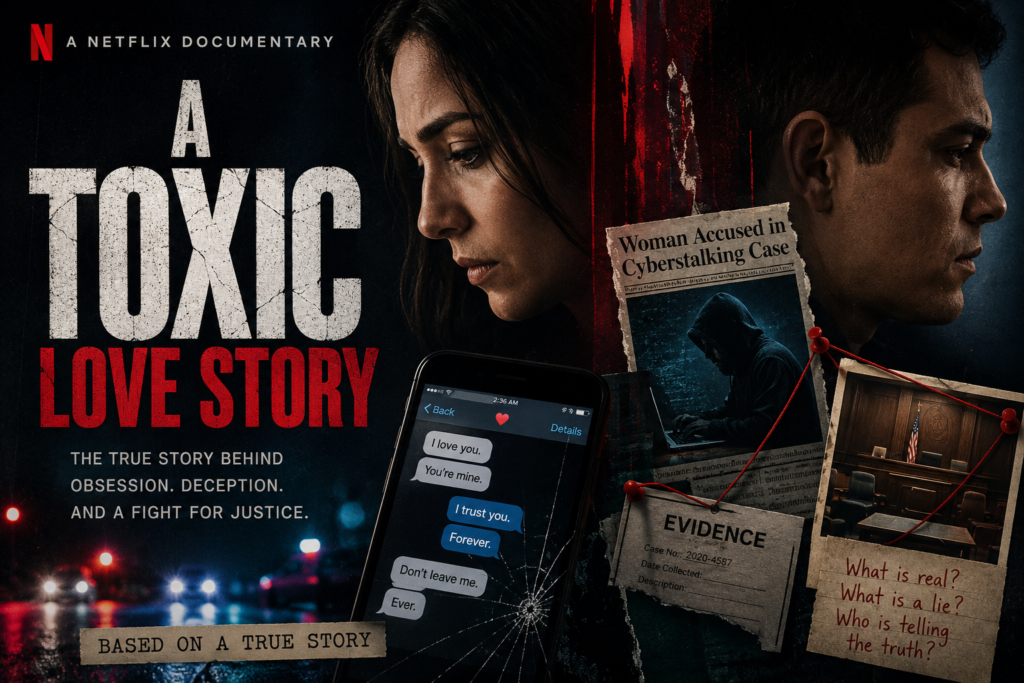
Netflix has built a reputation for releasing true crime documentaries that spark conversations long after the credits roll. From stories about financial fraud to shocking murder investigations, the platform has consistently explored real-life cases that challenge public perception. Now, A Toxic Love Story joins that growing collection with a documentary that asks a simple but unsettling question:
What happens when deception becomes more powerful than the truth?
Unlike many crime documentaries that focus on a single criminal act, A Toxic Love Story explores a complicated web of relationships, emotional manipulation, digital evidence, public judgment, and failures within the justice system. As the investigation unfolds, viewers are repeatedly forced to reconsider who the real victim is and whether the evidence they initially believed tells the complete story.
The documentary doesn’t rely on dramatic action sequences or fictional storytelling. Instead, it presents interviews, investigation records, digital communications, and legal developments that gradually reveal how appearances can be dangerously misleading.
For many viewers, the biggest surprise isn’t simply the twists. It’s realizing how quickly public opinion—and even official investigations—can move in the wrong direction when assumptions replace careful analysis.
In this comprehensive guide, we’ll explore the real events behind the documentary, explain why the case attracted national attention, examine its major themes, and discuss why A Toxic Love Story has become one of Netflix’s most talked-about true crime releases.
What Is A Toxic Love Story?
A Toxic Love Story is a Netflix true crime documentary released in July 2026 that revisits a highly unusual criminal case from Southern California. Rather than presenting the story as a traditional crime investigation, the documentary carefully reconstructs the timeline using interviews, court records, law enforcement material, and firsthand accounts.
At first glance, the case appears straightforward.
A woman is accused of carrying out an extensive campaign of harassment against her former fiancé and his new wife. Investigators receive disturbing emails, online messages, and other digital evidence that seem to point toward one obvious suspect.
But as investigators continue examining the evidence, unexpected inconsistencies begin to appear.
Those discoveries gradually transform what initially looked like a routine cyberstalking investigation into something much larger—raising difficult questions about manipulation, trust, digital evidence, and the possibility of a wrongful accusation.
Why A Toxic Love Story Is Trending
Several factors explain why A Toxic Love Story quickly attracted attention after its release.
It Isn’t a Typical True Crime Documentary
Many documentaries focus primarily on solving a crime.
This one focuses on understanding how people reached incorrect conclusions before all the facts became available.
Instead of asking:
- Who committed the crime?
it repeatedly asks:
- Why did everyone believe the original story?
- How did investigators interpret the evidence?
- What assumptions influenced the investigation?
- Could similar mistakes happen again?
That approach creates a viewing experience where audiences continuously reevaluate their own judgments.
The Story Contains Multiple Unexpected Twists
Without revealing every development, the documentary presents information in stages.
Each stage changes the audience’s understanding of the events.
Rather than depending on dramatic reenactments, the film allows interviews, digital records, and legal evidence to reshape the narrative naturally. Reviewers have highlighted this structure as one of the documentary’s biggest strengths because it mirrors the uncertainty experienced during the real investigation.
It Explores Modern Digital Crime
Technology plays a central role throughout the story.
The case demonstrates how:
- emails
- online identities
- social media activity
- internet records
- digital communication
can become critical evidence.
At the same time, it reminds viewers that digital evidence still requires careful verification and context.
The Real Story Behind A Toxic Love Story
The documentary is inspired by real events involving three central figures whose lives became intertwined through a deeply complicated legal case.
Without discussing every revelation presented in the documentary, the basic situation began after a relationship ended and another one began.
As tensions increased, allegations of harassment escalated.
Authorities soon became involved.
Digital messages appeared to support the accusations.
Media coverage amplified public attention.
Eventually, criminal charges followed.
For many observers, the evidence initially appeared convincing.
However, later investigations uncovered significant inconsistencies that dramatically changed the understanding of the case and led to new legal consequences.
Why This Story Feels Different
Many true crime documentaries revolve around violence.
A Toxic Love Story instead explores psychological manipulation.
The emotional impact comes from uncertainty.
Viewers repeatedly ask themselves:
- Who is telling the truth?
- Which evidence is reliable?
- Who benefits from the accusations?
- Can digital evidence be manipulated?
- What happens when investigators make early assumptions?
Those questions remain relevant far beyond this single case.
A Toxic Love Story Shows How Powerful First Impressions Can Be
Human beings naturally form quick opinions.
Once people believe someone is guilty, changing that opinion becomes difficult.
Psychologists sometimes refer to this as confirmation bias—the tendency to favor information that supports an existing belief while overlooking contradictory evidence.
The documentary illustrates how this tendency can affect:
- investigators
- media coverage
- online discussions
- public opinion
- even ordinary viewers
One of the documentary’s most effective storytelling techniques is encouraging audiences to experience those changing perceptions firsthand.
Why the Documentary Resonates With Modern Audiences
Although the events originated years ago, the themes feel surprisingly current.
Today’s world depends heavily on digital communication.
People routinely trust:
- text messages
- emails
- screenshots
- online conversations
- social media posts
Yet technology has made creating false impressions easier than ever.
That broader issue gives A Toxic Love Story relevance beyond its specific case.
Rather than focusing only on past events, it encourages viewers to think critically about the digital information they encounter every day.
Major Themes in A Toxic Love Story
Digital Manipulation
One of the strongest themes involves how technology can be used to influence investigations, relationships, and public perception.
Digital communication creates permanent records—but those records don’t always tell the complete story.
Emotional Control
The documentary also examines emotional manipulation.
Rather than relying solely on threats or violence, manipulation often develops gradually through:
- guilt
- fear
- dependency
- dishonesty
- psychological pressure
Understanding these behaviors helps explain why complex relationships are rarely as simple as they appear.
Trust and Betrayal
Relationships depend on trust.
When trust breaks down, the consequences can extend far beyond the people directly involved.
Throughout A Toxic Love Story, viewers see how betrayal can influence:
- personal relationships
- criminal investigations
- professional reputations
- public opinion
Justice and Accountability
Another important theme is accountability.
The documentary doesn’t simply ask who committed wrongdoing.
It also considers broader questions:
- How should investigators evaluate evidence?
- What safeguards protect innocent people?
- What happens after a wrongful accusation?
- Can reputational damage ever be fully repaired?
These questions remain central to discussions about fairness within the justice system.
Main Topics Covered in the Documentary
| Topic | Why It Matters |
|---|---|
| Relationships | Establishes the background of the case |
| Cyberstalking allegations | Drives the criminal investigation |
| Digital evidence | Forms the foundation of many accusations |
| Law enforcement investigation | Shows how cases develop |
| Media attention | Influences public perception |
| Court proceedings | Reveals how evidence is tested |
| Psychological manipulation | Explains relationship dynamics |
| Wrongful accusations | Highlights the consequences of investigative errors |
Who Should Watch A Toxic Love Story?
This documentary will likely appeal to viewers who enjoy:
- True crime documentaries
- Criminal investigations
- Psychological case studies
- Legal documentaries
- Digital crime stories
- Cybercrime investigations
- Real-life courtroom cases
- Netflix investigative documentaries
It may also interest readers who want to understand how technology, relationships, and criminal investigations increasingly intersect in modern society.
Why the Documentary Matters Beyond Entertainment
Some true crime productions focus mainly on suspense.
A Toxic Love Story also encourages viewers to think critically about evidence, assumptions, and accountability.
Its broader message extends beyond one criminal investigation.
It asks readers and viewers to consider:
- How easily can public opinion be influenced?
- How reliable is digital evidence without context?
- Why should investigations remain open to new facts?
- What responsibility does the justice system have when early assumptions prove incorrect?
Those questions make the documentary more than simply another crime story.
Instead, it becomes a discussion about truth, technology, and the importance of due process in the digital age.
The Timeline of A Toxic Love Story
Understanding the events in chronological order makes the documentary easier to follow. Although the film uses interviews and flashbacks to build suspense, the real case developed over several years. Each new event changed the direction of the investigation and revealed just how complicated the situation had become.
The timeline below summarizes the major stages without revealing every detail presented in the documentary.
| Stage | What Happened | Why It Mattered |
|---|---|---|
| Relationship Begins | Two people become engaged. | Sets the foundation for later events. |
| Relationship Ends | The engagement comes to an end. | Personal tensions increase. |
| New Relationship | One former partner begins a new relationship. | Creates a new dynamic involving multiple individuals. |
| Harassment Allegations | Disturbing emails and messages begin appearing. | Authorities become involved. |
| Criminal Investigation | Digital evidence points toward one suspect. | The case appears straightforward at first. |
| Arrest and Charges | Formal legal action is taken. | Public attention grows rapidly. |
| New Evidence Emerges | Investigators discover inconsistencies. | The direction of the case changes dramatically. |
| Court Proceedings | Evidence is reexamined. | Earlier assumptions are challenged. |
| Final Outcome | The legal process reaches its conclusion. | The case becomes a lesson about digital deception and justice. |
The Beginning of the Story
Every true crime case has a starting point, and A Toxic Love Story begins with what seemed like an ordinary romantic relationship.
Like many couples, the relationship included plans for the future. Friends and family expected life to move forward normally. However, relationships can change unexpectedly, and this one eventually ended.
Although breakups are common, the emotions surrounding them often remain complicated. Hurt feelings, misunderstandings, and unresolved conflicts can continue long after a relationship ends.
The documentary explains that this emotional backdrop became an important part of understanding what happened next. It avoids suggesting that a breakup alone caused the later events. Instead, it shows how several independent developments gradually converged into a much larger legal case.
A New Chapter Creates New Tensions
After the engagement ended, one of the former partners entered a new relationship.
On its own, this development would not normally attract public attention. However, in this case, the new relationship became closely connected to the allegations that followed.
As the documentary explains, personal relationships often become more complicated when:
- Emotional wounds remain unresolved.
- Communication breaks down.
- Distrust replaces understanding.
- New partners become involved.
These factors do not automatically lead to criminal behavior. However, they can create an environment where misunderstandings and accusations escalate more quickly.
A Toxic Love Story and the First Allegations
The situation changed dramatically when a series of disturbing communications began appearing.
According to investigators, these messages included threatening, disturbing, and highly personal content directed toward individuals connected to the relationship.
Because many of the communications appeared to come from the same source, authorities initially believed they were dealing with a serious cyberstalking case.
At first glance, several factors seemed to support that conclusion:
- The messages appeared consistent.
- The timing matched ongoing personal conflicts.
- The communications contained personal details.
- Investigators believed they had identified a likely suspect.
This combination created what appeared to be a convincing narrative.
However, appearances can sometimes be misleading.
How Digital Evidence Shaped the Investigation
One of the most fascinating aspects of A Toxic Love Story is its focus on digital evidence.
Modern investigations often rely on:
Emails
Electronic communication frequently becomes a primary source of evidence because it creates written records.
However, investigators must still determine:
- Who actually sent the message?
- Was the account compromised?
- Can the sender be verified?
- Has any information been manipulated?
These questions become increasingly important as technology evolves.
Online Accounts
The documentary also highlights how online identities can complicate investigations.
Creating an email account or online profile requires relatively little effort. As a result, simply seeing a name attached to an account does not automatically prove who controlled it.
That distinction became especially important during this case.
Digital Records
Investigators also examined:
- Internet activity
- Device information
- Communication history
- Account records
- Technical evidence
Instead of relying on one piece of evidence, they gradually assembled a much broader picture.
This careful approach eventually changed the direction of the investigation.
Why the Investigation Appeared Straightforward
One reason the case attracted so much attention is that the early evidence seemed unusually convincing.
Many people—including investigators and members of the public—believed the case had already been solved.
Several factors contributed to that belief.
A Clear Narrative
People naturally understand stories with obvious heroes and villains.
When evidence appears to support a simple explanation, few people initially question it.
The documentary illustrates how powerful that instinct can be.
Emotional Context
The allegations occurred shortly after significant relationship changes.
Because emotional conflict already existed, many observers assumed the accusations fit the circumstances.
Again, this demonstrates how context can influence interpretation.
Confidence in Technology
Many people assume that digital evidence is objective.
While technology provides valuable investigative tools, digital evidence still requires careful verification.
As the documentary repeatedly emphasizes, technology records information—but people must still interpret it correctly.
A Toxic Love Story Explores the Limits of Assumptions
One of the documentary’s central messages is that assumptions can become dangerous when they replace evidence.
Several assumptions shaped the early stages of the investigation:
- The apparent sender must have written the messages.
- Relationship conflict explained the behavior.
- Digital communications accurately reflected reality.
- Initial evidence told the complete story.
As investigators continued examining the facts, these assumptions became increasingly difficult to support.
The Turning Point in the Investigation
Every compelling documentary contains a moment when the audience realizes the story is far more complicated than expected.
For A Toxic Love Story, that turning point arrives when investigators begin uncovering inconsistencies.
Rather than fitting neatly together, pieces of evidence start raising new questions.
Examples include:
- Timeline discrepancies
- Technical inconsistencies
- Conflicting accounts
- Previously overlooked information
- New investigative leads
Instead of confirming the original theory, these discoveries encouraged investigators to reconsider their earlier conclusions.
This shift transforms the documentary from a straightforward crime story into a much deeper examination of justice and investigative process.
Why Investigations Must Remain Flexible
The documentary highlights an important principle of criminal investigations:
Good investigators follow evidence—not assumptions.
As new information becomes available, responsible investigators must be willing to:
- Reevaluate earlier conclusions.
- Test alternative explanations.
- Verify digital evidence.
- Eliminate confirmation bias.
- Continue searching for objective facts.
Although this process can be time-consuming, it helps reduce the risk of wrongful accusations.
Media Attention Intensifies the Case
As legal proceedings moved forward, the case attracted increasing media coverage.
True crime stories often capture public interest because they combine:
- Personal relationships
- Mystery
- Criminal investigations
- Courtroom developments
- Unexpected twists
However, widespread media attention also creates challenges.
News reports typically focus on available information at a particular moment.
If new evidence later changes the understanding of a case, early public impressions may remain difficult to correct.
The documentary encourages viewers to remember that ongoing investigations often evolve as additional evidence emerges.
Public Opinion vs. Proven Facts
One of the strongest themes in A Toxic Love Story involves the difference between public opinion and legally established facts.
These two concepts are not always the same.
| Public Opinion | Legal Process |
|---|---|
| Forms quickly | Develops gradually |
| Influenced by headlines | Guided by evidence |
| Often emotional | Based on legal standards |
| Can change rapidly | Requires formal procedures |
| Doesn’t determine guilt | Determines legal responsibility |
This distinction becomes increasingly important throughout the documentary.
Lessons From the Early Investigation
The first half of the case demonstrates several broader lessons.
Technology Is Helpful—but Not Perfect
Digital evidence provides investigators with valuable information.
However, every piece of evidence must still be verified within its proper context.
Relationships Can Complicate Criminal Cases
Personal relationships often create emotional backgrounds that influence investigations.
Understanding those relationships helps investigators evaluate evidence more accurately.
First Impressions Can Be Wrong
Perhaps the documentary’s biggest lesson is that early conclusions are not always correct.
Careful investigation requires patience, objectivity, and a willingness to reconsider previous assumptions.
The People at the Center of A Toxic Love Story
One reason A Toxic Love Story leaves such a strong impression is that it focuses on real people rather than fictional characters. Instead of presenting anyone as one-dimensional, the documentary explores how relationships, emotions, and assumptions combined to create an extraordinary legal case.
The film encourages viewers to separate verified facts from speculation. Rather than relying on rumors or sensational claims, it uses interviews, legal records, and investigative findings to explain how the case unfolded over time.
Understanding the roles of the people involved helps explain why the story became so complicated.
Michelle Hadley
Michelle Hadley became one of the most recognized names connected to the case after investigators initially identified her as the primary suspect.
According to the documentary, the accusations had a profound impact on her personal life, reputation, career, and emotional well-being. As the investigation progressed, she found herself navigating a complex legal process while maintaining her innocence.
Instead of portraying her story as simple or straightforward, A Toxic Love Story examines the challenges someone may face when criminal allegations become part of a highly public investigation.
The documentary also explores broader questions such as:
- How does a public accusation affect someone’s future?
- What happens when people form opinions before a trial concludes?
- Can reputational damage ever be fully repaired?
These questions remain relevant far beyond this individual case.
Ian Diaz
Ian Diaz occupies a unique position within the documentary because his personal relationships connect several major events in the story.
Rather than making him the sole focus, the film uses his perspective to explain how quickly personal conflicts can evolve into legal disputes.
His interviews provide context about:
- The progression of relationships.
- The emotional environment surrounding the case.
- The impact of ongoing allegations.
- The uncertainty experienced during the investigation.
By including multiple viewpoints, the documentary avoids reducing the story to a single perspective.
Angela Diaz
Angela Diaz becomes increasingly significant as the investigation develops.
Without revealing every major twist in advance, the documentary shows how investigators gradually began examining information that challenged their earlier assumptions.
As new evidence emerged, attention shifted toward questions that had not received enough consideration during the initial investigation.
This shift dramatically changed both the legal case and public understanding of what had actually occurred.
A Toxic Love Story and the Psychology of Manipulation
One of the documentary’s greatest strengths is its examination of manipulation.
Rather than focusing only on legal proceedings, it explores how manipulation can influence emotions, relationships, and even criminal investigations.
Manipulation is rarely obvious from the beginning.
Instead, it often develops gradually.
Some common characteristics include:
- Creating confusion.
- Controlling information.
- Encouraging distrust.
- Exploiting emotional vulnerabilities.
- Presenting misleading narratives.
The documentary suggests that these behaviors can become especially difficult to identify when emotions are already running high.
Understanding Emotional Manipulation
Emotional manipulation doesn’t always involve dramatic confrontations.
In many situations, it develops through smaller actions repeated over time.
Examples include:
Creating Doubt
A manipulative person may encourage others to question their own memory or judgment.
Over time, this uncertainty can make it harder for people to trust themselves.
Controlling Information
When someone selectively shares information, they can influence how others interpret events.
Incomplete information often produces misleading conclusions.
Exploiting Fear
Fear can influence decision-making.
People who feel threatened may react emotionally rather than analytically.
The documentary illustrates how fear can shape relationships as well as investigations.
Why Digital Deception Is So Dangerous
Technology has transformed modern communication.
Unfortunately, it has also created new opportunities for deception.
A Toxic Love Story demonstrates how digital tools can sometimes be misused in ways that appear highly convincing.
Examples include:
- Fake email accounts.
- Anonymous messages.
- Impersonation.
- False online identities.
- Misleading digital communications.
These tactics can create confusion not only for victims but also for investigators.
The Importance of Verifying Digital Evidence
One of the documentary’s most valuable lessons involves evidence verification.
Digital evidence should never be evaluated in isolation.
Instead, investigators often compare multiple sources of information.
These may include:
- Device records.
- IP information.
- Account activity.
- Metadata.
- Timeline analysis.
- Witness testimony.
When different pieces of evidence support one another, investigators gain greater confidence in their conclusions.
When inconsistencies appear, further investigation becomes necessary.
A Toxic Love Story Highlights Confirmation Bias
Confirmation bias affects everyone.
It occurs when people naturally favor information that supports what they already believe.
This psychological tendency influences:
- Individuals.
- Investigators.
- Journalists.
- Social media users.
- Jury members.
- Everyday readers.
The documentary demonstrates how confirmation bias can unintentionally shape major decisions.
For example:
Someone who already believes a suspect is guilty may interpret ambiguous evidence differently than someone approaching the case without prior assumptions.
Recognizing this tendency helps improve decision-making.
Social Media and Public Judgment
Modern criminal investigations unfold in an environment very different from previous generations.
Today, information spreads almost instantly.
As a result:
- Headlines circulate within minutes.
- Opinions form rapidly.
- Social media discussions expand quickly.
- Rumors spread alongside verified facts.
The documentary reminds viewers that online conversations often develop much faster than official investigations.
This difference creates important challenges.
Why Public Opinion Can Be Misleading
Public opinion is valuable because it reflects community interest.
However, it does not replace the legal process.
Throughout A Toxic Love Story, viewers repeatedly see the difference between:
- Allegations.
- Evidence.
- Charges.
- Court findings.
- Final legal outcomes.
Understanding those distinctions helps readers evaluate news more critically.
The Emotional Cost of High-Profile Cases
Legal investigations affect more than courtroom proceedings.
They also influence everyday lives.
People connected to major investigations may experience:
- Public scrutiny.
- Professional challenges.
- Financial stress.
- Emotional exhaustion.
- Damaged relationships.
- Long-term reputational concerns.
Even after legal cases conclude, rebuilding normal life can take years.
The documentary respectfully acknowledges these realities without becoming overly sensational.
The Justice System Under Pressure
Another major topic explored in A Toxic Love Story is the balance between protecting victims and protecting the rights of the accused.
Both responsibilities are essential.
Effective investigations must:
- Take allegations seriously.
- Protect public safety.
- Preserve evidence.
- Respect due process.
- Avoid premature conclusions.
The documentary argues that justice works best when investigators remain committed to evidence rather than assumptions.
What This Case Teaches About Cyberstalking Investigations
Cyberstalking investigations differ from many traditional criminal cases because much of the evidence exists in digital form.
Investigators may examine:
| Type of Evidence | Purpose |
|---|---|
| Emails | Establish communication history |
| Text messages | Verify conversations |
| Account records | Identify account ownership |
| Device data | Confirm activity |
| IP logs | Help trace online access |
| Timeline analysis | Compare events chronologically |
| Witness interviews | Provide additional context |
No single piece of evidence usually tells the entire story.
Instead, investigators combine multiple sources before reaching conclusions.
Broader Lessons From A Toxic Love Story
Although the documentary focuses on one extraordinary case, its lessons apply to everyday life.
Think Critically
Not every headline tells the complete story.
Reading beyond the first report often provides valuable context.
Verify Before Sharing
Social media encourages rapid sharing.
However, taking a few moments to verify information helps reduce misinformation.
Respect Due Process
Legal systems exist to evaluate evidence carefully.
Allowing investigations to proceed before reaching conclusions supports fairness for everyone involved.
Technology Requires Responsibility
Digital communication offers enormous benefits.
At the same time, it also requires responsible use and thoughtful verification.
A Toxic Love Story Review: Does the Documentary Deliver?
Netflix has earned a reputation for producing compelling true crime documentaries that combine investigative journalism with cinematic storytelling. A Toxic Love Story follows that tradition but approaches its subject differently.
Rather than focusing solely on suspense, the documentary explores how personal relationships, digital communication, and investigative decisions intersect. It asks viewers to think critically instead of simply following a mystery from beginning to end.
For audiences expecting constant twists and dramatic recreations, the pace may feel slower than some other Netflix crime documentaries. However, those interested in psychology, legal cases, and real-world investigations will likely appreciate its thoughtful approach.
Storytelling Style
One of the documentary’s greatest strengths is its storytelling.
Instead of revealing every major development immediately, the filmmakers organize the information in a way that allows viewers to understand how the investigation evolved over time.
Each interview, document, and piece of evidence adds another layer to the story.
This gradual structure helps viewers experience the uncertainty that investigators and the people involved faced during the real case.
Balanced Presentation
Another notable aspect is the documentary’s effort to present multiple perspectives.
Rather than relying on a single narrator, it includes:
- Firsthand interviews
- Court records
- Investigative material
- News coverage
- Supporting documentation
By presenting different viewpoints, the documentary encourages viewers to evaluate the evidence independently instead of accepting one version of events without question.
Cinematography and Production Quality
From a production standpoint, A Toxic Love Story maintains the polished style expected from a Netflix documentary.
The visuals support the story without becoming distracting.
The filmmakers use:
- Clean interview setups
- Archival photographs
- Court-related visuals
- Digital graphics
- Timeline animations
- Atmospheric background music
These elements create tension while keeping the focus on the facts rather than unnecessary dramatization.
Editing and Pacing
The documentary’s editing is generally effective.
Information is introduced gradually, allowing viewers to absorb new developments before moving to the next stage of the investigation.
However, some viewers may feel that certain interviews extend longer than necessary.
Those who enjoy slower investigative storytelling are unlikely to mind, while viewers expecting a faster-paced crime thriller may notice the deliberate pacing.
Overall, the editing prioritizes clarity over speed.
Interview Quality
The interviews form the emotional foundation of the documentary.
Rather than relying heavily on narration, the filmmakers allow many of the people connected to the case to explain their experiences directly.
This approach makes the documentary feel more personal.
It also helps viewers understand how differently individuals can remember or interpret the same events.
Because the interviews come from multiple perspectives, the story feels more balanced and credible.
The Emotional Impact
Unlike documentaries centered on violent crimes, A Toxic Love Story creates tension through uncertainty.
The emotional weight comes from questions such as:
- Who should be believed?
- How reliable is digital evidence?
- What happens when investigations take an unexpected turn?
- Can reputations recover after public accusations?
These questions remain with viewers even after the documentary ends.
How the Documentary Handles Sensitive Topics
The documentary discusses several sensitive subjects, including:
- Emotional manipulation
- Cyberstalking allegations
- Public accusations
- Mental and emotional stress
- Legal investigations
- Online harassment
Importantly, it avoids sensationalizing these issues.
Instead, the film focuses on understanding how complex situations develop and why careful investigation matters.
This measured approach gives the documentary greater credibility.
What Makes A Toxic Love Story Different?
Many true crime documentaries follow a familiar pattern:
- Introduce the crime.
- Identify the suspect.
- Solve the mystery.
- Reach a conclusion.
A Toxic Love Story takes a different path.
Instead of asking only who committed wrongdoing, it also explores:
- How investigators evaluate evidence.
- Why people reach incorrect conclusions.
- How technology influences modern investigations.
- The lasting effects of public judgment.
- The importance of due process.
This broader perspective makes the documentary feel more like an investigative case study than a traditional crime story.
Strengths of A Toxic Love Story
The documentary succeeds in several important areas.
Thought-Provoking Narrative
Rather than relying on shock value, the story encourages viewers to think critically about evidence and assumptions.
Strong Interview Selection
The interviews provide valuable context while keeping the emotional focus on the people involved.
Excellent Production Values
Professional cinematography, clear editing, and effective visuals help maintain viewer engagement throughout the documentary.
Relevant Modern Themes
Topics such as digital identity, online communication, and cyber investigations make the documentary especially relevant today.
Respectful Storytelling
The filmmakers generally avoid unnecessary sensationalism and instead prioritize factual storytelling.
Areas Where Some Viewers May Want More
No documentary can answer every question, and A Toxic Love Story is no exception.
Depending on individual expectations, some viewers may wish for:
- More detailed explanations of technical digital evidence.
- Additional legal analysis from experts.
- Greater discussion of investigative procedures.
- More context about events following the court proceedings.
These points do not significantly reduce the documentary’s quality, but they may leave some viewers wanting additional information.
Pros and Cons
| Pros | Cons |
|---|---|
| Engaging real-life story | Deliberate pacing may not appeal to everyone |
| Strong production quality | Some technical details receive limited explanation |
| Multiple perspectives | Certain viewers may want more legal analysis |
| Encourages critical thinking | A few interviews feel longer than necessary |
| Respectful treatment of sensitive issues | Some questions remain open for discussion |
How It Compares With Other Netflix True Crime Documentaries
Although every true crime documentary tells a different story, A Toxic Love Story shares several characteristics with other popular Netflix investigative productions.
| Feature | A Toxic Love Story | Typical True Crime Documentary |
|---|---|---|
| Based on real events | ✔ | ✔ |
| Focus on digital evidence | ✔ | Sometimes |
| Psychological analysis | ✔ | Often |
| Courtroom elements | ✔ | Often |
| Multiple interviews | ✔ | ✔ |
| Slow investigative approach | ✔ | Varies |
| Emphasis on critical thinking | ✔ | Less common |
Rather than competing through sensational twists alone, A Toxic Love Story distinguishes itself by examining how evidence, relationships, and perception interact throughout an investigation.
Who Should Watch A Toxic Love Story?
This documentary is a strong choice for viewers who enjoy:
- True crime documentaries
- Investigative journalism
- Legal case studies
- Psychological analysis
- Digital crime investigations
- Documentary storytelling based on real events
However, viewers looking for fast-paced action or fictional crime dramas may find its investigative style more measured.
Is A Toxic Love Story Worth Watching?
For many viewers, the answer is yes.
The documentary succeeds because it goes beyond asking what happened.
Instead, it explores:
- Why events unfolded the way they did.
- How evidence shapes investigations.
- Why public opinion can differ from legal findings.
- What lessons modern society can learn from the case.
Those broader themes make the documentary relevant even for viewers who are already familiar with the headlines.
Review Ratings
| Category | Rating (Out of 10) |
|---|---|
| Story | 9.4 |
| Investigation | 9.2 |
| Interviews | 9.1 |
| Production Quality | 9.3 |
| Emotional Impact | 9.0 |
| Educational Value | 9.4 |
| Rewatch Value | 8.7 |
| Overall Rating | 9.2/10 |
Note: These ratings represent an editorial assessment of the documentary’s storytelling and production quality, not an official or aggregated score.
Why A Toxic Love Story Stands Out
Many documentaries simply recount events.
A Toxic Love Story encourages viewers to question assumptions, evaluate evidence carefully, and recognize how technology has transformed both relationships and criminal investigations.
Its greatest achievement is not creating suspense—it is encouraging thoughtful discussion long after the documentary ends.
By blending emotional storytelling with legal and investigative analysis, Netflix delivers a documentary that feels both timely and relevant in today’s digital world.
The Bigger Picture: Why A Toxic Love Story Matters
Although A Toxic Love Story centers on a specific real-life case, its significance extends well beyond the courtroom. The documentary encourages viewers to examine larger issues that affect modern society, particularly in an era where digital communication influences nearly every aspect of daily life.
Today, emails, text messages, social media posts, and online accounts play an important role in personal relationships, workplaces, and criminal investigations. As a result, understanding how digital information can be created, interpreted, and sometimes manipulated has become increasingly important.
Rather than offering simple answers, the documentary invites audiences to think critically about evidence, fairness, and accountability. Those themes give the film lasting relevance long after the case itself has concluded.
What A Toxic Love Story Teaches About Modern Relationships
Healthy relationships rely on communication, trust, and mutual respect. When those foundations begin to weaken, misunderstandings can grow quickly.
While every relationship is unique, the documentary highlights several broader lessons that apply to many situations.
Communication Matters
Open and honest communication often helps resolve conflicts before they become larger problems. Avoiding important conversations can create misunderstandings that become increasingly difficult to correct.
Trust Should Be Built Carefully
Trust develops over time through consistent actions rather than assumptions. The documentary reminds viewers that trust should be earned, maintained, and, when necessary, evaluated with care.
Technology Changes Relationships
Digital communication has made staying connected easier than ever. However, it has also introduced new challenges, including identity verification, online impersonation, privacy concerns, and the rapid spread of misinformation.
Learning to navigate these challenges responsibly is an important part of modern life.
Why Critical Thinking Is More Important Than Ever
One of the documentary’s strongest messages is the value of critical thinking.
Instead of accepting every claim immediately, viewers are encouraged to ask thoughtful questions, such as:
- What evidence supports this claim?
- Is the information verified?
- Could there be another explanation?
- Are important facts still missing?
- Has the investigation reached its conclusion?
Developing these habits helps people evaluate information more responsibly, whether they are reading news reports or following discussions on social media.
Lessons for the Digital Age
The story presented in A Toxic Love Story reflects several realities of today’s connected world.
Some of the most important lessons include:
- Verify information before sharing it.
- Avoid making judgments based solely on headlines.
- Remember that digital evidence requires context.
- Respect ongoing legal processes.
- Recognize that public opinion and legal findings are not always the same.
- Consider multiple perspectives before reaching conclusions.
These lessons extend far beyond this single documentary.
Key Takeaways
Before finishing the article, here are the most important points readers should remember:
- A Toxic Love Story explores far more than a criminal investigation—it examines trust, manipulation, digital deception, and the pursuit of justice.
- The documentary demonstrates how personal relationships and technology can intersect in unexpected ways.
- Digital evidence can provide valuable insights, but it should always be examined carefully and supported by additional facts.
- Public opinion often develops much faster than legal investigations, making patience and critical thinking essential.
- Psychological manipulation and confirmation bias can influence individuals, investigators, and communities alike.
- The documentary encourages viewers to question assumptions, verify information, and appreciate the importance of due process.
- Beyond its true crime narrative, the film offers broader lessons about responsible communication, accountability, and fairness in the digital age.
Frequently Asked Questions (FAQs)
What is A Toxic Love Story about?
A Toxic Love Story is a Netflix true crime documentary based on a real criminal case involving allegations of cyberstalking, digital deception, and a complex legal investigation. It explores how relationships, technology, and evidence shaped the outcome of the case.
Is A Toxic Love Story based on a true story?
Yes. The documentary is inspired by actual events and follows the real investigation using interviews, legal records, and other documented sources.
Where can you watch A Toxic Love Story?
The documentary is available to stream on Netflix in regions where it has been released. Availability may vary depending on your country.
Is the documentary suitable for all audiences?
The documentary discusses mature topics such as harassment allegations, emotional manipulation, legal investigations, and psychological stress. Viewer discretion is recommended, particularly for younger audiences.
Does the documentary focus more on crime or psychology?
It combines both. While the case involves a criminal investigation, much of the documentary explores human behavior, digital communication, decision-making, and the psychology of manipulation.
How long is A Toxic Love Story?
The runtime may vary slightly depending on the version available in your region. Check the Netflix listing for the most up-to-date information.
What makes A Toxic Love Story different from other true crime documentaries?
Unlike many true crime productions that focus primarily on solving a mystery, A Toxic Love Story examines how investigations develop, how evidence is evaluated, and how assumptions can influence both public opinion and official decisions.
Is A Toxic Love Story worth watching?
If you enjoy thoughtful true crime documentaries that emphasize investigation, psychology, and real-world legal issues, A Toxic Love Story is well worth watching. Its balanced storytelling and modern themes make it engaging for a wide audience.
Final Verdict
A Toxic Love Story succeeds because it offers more than an intriguing true crime story. It explores how technology, relationships, and human psychology can influence investigations in ways that are both fascinating and deeply unsettling.
Rather than relying on sensationalism, the documentary builds its narrative through interviews, documented evidence, and a careful examination of the legal process. This measured approach allows viewers to appreciate the complexity of the case while encouraging thoughtful discussion about fairness, accountability, and the importance of verifying information before reaching conclusions.
Although some viewers may wish for additional technical or legal detail, the documentary remains engaging from beginning to end. Its strongest achievement lies in showing that real-life investigations are rarely as simple as they first appear.
For anyone interested in true crime, investigative journalism, or the impact of digital evidence on modern justice, A Toxic Love Story is a compelling and worthwhile watch. It serves as both an engaging documentary and a reminder that truth often emerges only after every piece of evidence has been carefully examined.