
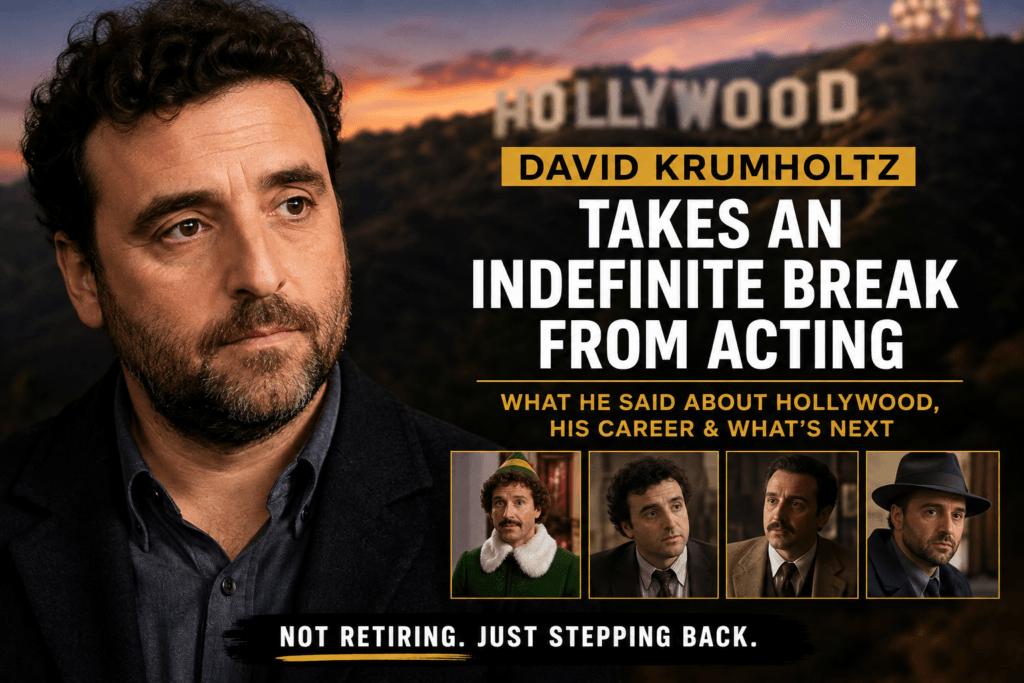
David Krumholtz is stepping back from acting after more than three decades in Hollywood, saying he has reached a point where the pressures and uncertainty of the business have become too heavy to ignore. The 48-year-old actor recently described putting his career on hold as a decision he had feared making for years, largely because of the possibility of financial instability.
The announcement quickly drew attention because Krumholtz is far from an unknown performer. Audiences have seen him in films and television series including The Santa Clause, 10 Things I Hate About You, Numb3rs and Oppenheimer. More recently, he appeared in projects connected to Supergirl and The Studio, keeping him active during a period when Hollywood itself has been undergoing major changes.
However, calling the development a permanent retirement would go too far. Krumholtz’s own follow-up comments indicate that he has not completely closed the door on acting. Instead, he is taking an indefinite break and reconsidering what he wants from his career.
What David Krumholtz Said About Stepping Away
Krumholtz announced the decision in a Threads post that was later deleted. He explained that putting his acting career on hold had been something he had considered for years, but fear kept him from making the move. His biggest concern involved money and the possibility that leaving the industry could leave him without a dependable source of income.
That fear appears to have competed with another feeling: relief. After sending what he described as the decisive email that put his career on pause, Krumholtz said he immediately felt a significant weight lift from him. The contrast is revealing. The decision created uncertainty about what he would do next, yet it also removed a burden he had apparently carried for a long time.
His comments suggest that the issue is not simply a lack of acting opportunities. Instead, Krumholtz has become increasingly dissatisfied with the way he believes professional actors are expected to navigate the modern entertainment business. He questioned whether continuing to chase roles under those conditions still made sense for him.
That makes the announcement more complicated than a conventional celebrity retirement. Krumholtz is not presenting acting as something he suddenly stopped loving. Rather, he appears to be questioning whether the current system allows him to pursue the profession in a way that feels financially and personally sustainable.
Why Krumholtz Said He Felt Relief
The emotional response to his decision may be one of the most significant parts of the story.
For years, Krumholtz had apparently associated stepping away from acting with a frightening financial consequence. That fear made remaining in the industry feel safer, even as dissatisfaction continued to build. Once he finally made the decision, however, he experienced the opposite reaction.
He described a powerful sense of relief after removing what he considered a major burden. At the same time, he acknowledged that he does not yet have a complete financial or professional roadmap for what comes next.
That uncertainty matters. Krumholtz is not announcing a neatly packaged second career with a confirmed start date. He is creating space to figure out what comes next.
For an actor who has spent most of his adult life working in film and television, that represents a major personal shift. His decision appears less about walking away from his past and more about refusing to let fear alone determine his future.
Is David Krumholtz Retiring From Acting?
No clear evidence currently supports describing David Krumholtz as permanently retired from acting.
The initial Threads announcement sounded final enough to trigger widespread reports that the actor was quitting Hollywood. Yet subsequent comments provided important context. Krumholtz indicated that he was not saying his acting career was completely over. Instead, he was redefining the terms under which he might work in the future.
That distinction is especially important for readers searching for the latest David Krumholtz news. “Retirement” suggests a definitive end point. “Indefinite break” leaves the future open.
Krumholtz’s position appears to be that he no longer wants to pursue acting simply because he feels obligated to remain in the business. He wants time to consider whether another path could provide a stronger sense of purpose.
He has also discussed the possibility of doing motivational speaking and connecting with students. That idea fits with his broader comments about wanting to find work that allows him to be useful and have a meaningful impact. However, there is no indication that he has formally abandoned acting forever.
For now, the most accurate description is straightforward: David Krumholtz has put his acting career on hold and is taking an indefinite break.
Why His Deleted Threads Posts Caused Confusion
The deleted Threads post helped create much of the confusion surrounding the story.
Krumholtz’s original message was emotional and direct, making his decision sound like a major departure from the profession. Because the post disappeared, later readers had to rely on reports and screenshots to understand what he had originally written.
That combination—an unusually candid announcement followed by deletion—naturally encouraged headlines describing the move as retirement or quitting Hollywood. Some coverage used stronger language than Krumholtz’s later clarification supported.
His follow-up response changed the picture. Rather than declaring that he would never act again, he suggested that his relationship with the profession was being redefined.
That is why the wording matters. Krumholtz has clearly expressed serious frustration with the industry, but frustration is not the same thing as a permanent career-ending decision.
For now, his break should be understood as an open-ended pause. Whether that eventually becomes a full retirement, a temporary reset or a return under different conditions remains unknown.
Why David Krumholtz Is Frustrated With Hollywood
Krumholtz’s decision goes beyond the normal frustrations that come with auditions, rejection and unpredictable employment. In his now-deleted Threads post, he described a deeper dissatisfaction with how the entertainment business treats experienced character actors. He argued that decades of professional experience no longer guarantee the stability or respect that once came with a long career.
One issue appears particularly important to him: the changing economics of acting. Krumholtz said he has spent more than three decades building a career, yet he now feels that established performers can face significantly reduced opportunities and compensation. He described this experience as a form of professional demotion, suggesting that longevity does not necessarily translate into greater security.
His frustration also reflects a broader change in Hollywood’s business environment. Studios and entertainment companies have increasingly adjusted their strategies around streaming, consolidation and digital audiences. At the same time, traditional film and television work has become less predictable for many professionals. Recent industry reporting has highlighted how companies are experimenting with cheaper, faster formats while established production models continue to change.
Krumholtz’s comments should remain understood as his personal assessment rather than proof that every actor faces identical circumstances. Still, his experience gives the debate a recognizable face. After years of steady work, he no longer wants to measure his career solely by whether Hollywood continues offering him roles.
The Pressure of Staying Relevant Online
Another major source of frustration involves social media.
Krumholtz objected to the idea that an experienced actor should effectively market himself as a digital brand just to remain competitive. In his view, professional acting should be judged primarily by talent, experience and the ability to perform—not by follower counts, online visibility or the size of a personal social-media audience.
That concern reflects a major shift in entertainment. Social platforms now influence casting conversations, publicity strategies and audience discovery. For younger performers, building an online following can become part of career development. However, Krumholtz clearly questions whether veteran performers should have to adopt the same model simply to maintain access to work.
His criticism is also tied to privacy and self-image. He has expressed frustration with the pressure to worry about appearance, personal branding and other superficial measures when he would rather focus on meaningful creative work.
For Krumholtz, the issue is not that social media exists. It is that he does not want his professional value reduced to how effectively he can promote himself online.
The Changing Economics of Being a Character Actor
Krumholtz’s comments are particularly interesting because his career has never depended entirely on being a traditional Hollywood leading man. He built his reputation as a character performer—an actor audiences recognize even when his name may not immediately come to mind.
That position can create a complicated career equation. Character actors often provide the connective tissue that makes films and television series feel believable. They can play executives, friends, parents, scientists, teachers, agents and other supporting figures across many genres. Yet recognition does not always translate into the financial security associated with top-billed stars.
Krumholtz’s frustration centers on that disconnect. He has accumulated decades of credits and has worked with major filmmakers, but he says the current system can still make experienced performers feel as though they are fighting for smaller opportunities. His argument is that professional history should count for something when an actor has repeatedly demonstrated the ability to deliver.
There is also a practical problem. Acting remains unpredictable even for established performers. A successful film does not guarantee another major role, and a recognizable television credit does not necessarily create steady income afterward. Krumholtz specifically connected his decision to the fear of eventually running out of money if he stepped away from the business.
That contradiction helps explain why his announcement carries weight. He is not walking away because acting has never worked for him. He is stepping back after achieving a level of experience that he believes should have produced a more sustainable professional relationship with Hollywood.
Why Decades of Experience Did Not End the Uncertainty
Krumholtz began acting as a child and has spent roughly 34 years in the profession. That history makes his financial concerns especially striking.
A common assumption is that a performer who has worked consistently for decades must have reached a point where employment becomes easier. Krumholtz’s comments challenge that assumption. Even after appearing in prominent productions, he says he remained worried about whether leaving acting would make him financially vulnerable.
The uncertainty appears to be one reason he remained in the business despite growing dissatisfaction. Stepping away meant giving up the possibility of another paycheck, another role or another opportunity. Staying, meanwhile, meant continuing to participate in a system he increasingly disliked.
That creates a difficult choice for any working actor: tolerate an unstable career because it provides income and identity, or accept the financial risk of stepping away.
Krumholtz ultimately chose the second option, at least for now. His reported sense of relief suggests that the psychological cost of remaining in the cycle had become significant enough to outweigh the comfort of familiarity.
His decision does not establish that Hollywood has become impossible for every character actor. Instead, it shows how one veteran performer has reached his personal limit after years of weighing the same risks.
What Krumholtz Wants From Acting If He Returns
Despite his criticism, Krumholtz has not rejected acting itself.
His follow-up comments make that distinction clear. He told a fan that he was not quitting entirely and described the move as a step back and an indefinite break. He also indicated that he would still consider acting when the work offered something more meaningful than simply another paycheck.
That could change the way he approaches future roles. Instead of pursuing every available opportunity, Krumholtz may become more selective about the projects he accepts. Artistic value, personal impact and a sense of purpose could become more important than maintaining a constant stream of credits.
He has also discussed wanting to inspire students through motivational speaking. That possibility gives his break another dimension. Rather than viewing the next stage solely as an escape from Hollywood, he appears interested in finding a way to use his experience outside traditional acting.
For now, however, there is no confirmed replacement career that has fully taken shape.
That uncertainty is part of the story. Krumholtz has spent most of his adult life knowing what his profession was. Now he is allowing himself to step away without having every detail of the next chapter settled.
In that sense, his decision is not simply about leaving Hollywood. It is about giving himself permission to decide what comes next on his own terms.
David Krumholtz’s Acting Career Before Hollywood Burnout
David Krumholtz’s career began remarkably early. At 13, he auditioned for the Broadway production Conversations with My Father and landed the role of Young Charlie alongside Judd Hirsch. That opportunity opened the door to film, television and stage work while he was still a teenager.
Soon afterward, Krumholtz appeared in Life With Mikey and Addams Family Values. He then became widely recognizable as Bernard the Elf in The Santa Clause, a role that introduced him to a huge family audience. He returned as Bernard in The Santa Clause 2 and later reprised the character in the Disney+ series The Santa Clauses.
During the 1990s, Krumholtz also demonstrated that he could move comfortably beyond family comedy. His credits included Ang Lee’s The Ice Storm, Slums of Beverly Hills, 10 Things I Hate About You and Liberty Heights. Those roles helped establish him as a versatile supporting performer rather than an actor tied to one particular genre.
His biggest television breakthrough arrived with CBS’s Numb3rs. From 2005 to 2010, he played mathematical genius Charlie Eppes, an FBI consultant who used mathematics to help solve complex cases. The series gave Krumholtz a sustained leading role and became one of the defining credits of his career.
That history is important when considering his current decision. Krumholtz is not an actor who struggled to establish himself. He built a long, varied career across Broadway, movies and television, making his present frustration with the business considerably more significant.
From Young Actor to Recognizable Character Performer
Krumholtz’s career developed around versatility rather than conventional movie-star status. He moved comfortably between comedy, drama, eccentric supporting characters and intellectually demanding roles without becoming locked into a single screen identity. After Numb3rs, he continued appearing in projects such as The Newsroom, The Good Wife, Master of None, The Deuce and The Plot Against America. His film credits have also included Ray, The Judge, Walk Hard: The Dewey Cox Story and The Ballad of Buster Scruggs.
His experience also reflects the unusual pressures that can accompany a career that begins early. Child actors and the pressures of starting young have become an increasingly relevant part of Hollywood conversations, particularly as performers transition from childhood roles into demanding adult careers.
That range helped Krumholtz become recognizable even when he was not the central star. His ability to make supporting characters memorable became one of the defining features of his career.
Hollywood has produced many performers who built lasting careers through recognizable roles, major franchises and years of consistent work rather than one defining breakthrough. Another actor with a long Hollywood career offers a different example of how performers can navigate that changing landscape.
Krumholtz’s career therefore represents the traditional working-actor model: build experience, accept varied roles and continue working across different formats. His current frustration raises an important question about whether that model still provides the professional stability experienced performers once expected.
David Krumholtz in Oppenheimer, Supergirl and The Studio
Krumholtz remained highly visible in major productions even as his relationship with Hollywood became more complicated.
One of his most prominent recent appearances came in Christopher Nolan’s Oppenheimer. The film assembled a large ensemble of established performers, and Krumholtz played physicist Isidor Isaac Rabi. The movie became a major cultural and commercial success while earning widespread awards recognition. His involvement gave a veteran character actor another opportunity to work inside a prestigious, filmmaker-driven production.
His recent work also extends into major television and franchise projects. Krumholtz appeared in The Studio, adding another contemporary credit to a filmography that already spans decades and multiple genres.
Then came Supergirl, the 2026 DC Studios film directed by Craig Gillespie. DC’s official cast listing includes Krumholtz alongside Milly Alcock, Matthias Schoenaerts, Eve Ridley, Emily Beecham, David Corenswet and Jason Momoa. The film arrived in theaters internationally beginning June 24, 2026, with its North American release following on June 26.
Those credits make the timing of Krumholtz’s announcement especially striking. He is not stepping away after disappearing from the screen. Instead, his decision comes during a period when he has continued landing recognizable projects.
Oppenheimer
Krumholtz’s role in Oppenheimer introduced him to audiences in a very different context from the lighter projects that first made him famous.
Playing physicist Isidor Isaac Rabi placed him inside one of the most ambitious historical dramas of recent years. The film’s ensemble included numerous respected actors, and Krumholtz’s presence reinforced the value of experienced supporting performers in large-scale productions.
The project also became part of a broader late-career period in which Krumholtz worked on increasingly prestigious material. His filmography around this period included projects from major directors and acclaimed television creators.
That makes his current frustration harder to reduce to a simple lack of opportunity. His recent résumé shows that significant work has continued to come his way.
Instead, Krumholtz appears to be questioning the larger professional equation: whether the rewards of continuing to pursue acting justify the financial uncertainty, self-promotion and industry pressures he says now accompany the job.
Supergirl and Recent DC Work
Supergirl represents another major franchise opportunity in Krumholtz’s recent career.
The DC Studios film centers on Kara Zor-El, played by Milly Alcock, and places Krumholtz within a large ensemble featuring several prominent actors. DC describes the story as an interstellar adventure involving Supergirl and an unexpected ally as they pursue a dangerous adversary.
His involvement demonstrates that Krumholtz continued to work at a high level even while expressing dissatisfaction with the broader industry.
That contrast is central to understanding his decision. The problem, based on his own statements, is not simply whether he can obtain credits. It is whether the modern business surrounding those credits still offers the kind of professional life he wants.
His recent projects therefore form an important part of the story. Krumholtz is walking away at a moment when audiences can still see him in major productions, making his decision less about fading from public view and more about reassessing what he wants his working life to look like.
What Happens to David Krumholtz’s Acting Career Now?
David Krumholtz’s decision creates an unusual situation because his career is not ending at a point of complete inactivity. He still has recent credits, a substantial body of work and projects connected to his name. However, his comments make clear that he no longer wants to pursue acting under the same conditions that have defined the past several years.
For now, the most accurate description remains an indefinite break. Krumholtz has said that he is not quitting acting altogether, but he is stepping back from the professional side of the business. He has also suggested that he wants to redefine the terms under which he works rather than continue competing for roles simply to remain employed.
That distinction leaves several possibilities open. He could eventually return for projects that offer stronger artistic value, better working conditions or a sense of personal purpose. Alternatively, he could spend a significant period away from acting while developing another professional direction.
The immediate future is therefore uncertain. Krumholtz himself has acknowledged that he does not have a complete financial or career plan for life outside Hollywood. What appears certain is that he no longer wants uncertainty and professional pressure to dictate every decision.
For established entertainers, making that kind of decision can mark the beginning of a new chapter outside an earlier career phase, even when their previous work remains an important part of their public identity.
Could David Krumholtz Return to Acting?
Yes, a return remains possible.
Krumholtz has repeatedly separated his love of acting from his dissatisfaction with acting as a profession. He has indicated that he still enjoys the creative act itself, even though the commercial side of the entertainment industry has lost much of its appeal.
That distinction could become important if the right opportunity appears. Instead of accepting roles because they provide another credit, he may choose projects based on their artistic or personal value.
His comments also suggest that he wants greater control over his time and priorities. If a future production gives him a reason to return without requiring him to participate in the parts of Hollywood he finds exhausting, the door appears open.
Still, there is no confirmed timeline for a comeback. Any claim that Krumholtz has already decided to return would go beyond what he has publicly said.
For now, his career is best viewed as paused rather than permanently closed.
What David Krumholtz May Do Instead
Krumholtz has already hinted at one possible direction: motivational speaking.
In response to fans asking what he might do next, he discussed the possibility of inspiring students in schools. That idea reflects a broader change in the way he is thinking about his professional life. Instead of focusing entirely on his own career, he wants to explore work that allows him to be useful to other people.
That does not mean he has formally launched a new career as a motivational speaker. Rather, it is one possibility he has mentioned while trying to determine what comes after acting.
His comments suggest that purpose has become increasingly important. For years, competing for roles, maintaining a career and staying visible could provide clear goals. Now, he appears interested in measuring success differently.
His desire for a different pace also connects with a broader pattern among established performers who eventually choose a quieter life away from Hollywood rather than remaining constantly in the public spotlight.
That could include speaking to students, pursuing another creative discipline or choosing selective acting projects that allow him to make an impact.
The important point is that Krumholtz has not presented a detailed five-year plan. He has openly acknowledged that he does not know exactly what comes next.
That uncertainty may actually be central to his decision. After decades of building a career around acting, he is giving himself permission to explore a different definition of professional success.
A New Direction Rather Than a Clean Break
Krumholtz’s language points toward reinvention rather than disappearance.
He has expressed gratitude for the opportunities acting gave him and has spoken positively about the experience of performing. At the same time, he has argued that professional acting and the simple act of acting are no longer the same thing for him.
That distinction allows him to preserve the part of the profession he loves while rejecting the pressures he no longer wants to accept.
He could therefore return in a limited capacity, perform in projects with a strong personal connection or spend years pursuing something completely different. None of those possibilities can be confirmed yet.
What can be confirmed is that Krumholtz wants his next chapter to be more deliberate. His decision is not framed as abandoning everything he accomplished. Instead, he appears to be trying to separate the value of his creative work from the demands of maintaining a conventional Hollywood career.
Experience Versus the Modern Hollywood Model
The traditional Hollywood career path often rewarded performers who remained dependable, versatile and consistently employed.
Krumholtz built exactly that kind of career. He moved from child actor to Broadway performer, film supporting player, television lead and acclaimed character actor. His résumé demonstrates adaptability across different eras of entertainment.
Yet the industry around him has changed substantially.
Actors now operate in an environment shaped by streaming, social media, franchise filmmaking and rapidly changing audience habits. At the same time, performers may face pressure to promote themselves beyond the work itself.
Krumholtz’s criticism focuses on that changing relationship between talent and business. He wants the work to have value beyond visibility, branding and financial calculation.
That perspective helps explain why his announcement has resonated beyond his own fan base. The story is not simply about whether one actor retires. It is about what happens when someone with decades of experience decides that the traditional definition of career success no longer works for him.
David Krumholtz’s Remaining Projects and Career Legacy
David Krumholtz’s decision to take an indefinite break comes with an important caveat: stepping away from acting does not erase the work he has already completed. His recent credits also mean audiences may continue seeing him on screen even while he takes a pause from pursuing new roles.
Among his latest high-profile appearances is Supergirl, where he plays Zor-El, the father of Kara Zor-El. DC’s official film information lists Krumholtz among the principal cast alongside Milly Alcock, Matthias Schoenaerts, Eve Ridley, Emily Beecham, David Corenswet and Jason Momoa. The film opened internationally on June 24, 2026, followed by its North American theatrical release on June 26.
He is also associated with Mr. Irrelevant: The John Tuggle Story, which has been reported as another upcoming project. That means his professional presence may continue even if he stops actively seeking additional work.
For audiences, this creates an unusual transition. Krumholtz can step away from the industry’s day-to-day demands while still having recent performances available to watch.
More importantly, his career already has a lasting footprint. From Bernard in The Santa Clause films to Charlie Eppes in Numb3rs and Isidor Isaac Rabi in Oppenheimer, he built a filmography that reaches several generations.
A Career Built on Range
Krumholtz’s legacy does not depend on a single signature performance.
He moved between comedy, drama, television, film and theater, often taking supporting roles that became memorable because of his individual style. That versatility allowed him to work with different generations of filmmakers and performers.
His career also demonstrates how a character actor can remain relevant without becoming a conventional leading man. Audiences may recognize his face and performances across many projects even when his name receives less attention than the stars around him.
That makes his current decision especially significant. Krumholtz has already accomplished something many actors spend decades pursuing: a sustained career with recognizable work across multiple formats.
His break therefore does not need to be interpreted as a failure. It can also represent a veteran performer deciding that professional longevity alone is no longer enough.
What David Krumholtz’s Acting Break Means for His Legacy
Krumholtz’s decision is unlikely to change how audiences remember the strongest parts of his career.
For younger viewers, he may remain associated with The Santa Clause and its long-running holiday appeal. Television audiences may remember Charlie Eppes from Numb3rs, while film fans can point to his appearances in 10 Things I Hate About You, Oppenheimer and other ensemble productions.
His recent appearance as Zor-El in Supergirl adds another major franchise credit to that résumé.
The broader legacy, however, comes from consistency. Krumholtz worked across different periods of Hollywood rather than depending on one era or one type of project.
That makes his criticism of the industry particularly noteworthy. He has experienced Hollywood before and after major changes in distribution, technology, audience behavior and studio strategy. His perspective comes from someone who has remained professionally active across those shifts.
Still, his decision should not be turned into a universal verdict on the entertainment business. Krumholtz is describing his own experience and priorities. Another actor could reach the opposite conclusion and find the current industry exciting or financially worthwhile.
The lasting significance of his announcement may instead be personal. After decades of defining himself through acting, he is asking whether the next stage of his life should continue to revolve around the same profession.
That question gives the story more depth than a standard celebrity retirement headline.
Will David Krumholtz Return to Acting?
There is no confirmed date for David Krumholtz’s return, and there is no reason to assume one either way.
His own clarification leaves the door open. He has indicated that he is not completely quitting acting, even while making an indefinite break his current priority.
That means a future return could take several forms. He might accept a role that strongly appeals to him, appear selectively in projects with personal meaning, or eventually decide that he prefers life away from the industry.
The most reasonable expectation is therefore uncertainty.
An indefinite break gives Krumholtz room to make that decision without committing himself to a permanent label. It also prevents his current frustration from becoming a prediction about the rest of his career.
For fans, that distinction matters. His latest statement does not mean they will never see him act again. It means that he no longer wants to organize his life around constantly finding the next acting job.
If the right opportunity comes along, his comments suggest that acting itself may still have a place in his future. What appears less certain is whether he wants to return to the traditional Hollywood grind that led him to step back in the first place.
Frequently Asked Questions About David Krumholtz
Is David Krumholtz retiring from acting?
David Krumholtz has announced an indefinite break from acting, but current reporting does not establish a permanent retirement. He later clarified that he was not quitting acting entirely. His future involvement will depend on what opportunities and priorities emerge after his break.
Why is David Krumholtz taking a break from acting?
Krumholtz has described growing frustration with the entertainment industry, including financial uncertainty, changing expectations for actors and the pressure to promote himself online. He said stepping away brought him a strong sense of relief after years of fearing the consequences of leaving.
Why did David Krumholtz delete his Threads posts?
Krumholtz deleted the posts in which he initially discussed putting his acting career on hold. Their disappearance contributed to confusion about whether he intended to retire permanently. Later comments provided additional context and indicated that he had not completely closed the door on acting.
What is David Krumholtz best known for?
Krumholtz is widely recognized for playing Bernard in The Santa Clause films and Charlie Eppes in Numb3rs. His other notable credits include 10 Things I Hate About You, Oppenheimer and Supergirl.
Who does David Krumholtz play in Supergirl?
David Krumholtz plays Zor-El, the father of Kara Zor-El, in the 2026 DC Studios film Supergirl. DC’s official cast information confirms his role alongside Milly Alcock and the film’s other principal performers.
Did David Krumholtz quit acting permanently?
No. The available reporting supports describing his decision as an indefinite break, not a confirmed permanent retirement. Krumholtz has indicated that he remains open to acting under circumstances that feel worthwhile to him.
Final Takeaway on David Krumholtz’s Acting Break
David Krumholtz’s latest career decision is more complicated than the phrase “actor retires” suggests.
After more than three decades in entertainment, he has decided to step away from the professional pressures of acting and reassess what he wants from the next stage of his life. His concerns include financial uncertainty, changing industry expectations and the growing importance of personal branding in Hollywood.
Yet the door is not completely closed. Krumholtz has clarified that his break does not necessarily mean he will never act again. Instead, he appears to want greater control over what he does, why he does it and whether a project provides genuine value.
That makes David Krumholtz’s story less about abandoning a successful career and more about redefining success after decades of work.
His filmography already speaks for itself. From The Santa Clause and Numb3rs to Oppenheimer and Supergirl, he has created a body of work that will remain available regardless of what he chooses next.
For now, however, the clearest answer is simple: David Krumholtz is taking an indefinite break from acting, not announcing a confirmed permanent retirement. What comes next remains his decision—and, for the first time in years, he appears determined to make that decision on his own terms.