
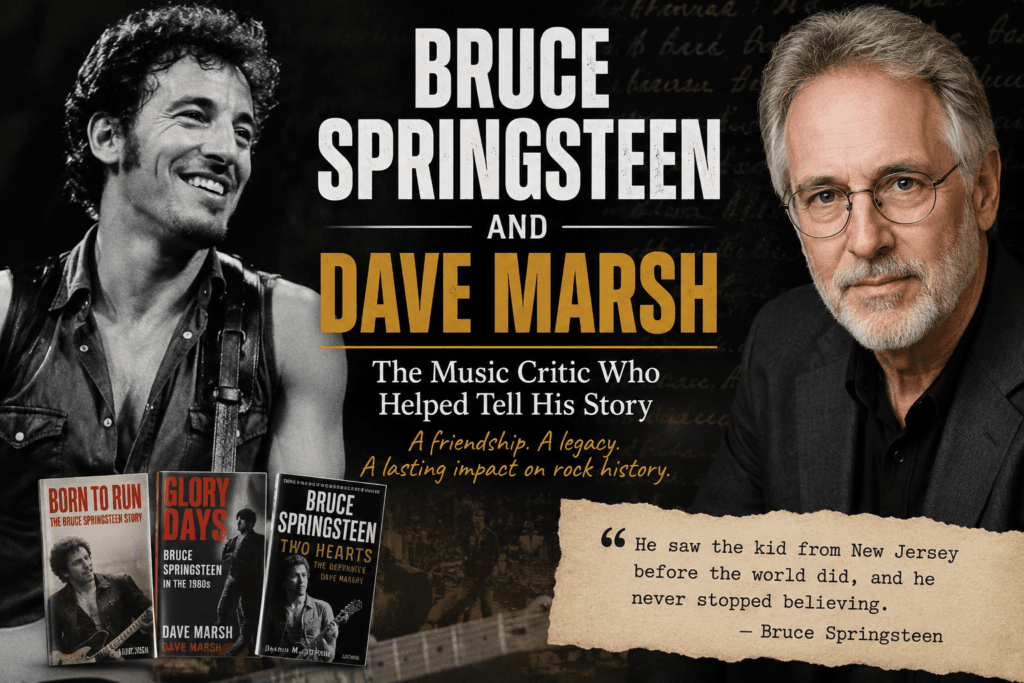
The death of Dave Marsh has renewed attention on one of the most important writers ever to document Bruce Springsteen’s career. Marsh, the veteran rock critic and biographer, died August 14, 2026, at his home in Connecticut at age 76. His death brought an immediate response from Springsteen, who remembered Marsh as a longtime friend, fierce supporter and deeply committed rock-and-roll writer.
For Springsteen fans, Marsh’s name carries unusual weight. He was not simply a journalist who occasionally covered the New Jersey songwriter. He followed Springsteen’s development from his early years, wrote the first major book about his career, and continued documenting his music across decades. His books Born to Run, Glory Days and Bruce Springsteen: Two Hearts became important reference points for understanding the artist’s rise, his changing public image and the cultural meaning of his music.
Marsh’s connection to Springsteen also went beyond books. He championed the singer early in his career, wrote about him for Creem, and published Springsteen’s first Rolling Stone cover story in 1978. He also maintained a close relationship with people in Springsteen’s professional circle, including longtime manager and producer Jon Landau.
That closeness helped make Marsh an unusually influential chronicler. At the same time, it made his work more personal and openly opinionated than conventional celebrity biography. His writing often reflected strong convictions about what mattered in rock music and why Springsteen deserved attention.
Who Was Dave Marsh?
Dave Marsh built a career around a simple but demanding idea: rock music deserved serious criticism. Born in Pontiac, Michigan, in 1950, he entered journalism through Detroit’s music scene and became an early editor of Creem. From there, his work reached major publications, including Rolling Stone, Newsday and The Village Voice. Over a career spanning several decades, he wrote more than 25 books about music and became one of the recognizable voices of American rock criticism.
His interests stretched far beyond Springsteen. Marsh wrote about The Who, Elvis Presley, Aretha Franklin and other major artists while also producing books that examined rock history more broadly. His The Heart of Rock & Soul became one of his notable works of criticism, while his writing and broadcasting kept him connected to music audiences long after the peak years of traditional rock magazines.
His broader interest in live music and its connection with audiences also reflects the continuing importance of concert culture, as seen in CLIMAX Magazine’s coverage of Daniel Caesar’s Barclays Center performance.
Marsh also worked in radio and became closely associated with Springsteen-focused programming on SiriusXM. His later career showed that he had never treated music criticism as a temporary profession. He continued debating records, artists and the culture surrounding them.
His style could be forceful, argumentative and intensely subjective. That quality attracted devoted readers but also drew criticism. Marsh did not try to sound detached when he believed an artist mattered. Instead, he wrote with the conviction of someone who considered music a serious cultural force.
From Detroit Rock Journalism to National Recognition
Marsh’s early years at Creem placed him inside the rapidly developing American rock press. The magazine’s Detroit roots gave him proximity to a scene that valued loud, direct and uncompromising music, while his later work expanded his reach nationally.
Springsteen became one of the clearest examples of Marsh’s ability to identify artists he believed deserved greater attention. Long before Springsteen became a global superstar, Marsh wrote enthusiastically about his music. He also helped connect Springsteen with Jon Landau, who would eventually become a central figure in the singer’s career.
That early advocacy matters because Marsh was documenting Springsteen while the artist’s story was still unfolding. He was not looking backward from the perspective of an established legend. He was writing while the future remained uncertain.
That gave his early work a particular historical value. Marsh saw the potential in Springsteen’s music before the wider mainstream had fully accepted it, and he spent the rest of his career explaining why that music mattered.
How Dave Marsh Became Closely Associated With Bruce Springsteen
Marsh’s relationship with Bruce Springsteen developed during a crucial period in the singer’s career. Springsteen was building a reputation through relentless live performances and increasingly ambitious songwriting, but his eventual status as one of America’s defining rock artists had not yet become inevitable.
Marsh became an early advocate. His writing for Creem helped introduce Springsteen to readers who were paying close attention to emerging rock musicians. In 1978, Marsh also wrote Springsteen’s first Rolling Stone cover story, placing the artist on a major national music publication at an important moment in his rise.
The relationship became even more significant because Marsh was connected to people around Springsteen’s career. Reporting on his death has long associated him with Jon Landau’s introduction to Springsteen’s music. According to accounts of their history, Marsh brought Landau to a Springsteen performance in the 1970s, helping create a connection that would become enormously important to the singer’s professional future.
Marsh therefore occupied an unusual position. He was a critic, but he was also someone who knew the people involved and had a personal investment in Springsteen’s success.
That combination shaped his writing. His books were deeply informed by access and knowledge, yet they also reflected his strong opinions. For readers, that made Marsh’s Springsteen work both valuable and worth examining critically.
The Importance of Marsh’s Access to the E Street World
Marsh’s proximity to Springsteen’s professional circle gave him access that many outside observers did not have. His connection to Springsteen’s team and longtime relationships within the E Street world helped him place individual songs, performances and career decisions into a broader context.
However, access can create complications for a biographer. A writer who knows the subject personally may understand details that outsiders miss, but that same closeness can make complete detachment difficult.
That tension followed Marsh’s Springsteen writing. Critics sometimes viewed his admiration for Springsteen as excessive. A 1987 Washington Post review of Glory Days, for example, argued that Marsh’s enthusiasm sometimes overwhelmed his critical distance.
Still, that enthusiasm was also part of Marsh’s significance. He did not merely observe Springsteen’s career from a distance. He believed strongly in the music and spent decades explaining its importance to readers.
For Springsteen fans, his work consequently became more than a collection of reviews. It became part of the documentary record surrounding an artist whose career unfolded across generations.
Bruce Springsteen and Born to Run: Marsh’s First Major Biography
In 1979, Dave Marsh published Born to Run: The Bruce Springsteen Story, becoming the first author to produce a major book-length account of Springsteen’s life and career. The timing made the project especially significant. Springsteen had already established himself as a major rock performer, but his mythology was still developing.
Rather than approaching Springsteen as a finished cultural icon, Marsh documented the artist’s early development. The book focused on the formative period that led toward Springsteen’s breakthrough and helped preserve a contemporary account of an artist still moving rapidly through the music industry.
That distinction matters today. Later biographies could examine Springsteen with decades of hindsight. Marsh’s first book captured an earlier moment, when the trajectory of his career remained open.
Born to Run also established a pattern that would define Marsh’s relationship with Springsteen. He combined reporting, criticism and interpretation rather than treating the singer’s life as a collection of disconnected facts.
The result was an account shaped by a strong belief in Springsteen’s artistic importance. That approach appealed to many readers and helped establish Marsh as one of the central writers associated with Springsteen’s story.
The book’s lasting importance comes partly from that historical position. It represents an early attempt to explain Springsteen while the artist was still becoming the figure audiences now recognize.
For that reason, Marsh’s first Springsteen biography remains an important part of the written history surrounding the singer’s rise.
Glory Days Expanded the Bruce Springsteen Story
Dave Marsh’s second major Bruce Springsteen biography arrived after the singer had moved from ambitious cult favorite to international rock star. Glory Days: Bruce Springsteen in the 1980s examined the decade in which Springsteen’s fame expanded dramatically, particularly after Born in the U.S.A. turned him into one of the biggest names in popular music.
The book gave Marsh an opportunity to look beyond the early-career story he had explored in Born to Run. Springsteen’s world had changed. His concerts had grown larger, his audience had become more mainstream, and his public image had taken on a scale that few rock artists could match.
Marsh approached that period with the same combination of reporting and strong personal interpretation that had defined his earlier work. He examined Springsteen’s music, performances, career decisions and public identity while placing them within the broader culture of the 1980s.
That approach made Glory Days an important companion to the earlier biography. Instead of presenting Springsteen as a static celebrity, Marsh continued following the tension between the artist’s growing fame and the working-class identity that remained central to his songwriting.
The book also reflected Marsh’s unusual access to Springsteen’s professional world. His familiarity with the singer and people around him allowed him to provide details that ordinary music coverage could not easily capture.
At the same time, the closeness created a recurring question about Marsh’s work: could a writer so personally invested in Springsteen maintain enough distance to offer a fully independent assessment?
Why Glory Days Remained Important to Springsteen Fans
The enduring value of Glory Days comes partly from when Marsh wrote it. He was documenting Springsteen’s enormous rise close to the events themselves rather than reconstructing the decade years later.
That contemporary perspective captured an important transformation. Springsteen had moved from intimate theaters and dedicated rock audiences to stadiums filled with listeners who knew him through radio hits, MTV and Born in the U.S.A. The change created a new set of questions about authenticity, celebrity and commercial success.
Marsh explored those tensions through the perspective of someone who had followed Springsteen long before mainstream fame arrived. That gave him a useful historical comparison between the emerging songwriter of the 1970s and the stadium performer of the 1980s.
However, readers also need to understand the book as criticism rather than neutral archival history. Marsh had a clear view of Springsteen’s artistic importance, and his enthusiasm sometimes shaped the way he presented the evidence.
That does not make the book irrelevant. Instead, it makes Glory Days most useful when readers treat it as both a historical source and a strongly argued interpretation of Springsteen’s career.
For fans studying how Springsteen’s public identity developed, that combination remains valuable. Marsh captured the moment when an artist who once seemed like a promising rock outsider became a defining American music figure.
Two Hearts Brought Marsh’s Springsteen Work Together
Marsh later returned to Springsteen’s story with Bruce Springsteen: Two Hearts: The Definitive Biography, a substantially expanded project that brought together his earlier biographical work while adding material covering the artist’s later career.
The book gave Marsh a chance to revisit his earlier writing with decades of additional perspective. Instead of stopping with Springsteen’s early rise or the events of the 1980s, Two Hearts followed the story into a later stage of the singer’s career.
That broader timeline changed the meaning of earlier events. Songs, albums and career decisions could now be considered alongside developments that occurred years afterward. Springsteen’s continuing work also demonstrated that his career could not be understood solely through the breakthrough period that had made him famous.
The book’s scope made it particularly useful for readers who wanted one substantial account of Marsh’s interpretation of Springsteen rather than separate volumes covering different periods.
According to the book’s publisher description, Two Hearts combined Born to Run and Glory Days with new material that extended the story into the early 2000s. That included the period surrounding The Rising, an album shaped by the cultural aftermath of September 11, 2001. (routledge.com)
The result was more than an updated biography. It represented the culmination of Marsh’s long-running effort to explain why Springsteen mattered.
Springsteen’s Career Through Marsh’s Long View
The greatest strength of Marsh’s later Springsteen writing was the amount of historical distance he had accumulated.
He had watched Springsteen before Born to Run became a landmark album. He had written about the artist during the explosion of Born in the U.S.A. And he later examined Springsteen after the singer had entered a very different phase of his career.
Few critics had followed that entire arc so closely.
That continuity allowed Marsh to connect periods that often appear separate when viewed through individual albums. The young songwriter from New Jersey, the stadium superstar of the 1980s and the mature artist working through grief, politics and American identity were part of the same larger story.
It also allowed Marsh to challenge the idea that Springsteen’s career depended on one particular era. His writing repeatedly treated Springsteen as an evolving artist rather than someone permanently defined by his most famous songs.
That perspective remains especially useful because Springsteen’s career has lasted far longer than the period covered by Marsh’s earliest books. Later generations encountered Springsteen through different albums, tours and cultural moments.
Marsh’s work provides a bridge between those generations. His writing preserves the excitement surrounding Springsteen’s early rise while also showing how the singer’s meaning changed as his career continued.
How Dave Marsh Influenced the Way Fans Viewed Bruce Springsteen
Dave Marsh did more than record Bruce Springsteen’s career. He helped interpret it.
That distinction explains why his influence reached beyond readers who purchased his books. Music critics often shape the language audiences use when discussing artists, and Marsh developed a particularly strong vocabulary around Springsteen’s songwriting, performances and cultural significance.
His writing encouraged readers to treat Springsteen as an artist whose music deserved close examination. Songs could carry political meaning, personal history and social observation at the same time. Concerts could function as more than entertainment. They could become expressions of community and identity.
This perspective fit naturally with Springsteen’s songwriting, which frequently explored work, family, economic pressure, relationships and American ideals. Yet Marsh’s interpretation also reflected his own critical priorities.
That is important when evaluating his legacy. A biography is never simply a database of facts. The author decides which events deserve emphasis, how people are portrayed and what larger meaning should emerge.
Marsh made those choices openly. His writing carried conviction, and his admiration for Springsteen was difficult to separate from his analysis.
For some readers, that commitment made his work powerful. For others, it raised questions about objectivity.
Both reactions help explain why Marsh remained an influential and sometimes debated figure in rock journalism. He did not merely describe what happened. He argued for why it mattered.
A Supporter Who Was Also a Strongly Opinionated Critic
Marsh’s enthusiasm for Springsteen never meant that his writing existed outside criticism. He had strong views about music, journalism and the cultural role of rock, and he applied those views throughout his career.
His approach could sometimes appear confrontational. He was willing to make judgments about artists, records and critics rather than hiding behind neutral language.
That style became part of his identity as a writer. It also meant that his Springsteen books should not be treated as unquestionable accounts.
A 1987 review of Glory Days in The Washington Post raised concerns about Marsh’s closeness to his subject and questioned whether his admiration limited his critical distance.
Still, the criticism itself demonstrates why Marsh’s work mattered. His books generated discussion because he presented a clear interpretation rather than a bland chronology.
For readers today, the best approach is to recognize both sides. Marsh’s access, knowledge and decades of experience make his Springsteen writing historically valuable. His strong opinions make it interpretive rather than purely objective.
That combination is part of what makes his work worth revisiting.
Dave Marsh’s Wider Legacy in Rock Music
Although Bruce Springsteen became the central subject of Marsh’s career, his influence extended much further.
He wrote extensively about other major musicians and helped establish rock criticism as a form of serious cultural writing. His subjects included The Who, Elvis Presley and numerous artists whose work shaped popular music across generations.
That continuing interest in influential rock musicians can also be seen in CLIMAX Magazine’s coverage of Lindsey Buckingham’s reflections on Stevie Nicks and Fleetwood Mac.
His book The Heart of Rock & Soul showed the breadth of his interests. Rather than focusing on one performer, Marsh examined a large body of recordings and offered strong judgments about their place in rock history.
He also continued working in journalism and broadcasting. His career eventually included radio work and a role connected to E Street Radio on SiriusXM, keeping him involved in conversations about Springsteen and rock music long after the traditional music-magazine era had changed.
That longevity matters. Marsh belonged to an earlier generation of music journalists who helped create the vocabulary through which rock was discussed. He treated records as cultural documents and performers as subjects worthy of serious reporting.
His writing was never universally accepted, but it rarely felt indifferent.
That may be the clearest thread connecting his work on Springsteen with his broader career. Marsh believed music mattered, and he wrote as though criticism itself could influence how audiences understood an artist.
For Springsteen, that meant having one of the most persistent writers of his generation documenting his journey from emerging New Jersey performer to international icon.
For rock journalism, Marsh’s legacy is broader: he helped demonstrate that writing about popular music could carry the ambition, argument and cultural weight normally associated with other forms of criticism.
How Dave Marsh Influenced the Way Fans Viewed Bruce Springsteen
Dave Marsh’s influence on Bruce Springsteen’s public story reached beyond the pages of his biographies. His writing helped establish a framework through which readers could understand Springsteen as both a songwriter and a cultural figure. Rather than treating individual albums as isolated releases, Marsh connected Springsteen’s music to questions of class, work, community, identity and American life.
That approach became especially important as Springsteen’s audience expanded. A listener discovering him through a major hit in the 1980s could encounter a very different version of the artist than someone who had followed him through small venues in the 1970s. Marsh’s long view helped connect those two versions.
His work also encouraged fans to examine the meaning behind Springsteen’s performances. The intensity of an E Street Band concert, for example, became part of a larger story about connection between performer and audience. Marsh understood that Springsteen’s reputation depended not only on records but also on the live experience that surrounded them.
At the same time, Marsh’s interpretation was never completely neutral. He strongly believed in Springsteen’s importance, and that conviction shaped his choice of subjects and arguments. Readers therefore encountered Springsteen through Marsh’s perspective rather than through an entirely detached historical account.
That distinction remains important today. Marsh’s books are valuable because of his knowledge, access and longevity, but they are also products of a particular critic’s worldview.
His lasting contribution may therefore be less about providing the final word on Springsteen and more about giving generations of readers a detailed, passionate way to enter the story.
A Supporter Who Was Also a Strongly Opinionated Critic
Marsh’s reputation rested partly on his willingness to take firm positions. He did not approach rock criticism as an exercise in avoiding judgment. If he considered an artist important, he argued for that importance directly.
Springsteen received some of his strongest advocacy. Marsh recognized qualities in the singer’s music early and continued defending his significance as Springsteen’s fame grew. That consistency helped distinguish Marsh from critics who evaluated the artist only after commercial success had already established his reputation.
However, strong advocacy can create its own limitations. Marsh’s close relationship with Springsteen meant that readers could reasonably question whether his enthusiasm affected his critical distance. Contemporary reviews of his books raised precisely that issue.
Yet this tension also makes his work useful. Readers can compare Marsh’s interpretation with other critics, later biographies and Springsteen’s own public statements. His writing becomes one perspective within a much larger historical record.
In that sense, Marsh’s influence was not simply about convincing everyone to agree with him. He helped make Springsteen a subject worthy of sustained critical discussion.
Dave Marsh’s Wider Legacy in Rock Music
Springsteen occupied a major place in Dave Marsh’s career, but it would be misleading to define him only as a Springsteen writer.
Marsh developed a broad body of work covering the history and culture of popular music. His subjects included The Who, Elvis Presley and other major performers, while his criticism examined the records and artists that he believed had shaped rock’s development.
His approach reflected the changing role of the music journalist during the second half of the 20th century. Rock criticism increasingly moved beyond simple album reviews. Writers began examining musicians as cultural figures and asking why particular records connected with audiences.
Marsh embraced that broader role. His books often combined reporting, criticism and historical interpretation. He wanted readers to understand not only what an artist had done but also why the work mattered.
That philosophy made him influential among music writers. His prose could be provocative, and his judgments sometimes generated disagreement, but he rarely treated popular music as disposable entertainment.
His career also continued into radio and digital-era broadcasting. He became associated with SiriusXM’s E Street Radio, allowing him to remain part of conversations about Springsteen and rock music as the media landscape changed.
That longevity gave Marsh an unusual position. He began in the era of influential print music magazines and continued working when audiences increasingly discovered music through radio, television and digital platforms.
His career therefore connects several generations of music journalism.
From Creem to a Larger Rock-Criticism Tradition
Marsh’s early work at Creem helped establish the foundation for his later reputation. The Detroit-based magazine developed a distinctive voice during a period when rock music was becoming increasingly important to American youth culture.
Working within that environment gave Marsh an opportunity to develop a style that was energetic, direct and unafraid of strong opinions. He carried those qualities into later work for larger publications and into his books.
His rise also reflected a broader shift in journalism. Music writers increasingly became interpreters of culture rather than simple reporters of entertainment news.
Marsh took that role seriously. He believed critics could help preserve musical history by identifying important recordings, challenging accepted opinions and documenting artists while their careers were still developing.
Springsteen offered an ideal subject for that approach because his career changed dramatically over time. But Marsh applied the same belief in the importance of documentation to many other artists.
His work ultimately helped reinforce the idea that popular music deserved a permanent place in cultural history.
Why Dave Marsh’s Writing Still Matters for Springsteen Fans
The value of Marsh’s Springsteen writing has increased in one important way: time has transformed the events he documented into history.
When Marsh wrote Born to Run, Springsteen was still building his reputation. When he published Glory Days, Springsteen’s fame had reached an entirely different level. By the time Two Hearts expanded the story into the early 2000s, readers could see several distinct phases of the singer’s career within a single historical narrative.
That continuity gives Marsh’s work a quality that newer commentary cannot easily reproduce.
Modern readers can find countless interviews, reviews, videos and fan discussions about Springsteen. However, Marsh experienced and documented several stages of the artist’s development as they happened. His work therefore preserves contemporary reactions that might otherwise disappear beneath later mythology.
It also provides a record of how Springsteen’s image changed.
The early Springsteen was marketed and understood as a hungry young songwriter from New Jersey. The 1980s brought stadium fame and unprecedented commercial visibility. Later decades introduced different themes, different audiences and new interpretations of American identity.
Marsh’s writing followed those changes instead of freezing Springsteen inside one famous era.
That is why his books remain relevant even when readers disagree with individual conclusions. They provide evidence of how one influential critic understood Springsteen at different points in the artist’s career.
For researchers, fans and newer listeners, that perspective can complement rather than replace other sources.
The Difference Between Documentation and Interpretation
One of the most useful ways to read Marsh today is to separate his factual reporting from his critical interpretation.
A documented event can be checked against interviews, contemporary reporting, official records and other accounts. An argument about the meaning of a song or the importance of an album is different. It reflects the writer’s judgment.
Marsh’s books contain both.
That distinction matters because his close relationship with Springsteen gave him unusual access while also creating a strong personal connection. His familiarity with the artist’s world could produce valuable context, but his admiration could also influence how he evaluated events.
Readers do not have to choose between treating Marsh as completely objective or dismissing his work as biased. A more useful approach recognizes that biography and criticism can preserve important information while still reflecting an author’s perspective.
This is especially relevant when examining an artist as extensively documented as Springsteen. No single biography can contain the entire truth of a decades-long career.
Instead, Marsh’s work forms one major layer of the historical record.
His importance comes from the combination of timing, access and persistence. He was there during key stages of Springsteen’s rise, wrote extensively about what he saw and continued returning to the story as the artist’s career evolved.
That makes his books valuable even when modern readers approach them with a more critical eye.
Dave Marsh’s Place in the History of Rock Journalism
Marsh belonged to a generation of writers who helped define what serious rock journalism could become.
Before that transformation, popular music coverage often focused heavily on entertainment reporting, celebrity personalities and promotional material. Rock criticism increasingly demanded something more. Writers analyzed lyrics, performances, production, social context and the relationship between musicians and audiences.
Marsh became one of the strongest voices within that tradition.
His writing also reflected the conviction that critics had a responsibility to preserve musical history. Albums disappeared from the charts, tours ended and cultural moments passed, but detailed criticism could preserve how those moments felt and why they mattered.
That same interest in preserving music history extends across generations of performers. CLIMAX Magazine’s profile of Bonnie Tyler, for instance, looks at the career and lasting influence of another major rock voice.
That philosophy explains his continuing relevance.
For Springsteen fans, Marsh documented one of the most significant American music careers of the modern era. For rock journalism, he represented a critic who treated popular music as worthy of serious argument.
His influence therefore exists on two levels. He helped shape the narrative around one major artist, and he contributed to a larger tradition of writing about rock as an important part of culture.
Those two legacies are difficult to separate.
Springsteen gave Marsh one of his most enduring subjects, while Marsh gave generations of readers a detailed critical framework for understanding Springsteen’s journey.
Dave Marsh’s Activism and Life Beyond Music Criticism
Dave Marsh’s legacy extended beyond music journalism. He was also involved in social causes, particularly efforts connected to cancer research, patient support and justice. His activism became deeply personal after the death of Kristen Ann Carr, his stepdaughter, from sarcoma in 1993 at age 21.
Marsh and his wife, Barbara Carr, helped establish the Kristen Ann Carr Fund in her memory. The organization focuses on sarcoma research, education for young physicians and improving the lives of cancer patients, particularly adolescents and young adults.
The cause also strengthened the connection between Marsh’s family and Bruce Springsteen. Barbara Carr was a longtime co-manager of Springsteen, and the singer supported the fund through major fundraising efforts. Shortly after Kristen’s death, Springsteen performed a benefit concert at Madison Square Garden that raised $1.5 million toward an endowment for sarcoma research and a fellowship at Memorial Sloan Kettering Cancer Center.
That work offers another way to understand Marsh’s relationship with Springsteen. Their connection was not limited to books, interviews or music criticism. It also extended into family, friendship and charitable work.
Marsh’s activism remained part of his public identity. Later tributes described him as an advocate for justice, human rights and social causes, showing that his interests reached well beyond the music industry.
The Kristen Ann Carr Fund Became Part of His Lasting Legacy
The fund created in Kristen’s memory became an enduring institution rather than a temporary memorial project. Its mission includes supporting sarcoma research, educating young physicians and improving the quality of life for cancer patients and their families.
Kristen herself had pushed for greater attention to young adults dealing with cancer. Her family’s account describes how she became concerned about other young patients who often faced serious illness without enough support from peers or people who understood their situation.
That history helps explain why the fund became so closely connected with the music community. Marsh and Carr could draw on relationships built through decades in the industry, while artists could use their visibility to raise money and awareness.
Springsteen remained an important supporter. His involvement included the 1993 Madison Square Garden benefit, while the fund has continued listing Springsteen and Patti Scialfa among its supporters.
For Marsh, this work represented a different kind of influence. His music writing shaped conversations about artists; his activism helped direct attention and resources toward a serious medical cause.
That distinction matters when considering his complete legacy.
Bruce Springsteen’s Response to Dave Marsh’s Death
Springsteen’s response to Marsh’s death made clear that their relationship had remained deeply personal. After learning of Marsh’s passing, Springsteen described him as a longtime friend and a committed rock-and-roll figure whose support had meant a great deal throughout his career.
Springsteen’s tribute emphasized characteristics that fit Marsh’s public reputation: intelligence, passion, strong opinions and an argumentative personality. Rather than presenting Marsh as a distant professional colleague, Springsteen remembered someone who had been part of his life for decades.
That distinction is significant. Musicians work with hundreds of journalists during long careers, but only a small number become trusted friends or enduring figures in their personal circles.
Marsh occupied that unusual position with Springsteen.
The relationship began when Springsteen was still an emerging performer and continued through decades of albums, tours and cultural changes. Marsh documented many of those developments while also remaining connected to people inside Springsteen’s professional and personal world.
Springsteen’s tribute therefore added an important perspective to Marsh’s obituary. It confirmed that Marsh’s influence was not limited to what appeared in print.
Steven Van Zandt also paid tribute to Marsh, describing him as a fearless and relentless figure and emphasizing his abilities as a writer.
Together, the tributes from Springsteen and Van Zandt reflect Marsh’s complicated personality. He could be difficult, forceful and argumentative, yet those qualities existed alongside loyalty, conviction and a deep belief in the music he championed.
A Friendship That Lasted Across Decades
The length of the relationship between Marsh and Springsteen is one of its most remarkable features.
Marsh began writing about Springsteen before the singer became a worldwide superstar. He later became his biographer, maintained professional relationships within the Springsteen camp and remained involved with Springsteen-related broadcasting.
Their connection also became intertwined with family history. Marsh married Barbara Carr in 1979, and Carr later served for decades as one of Springsteen’s managers alongside Jon Landau. Springsteen attended Marsh and Carr’s wedding, further illustrating how closely their personal and professional circles overlapped.
That history makes Springsteen’s reaction to Marsh’s death easier to understand.
For Springsteen, Marsh was not simply the author who wrote Born to Run. He was someone who had known the artist’s world since its formative years and had remained present through major chapters of his career.
The friendship also survived changes in the music industry. Magazines declined in influence, new media platforms emerged and music consumption changed dramatically. Yet Marsh continued discussing Springsteen and rock music through broadcasting and other outlets.
His relationship with Springsteen therefore mirrored the longevity of the artist’s career itself.
What Dave Marsh Leaves Behind for Bruce Springsteen Fans
For Springsteen fans, Marsh leaves behind something difficult to replace: a firsthand critical perspective developed across decades.
His books captured different versions of Springsteen at different moments. Born to Run documented an emerging artist. Glory Days examined a superstar navigating extraordinary fame. Two Hearts brought much of that history together while extending the story into a later period.
No single book can fully explain a career as long or complicated as Springsteen’s. However, Marsh’s work provides a valuable thread connecting those eras.
The idea of preserving an artist’s musical legacy also appears in CLIMAX Magazine’s coverage of Glen Hansard’s musical legacy.
His writing also preserves the perspective of someone who believed in Springsteen before that belief became widely accepted. That early advocacy matters because it records how the artist appeared before hindsight turned his rise into an apparently inevitable story.
History often makes success look predetermined. It rarely is.
Marsh’s early support reminds readers that Springsteen’s eventual status as an American rock icon developed through uncertain years, critical arguments and gradual audience growth.
His books also show how music criticism can influence cultural memory. A critic does not merely describe an album or concert. Through repeated coverage, interpretation and argument, the critic can help determine which parts of an artist’s story future audiences remember.
Marsh did that with Springsteen.
His perspective should not stand alone, but it remains an important part of the larger record. Readers can place it alongside interviews, recordings, other biographies and contemporary reporting.
That is perhaps the most useful way to preserve his legacy: not as the final authority on Springsteen, but as one of the most persistent and influential voices to document the journey.
Dave Marsh’s Legacy Beyond the Books
Marsh’s death closes a long chapter in American music journalism, but his influence extends beyond the biographies sitting on bookshelves.
He represented an era when rock critics could become cultural figures in their own right. His work demonstrated that music writing could be passionate, argumentative and historically ambitious.
He also showed that criticism could intersect with activism. His involvement with the Kristen Ann Carr Fund connected his music-industry relationships with a long-term effort to support cancer research and patients. The organization continues that mission today.
His broader career included more than 25 books, work with major music publications, broadcasting and a long association with the Rock & Roll Hall of Fame’s nominating process. He also received a Grammy for album notes connected to Aretha Franklin recordings.
His legacy also fits within the wider history of American rock and popular music, a subject explored in CLIMAX Magazine’s retrospective on Freddy Cannon.
In later years, other writers and musicians continued to revisit his influence. A 2021 series celebrating his work brought together figures including Springsteen, Tom Morello, Pete Townshend, Jackson Browne and Steven Van Zandt to discuss his writing, activism and vision.
That retrospective attention suggests that Marsh’s importance was never limited to one artist.
Still, Bruce Springsteen remains central to his story.
Marsh found in Springsteen an artist whose career gave him an unusually rich subject, while Springsteen found in Marsh a critic who believed strongly in his work and continued documenting it for decades.
Their professional relationship became friendship, and their friendship became part of the history surrounding Springsteen’s career.
That is why Marsh’s death matters to Springsteen fans. They are not simply losing a writer who covered the artist. They are losing one of the people who helped preserve the story of how Bruce Springsteen became Bruce Springsteen.
Frequently Asked Questions About Bruce Springsteen and Dave Marsh
Who was Dave Marsh?
Dave Marsh was an American rock critic, author and broadcaster who became one of the best-known writers documenting Bruce Springsteen’s career. He began his journalism career in Detroit and later worked with publications including Creem and Rolling Stone. Marsh wrote more than 25 books about music and remained active in music broadcasting for decades. His work covered many artists, but his long association with Springsteen became one of the defining parts of his career.
How was Dave Marsh connected to Bruce Springsteen?
Marsh first became associated with Springsteen during the singer’s early career, when he wrote enthusiastically about his music. Their professional relationship developed into a long personal friendship. Marsh wrote several major books about Springsteen and maintained close connections with people around the singer, including manager Jon Landau and Barbara Carr. That relationship gave Marsh unusual access to Springsteen’s career and helped make him one of its most persistent chroniclers.
What books did Dave Marsh write about Bruce Springsteen?
Marsh wrote three major books associated with Springsteen’s biography: Born to Run: The Bruce Springsteen Story, Glory Days: Bruce Springsteen in the 1980s, and Bruce Springsteen: Two Hearts: The Definitive Biography. The first book examined Springsteen’s early career, while Glory Days focused on his rise through the 1980s. Two Hearts combined material from the earlier biographies with additional coverage of his later career.
When was Born to Run published?
Born to Run: The Bruce Springsteen Story was published in 1979. The timing was significant because Springsteen was still establishing himself as a major rock artist. Instead of looking backward at an already completed career, Marsh documented Springsteen while his rise was still unfolding. That contemporary perspective gives the book historical value for readers interested in the period before Springsteen became an international superstar.
What is Bruce Springsteen: Two Hearts?
Bruce Springsteen: Two Hearts: The Definitive Biography is Marsh’s expanded account of Springsteen’s life and career. It brought together his earlier biographies, Born to Run and Glory Days, while adding material covering Springsteen’s later career. The book therefore offers a much broader timeline than either earlier volume and reflects Marsh’s long-term perspective after decades of following the singer.
Did Bruce Springsteen comment on Dave Marsh’s death?
Yes. Springsteen publicly paid tribute to Marsh after his death, remembering him as a longtime friend and an important figure in rock music. The response reflected the depth of their relationship, which stretched back to Springsteen’s early career. Their connection involved much more than journalism because Marsh remained connected to Springsteen’s professional and personal circle for decades.
Why was Dave Marsh important to rock music?
Marsh helped establish rock criticism as a serious form of cultural journalism. He wrote extensively about major artists and examined music through historical, social and cultural perspectives rather than treating it simply as entertainment. His work included books about Springsteen, The Who and other influential performers. He also worked in broadcasting and remained active in music discussions long after the traditional print-rock era had changed.
What was Dave Marsh’s connection to the Kristen Ann Carr Fund?
Marsh helped establish the Kristen Ann Carr Fund with his wife, Barbara Carr, following the death of her daughter Kristen from sarcoma. The organization supports sarcoma research, medical education and assistance for young adults dealing with cancer. Bruce Springsteen became an important supporter of the organization, including through a major 1993 benefit concert. The fund became an important part of Marsh’s life beyond music journalism.
The Lasting Meaning of Dave Marsh’s Bruce Springsteen Legacy
Dave Marsh’s place in Bruce Springsteen’s history goes beyond the books he wrote. He encountered Springsteen before worldwide fame, documented his rise and continued interpreting his career for decades.
That long perspective gave Marsh something few writers could match. He saw Springsteen as an emerging performer before his eventual success became obvious. He then followed the transformation into a stadium-level artist and cultural figure whose music continued to evolve.
His writing therefore preserves more than facts. It captures how Springsteen’s career looked while those major changes were actually happening.
Marsh’s perspective was also personal. He strongly believed in Springsteen’s music and sometimes wrote more like an advocate than a detached observer. Readers should recognize that viewpoint rather than treat every interpretation as definitive.
Still, that does not diminish his historical contribution. Instead, it shows why Marsh’s work remains valuable alongside other biographies, interviews and critical perspectives.
For Springsteen fans, his persistence is perhaps his greatest legacy. He was there early, kept documenting the artist’s journey and helped explain why the music mattered to so many listeners.
His influence also extended beyond Springsteen. Through music criticism, broadcasting, activism and charitable work, Marsh demonstrated how a journalist could become a cultural historian and advocate.
Springsteen’s career will continue long after the writers who first documented it are gone. Yet Marsh’s work gives future listeners a detailed window into the years when that career was taking shape.
His enduring contribution is not that he told the only story of Bruce Springsteen. It is that he preserved one of its most passionate and influential perspectives.