
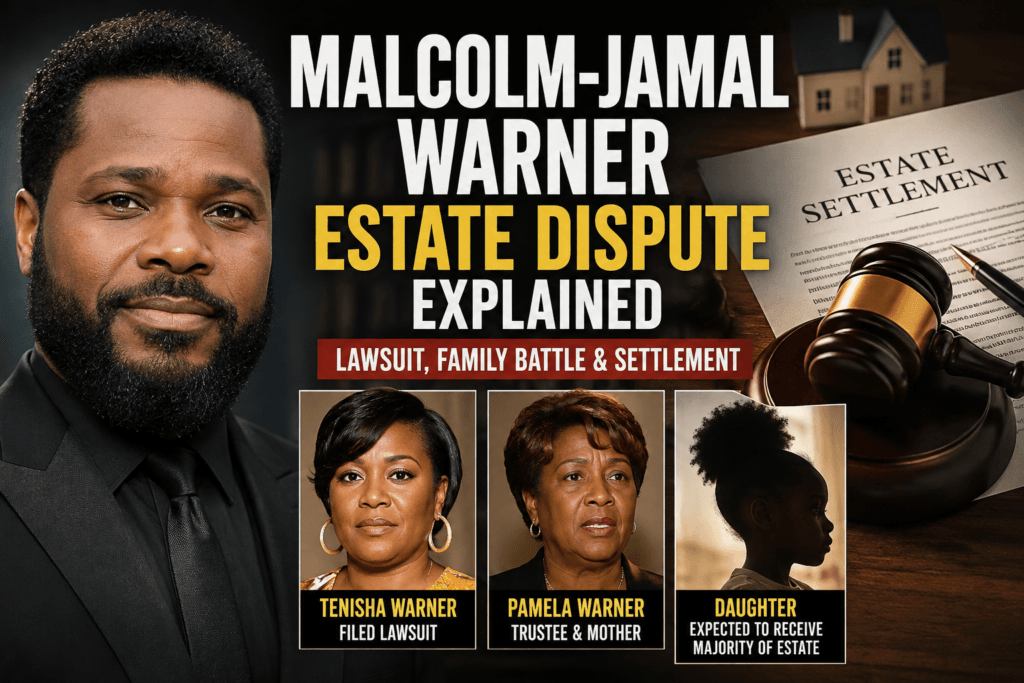
The legal dispute over Malcolm-Jamal Warner’s estate has become a major story after his death. Warner died at 54 in July 2025. His death left behind his wife, Tenisha Warner, their daughter, and his mother, Pamela Warner.
The Malcolm-Jamal Warner estate later became the subject of legal action. Tenisha Warner says Malcolm owed her money under their prenuptial agreement. She also says he planned to update his estate documents before his death. Those changes never became part of a completed estate plan, according to her claims.
The dispute has since taken a new turn. Pamela Warner and representatives for her granddaughter reportedly reached a settlement. The agreement would give the majority of Malcolm-Jamal Warner’s estate to his daughter. However, the court must still approve the agreement.
The case involves more than a family disagreement. It includes a prenuptial agreement, life insurance, retirement contributions, estate documents, and claims about unpaid compensation. Understanding those separate issues helps explain why the dispute became complicated.
Malcolm-Jamal Warner Estate Dispute: What Happened?
Malcolm-Jamal Warner’s estate became the focus of a legal dispute after his death in July 2025. Warner died during a family vacation in Costa Rica after an accidental drowning. He was 54.
About a year later, Tenisha Warner filed legal claims involving Malcolm’s estate. She also sued Pamela Warner, who served as the successor trustee connected to the Warner Family Trust.
Tenisha says Malcolm failed to meet several financial obligations from their prenuptial agreement. Her lawsuit seeks more than $1.2 million. The reported amount includes a $1 million life-insurance obligation, unpaid anniversary payments, Roth IRA contributions, and compensation for work she performed for Malcolm.
The estate dispute also involves Malcolm’s daughter. Tenisha says Malcolm planned to change his older estate arrangements. She claims he wanted to provide greater financial protection for his wife and daughter. However, he died before completing those changes.
Pamela Warner has offered a different perspective on the family’s financial plans. She has said Malcolm wanted to provide for his daughter and had made plans for her future.
Recent reports indicate that representatives for Malcolm’s daughter reached a settlement with Pamela Warner. The agreement would give the daughter most of the estate. The court must approve the agreement before it becomes final.
Why the Estate Became a Legal Issue
The dispute grew from a gap between Malcolm’s existing estate documents and the changes Tenisha says he planned to make.
Reports say Malcolm had an estate plan dating back to 1996. Tenisha claims he later intended to update that plan. She says the new plan would give her and their daughter greater protection.
However, Malcolm died before he completed those changes. That left the older estate arrangements in place. The existing documents then became important in the dispute.
This issue also differs from Tenisha’s claims under the prenuptial agreement. The prenup involved specific financial commitments between Malcolm and Tenisha. Those commitments included insurance, retirement savings, annual payments, and compensation.
The estate documents raised a different question. They determined how Malcolm’s assets and trust interests would pass after his death.
That distinction matters in estate disputes. A person’s plans or private statements do not always change a legally executed estate document. Courts often must examine the documents that existed when the person died.
Pamela Warner has also defended her position. She has said her son made plans for his family. She has stressed that his daughter remained an important part of those plans.
The reported settlement now shifts attention toward Malcolm’s daughter and the final distribution of his estate.
Who Was Malcolm-Jamal Warner?
Malcolm-Jamal Warner was an actor, director, musician, and poet. He became famous as Theo Huxtable on The Cosby Show. The NBC sitcom ran from 1984 to 1992.
The role made Warner a familiar face to American television audiences. It also earned him a Primetime Emmy nomination.
Warner later expanded his career beyond acting. He directed episodes of The Cosby Show and worked on several other television productions. His credits included Malcolm & Eddie, The Fresh Prince of Bel-Air, Kenan & Kel, and All That.
Malcolm-Jamal Warner also built a career in music and poetry. His later acting work included Reed Between the Lines and The Resident. On The Resident, he played Dr. AJ Austin.
Warner also earned a Grammy Award in 2015. He shared the award with the Robert Glasper Experiment and Lalah Hathaway for their work on “Jesus Children.”
Malcolm-Jamal Warner career therefore extended far beyond his best-known childhood television role. Warner continued working in entertainment for decades.
Malcolm-Jamal Warner private family life received less public attention. That changed after his death and the legal dispute involving his estate.
Malcolm-Jamal Warner’s Family and Personal Life
Malcolm-Jamal Warner was married to Tenisha Warner. The couple had a daughter and kept much of their family life private.
Celebrity marriages often attract public attention, especially when family life remains private. Anna Osceola’s relationship with Jon Hamm offers another example of a celebrity couple whose personal life has drawn interest from fans and media.
After Malcolm’s death, Tenisha faced the loss of her husband while caring for their daughter. She also became involved in the financial and legal issues surrounding his estate.
A later fundraising campaign highlighted some of those financial concerns. Tenisha’s friend, Destiny Rael, launched a GoFundMe campaign for Tenisha and her daughter. The campaign came amid the estate dispute.
The legal proceedings also brought Pamela Warner into the public spotlight. Pamela is Malcolm’s mother and served as the successor trustee connected to his estate arrangements.
Malcolm had a long relationship with his mother. His parents divorced when he was young, and Pamela raised him in Los Angeles.
Still, family history does not decide the legal issues in the estate case. The key questions involve the documents, financial agreements, and claims made by the parties.
The Malcolm-Jamal Warner estate later became the subject of legal action. Representatives for the child reportedly reached a settlement with Pamela Warner. The agreement would give the daughter the majority of the estate.
The court must still approve that agreement. Until then, the settlement remains a proposed resolution rather than a completed final distribution.
Why Did Tenisha Warner Sue Pamela Warner?
Tenisha Warner’s lawsuit focuses on financial obligations she says Malcolm-Jamal Warner agreed to meet. She says those obligations came from their prenuptial agreement.
Tenisha filed the lawsuit against Pamela Warner, who served as the successor trustee of the Warner Family Trust. She also filed a creditor’s claim against Malcolm’s estate.
The lawsuit seeks more than $1.2 million. Reports put the total claim at $1,276,042.46. Tenisha also seeks interest and legal fees.
The claim includes several separate financial issues. The largest involves a reported $1 million life-insurance obligation. Other claims involve anniversary payments, Roth IRA contributions, and compensation for work Tenisha performed for Malcolm.
Tenisha argues that these obligations survived Malcolm’s death. She wants the estate or trust to address the amounts she says remained unpaid.
The lawsuit also raises questions about Malcolm’s estate plan. Tenisha says Malcolm intended to update his estate documents. She claims he wanted to provide more protection for her and their daughter.
However, that issue differs from her claims under the prenup. The prenuptial agreement created specific financial commitments between the couple. The estate plan addressed the distribution of Malcolm’s assets after his death.
These claims remain allegations from Tenisha’s legal filings. The reported dollar amounts do not represent a final court judgment.
What Tenisha Warner Says She Was Owed
Tenisha’s claims come from several provisions in the couple’s premarital agreement.
According to reports, Malcolm agreed to maintain a $1 million term life-insurance policy on himself. The agreement reportedly named Tenisha as the sole beneficiary.
The agreement also included another $1 million insurance provision involving Tenisha. Malcolm would serve as the preferred beneficiary under that arrangement.
Tenisha says Malcolm did not establish the required policies. She therefore seeks compensation connected to the alleged insurance obligation.
The prenup also included annual payments. Tenisha says Malcolm agreed to pay her $16,000 each year around their wedding anniversary.
She also says he agreed to make the maximum annual contribution to a Roth IRA in her name. The lawsuit reportedly values the unpaid contributions at $30,500.
Another provision involved Tenisha’s work for Malcolm. She says Malcolm agreed to pay her $5,000 each month for her work as his chief of staff and assistant.
The reported unpaid compensation totals about $195,000.
Together, these claims make up the reported $1,276,042.46 total. Tenisha also seeks interest and attorney fees.
These figures come from her lawsuit. They do not show that a court has already ruled in her favor.
The $1 Million Life Insurance Dispute
The life-insurance claim makes up a large part of Tenisha Warner’s lawsuit.
According to the reported terms of the prenup, Malcolm agreed to maintain a $1 million term life-insurance policy on his life. Tenisha would receive the policy benefit as the sole beneficiary.
The agreement reportedly included a separate $1 million insurance requirement for Tenisha. Malcolm would serve as the preferred beneficiary for that policy.
Tenisha alleges that Malcolm never secured the required policies. That claim became especially important after his death in 2025.
A life-insurance policy can provide direct financial protection after someone’s death. Tenisha argues that Malcolm’s failure to maintain the required coverage left her without that protection.
Her lawsuit therefore seeks the value connected to the alleged obligation. The claim does not mean that an insurer currently owes Tenisha $1 million. Instead, she is seeking recovery through the legal proceedings.
The exact legal treatment of such an obligation depends on the agreement and applicable law. The available reports do not establish a final court ruling on this issue.
The insurance dispute also shows why the prenup became central to the case. The agreement reportedly created specific promises. Those promises required Malcolm to take additional steps during his lifetime.
His death left questions about whether those steps occurred and what remedy might apply.
What Was in Malcolm-Jamal Warner’s Prenuptial Agreement?
Malcolm-Jamal Warner and Tenisha Warner signed a prenuptial agreement before their 2022 marriage. The agreement reportedly addressed several financial matters.
Those provisions covered life insurance, retirement savings, annual payments, compensation, and family expenses.
The prenup became important after Malcolm’s death. Tenisha argues that several promised payments and financial arrangements remained incomplete.
Her lawsuit does not simply challenge the existence of the agreement. Instead, she claims Malcolm failed to fulfill obligations contained in it.
According to reports, the agreement required Malcolm to maintain certain insurance coverage. It also required annual payments to Tenisha and contributions to her Roth IRA.
The agreement reportedly included compensation for Tenisha’s work as well. She says Malcolm agreed to pay her $5,000 each month for her professional duties.
The document also addressed financial support for the couple’s children. That provision adds another connection between the prenup and the family’s long-term financial planning.
However, the lawsuit’s main financial claim focuses on amounts Tenisha says Malcolm failed to provide.
The reported total reaches $1,276,042.46. Tenisha also seeks interest and legal costs.
It is important to separate these claims from established facts. The figures come from Tenisha’s complaint and reports based on that filing.
A court would need to determine which obligations apply and whether the estate must pay them.
Anniversary Payments, IRA Contributions and Other Claims
The life-insurance dispute is not the only financial issue in Tenisha Warner’s lawsuit.
Tenisha says the prenup required Malcolm to make a $16,000 payment each year around their wedding anniversary. Her lawsuit reportedly includes more than $50,000 in unpaid anniversary payments.
She also claims Malcolm agreed to make the maximum annual contribution to a Roth IRA in her name. The reported value of those unpaid contributions is $30,500.
Another claim concerns Tenisha’s work for Malcolm. She says he agreed to pay her $5,000 each month.
Tenisha worked as Malcolm’s chief of staff and assistant, according to the lawsuit. She claims that Malcolm did not pay all of the compensation required under their agreement.
Reports place the unpaid compensation at roughly $195,000.
These amounts help explain the lawsuit’s overall value. The case does not involve one disputed payment. Instead, it combines several alleged unpaid obligations.
Tenisha’s complaint also seeks interest and attorney fees. She has asked the court to protect the relevant trust assets while the dispute continues.
The reported figures remain claims from the lawsuit. They do not represent a final judgment against Malcolm’s estate or Pamela Warner.
That distinction matters as the estate case moves forward. The parties may resolve some issues through settlement rather than a court ruling.
Why Did the 1996 Estate Plan Matter?
Malcolm-Jamal Warner’s estate plan dates back to 1996. He created the Warner Family Trust when he was 26 years old. That was long before he met Tenisha Warner or became a father.
According to court filings cited by news outlets, the trust divided his assets among members of his family. Pamela Warner held the largest share at 70%. Malcolm’s father, Robert Warner Jr., received 15%. His half-sister, Collage, received the remaining 15%.
Those arrangements became important after Malcolm’s death. Tenisha argued that the trust no longer reflected his family situation or his wishes.
The timing also mattered. Malcolm created the trust decades before his marriage. He also created it before the birth of his daughter. As a result, the document did not reflect the family he had later built with Tenisha.
Tenisha’s legal filings argue that the old trust provided little protection for her or their daughter. She said Malcolm wanted to replace the older plan with a new one.
The dispute does not mean the 1996 trust was automatically invalid. Instead, it created a conflict between the existing legal documents and the changes Tenisha says Malcolm planned.
That difference now sits at the center of the estate battle. The court must consider the documents that Malcolm actually completed, along with the separate claims raised under the couple’s prenup.
Malcolm-Jamal Warner’s Intended Estate Update
Tenisha Warner says Malcolm planned to update his estate arrangements before his death.
In a statement shared after she filed her lawsuit, Tenisha said Malcolm was close to completing a new estate plan. She described the 1996 trust as an outdated plan from a very different stage of his life.
According to Tenisha, the proposed changes would have included financial protection for her and their daughter. She said Malcolm wanted to make sure their daughter received proper support.
However, Malcolm died before he could complete the changes. That left the older trust in place.
This point creates an important legal distinction. A planned estate change does not necessarily have the same effect as a signed and valid estate document. Tenisha can describe Malcolm’s intentions, but the existing documents still carry legal weight unless a court finds another basis for changing them.
Reports also indicate that Tenisha pursued legal action to protect her claims. She asked the court to stop the distribution of trust assets while the dispute continued.
Her position was not limited to the estate plan. She also pursued the financial obligations that she says Malcolm accepted in their 2022 prenuptial agreement.
The two issues therefore became connected. One concerned Malcolm’s intended future estate plan. The other concerned financial commitments that Tenisha says Malcolm had already made.
What Did Pamela Warner Say About the Estate Dispute?
Pamela Warner eventually addressed the public controversy surrounding her son’s estate.
In a statement reported in August 2026, Pamela rejected claims that she tried to block financial support for her granddaughter. She said Malcolm had made detailed plans for the people he loved.
Pamela also said Malcolm made separate financial provisions for his wife and daughter. At the same time, she acknowledged that the Warner Family Trust divided assets among other relatives.
Her comments offer a different view of the estate dispute. Tenisha has argued that the old trust did not reflect Malcolm’s final wishes. Pamela says her son had been deliberate about planning for his family.
These positions are important because they address different parts of the dispute. Tenisha focuses on the gap between the old trust and Malcolm’s later family life. Pamela focuses on the broader estate planning that she says Malcolm had already completed.
Neither position alone determines the final legal outcome.
The court will ultimately decide how the relevant legal documents and claims affect the estate. The proposed settlement involving Malcolm’s daughter could resolve part of the dispute, but it still requires approval.
Pamela Warner’s Position on Her Granddaughter’s Inheritance
Pamela Warner has emphasized that Malcolm’s daughter was always important to his financial plans.
Questions about celebrity parents and their children’s futures often become part of wider public discussions. Angelina Jolie’s views on motherhood and her children’s future provide another example of a celebrity openly discussing family responsibilities and long-term concerns.
She said recent claims suggesting that she wanted to prevent her granddaughter from receiving support were untrue. Pamela also said Malcolm had planned for his loved ones and wanted his daughter to have financial security.
That statement came as the estate dispute received renewed attention. It also followed Tenisha’s public comments about struggling to support their daughter after Malcolm’s death.
Pamela’s position is significant because she serves as successor trustee of the Warner Family Trust. Her role gives her responsibility for handling trust matters. It also placed her at the center of Tenisha’s legal claims.
The two women have therefore presented different accounts of the estate situation.
Tenisha says Malcolm intended to replace the 1996 trust with a newer plan. She also says the existing arrangements did not provide enough support for her or their daughter.
Pamela says Malcolm had already made thoughtful plans for his family. She has denied trying to deprive her granddaughter of financial support.
The latest settlement suggests that both sides have moved toward a practical resolution for Malcolm’s daughter. Under the proposed agreement, the daughter would receive the majority of the remaining trust and estate. The settlement would also cover her college tuition.
However, the agreement still needs court approval. Until that happens, the proposed terms should not be treated as a final distribution.
The settlement also does not erase the separate financial claims raised by Tenisha. Those claims remain part of the wider estate dispute.
Malcolm-Jamal Warner Estate Settlement: What We Know Now
The estate dispute has recently moved toward a possible settlement. Pamela Warner said she reached an agreement with representatives for her granddaughter. The proposed deal would give Malcolm-Jamal Warner’s daughter the majority of his estate. The agreement still needs court approval.
The development changes the focus of the estate case. Earlier reports centered on Tenisha Warner’s lawsuit and her claims under the couple’s prenup. The latest reports instead highlight the financial future of Malcolm’s daughter.
Pamela said the settlement reflects her son’s wishes for his child. She has also denied claims that she tried to prevent her granddaughter from receiving financial support.
The proposed agreement does not mean every dispute has received a final court ruling. Court approval remains necessary before the settlement can take effect.
The case also shows why estate planning can become difficult after an unexpected death. Malcolm reportedly intended to revise his older estate plan. He died before signing the updated documents. That left his family dealing with the older trust and separate financial claims under the prenup.
For now, the settlement represents a possible path toward resolving the estate issues involving Malcolm’s daughter. The final outcome will depend on the court’s review.
What the Settlement Could Mean for His Daughter
Malcolm-Jamal Warner’s daughter stands at the center of the latest settlement. Reports say the agreement would give her the majority of her father’s estate.
That outcome could provide the financial protection Tenisha says Malcolm wanted for their child. Tenisha has said Malcolm planned to update his estate documents before his death. She claims the new plan would have included both her and their daughter.
The settlement also reportedly addresses the child’s future expenses. Pamela has said Malcolm wanted his daughter to receive financial support and have access to the resources he intended for her.
However, readers should separate the proposed settlement from the earlier allegations. The agreement still requires court approval. Its final terms may also depend on the court’s review of the child’s interests.
The reported settlement does not automatically resolve Tenisha’s separate claims. Her lawsuit concerns financial obligations that she says Malcolm accepted under their premarital agreement.
The settlement therefore appears to address a major part of the family dispute. It also gives the child a clearer path toward receiving assets from her father’s estate.
The GoFundMe for Tenisha Warner and Her Daughter
The estate dispute also led to a public fundraising campaign for Tenisha Warner and her daughter.
Destiny Rael, a longtime friend of Tenisha, launched the GoFundMe in August 2026. Rael said she created the campaign because Tenisha faced major emotional and financial pressure after Malcolm’s death.
The fundraiser originally set a $40,000 goal. Reports said it had raised more than $35,000 by August 12. The campaign sought help with household costs, legal expenses, and financial stability for Tenisha and her daughter.
Rael also described problems at the family’s home. She said unexpected flooding damaged the house after Tenisha returned from Costa Rica following Malcolm’s death.
The campaign also highlighted Tenisha’s role as a parent. According to Rael, Tenisha had been homeschooling the couple’s nine-year-old daughter while dealing with the estate dispute.
The fundraiser does not determine any legal rights in the estate case. It reflects the family’s reported financial situation while the legal process continues.
Celebrity families often face intense public attention when personal circumstances become part of the news cycle. Gigi Hadid’s career and family life have also remained subjects of widespread public interest.
Why Financial Support Became Part of the Story
Tenisha’s financial situation became part of the public discussion because the estate dispute remained unresolved.
Her friend said Tenisha had spent the year dealing with grief, parenting, legal costs, and household problems. The fundraiser aimed to give her some financial breathing room during that period.
Tenisha also says Malcolm failed to complete several financial commitments from their prenup. Those claims include the disputed $1 million life-insurance obligation and other payments.
The fundraiser therefore emerged alongside, but separately from, the court case. Donations do not replace the legal claims. They also do not establish whether Tenisha will ultimately recover the amount requested in her lawsuit.
The campaign instead offers immediate support while the legal issues work through the courts.
That distinction matters. The GoFundMe reflects the family’s reported needs. The lawsuit concerns legal rights and financial obligations.
Together, the two developments show the personal impact of the estate dispute. Tenisha has had to manage the aftermath of Malcolm’s death while seeking financial protection for herself and their daughter.
The proposed settlement now offers a separate development for their child. If the court approves it, the agreement could provide the daughter with the majority of her father’s estate.
Malcolm-Jamal Warner Estate Dispute Timeline
The estate dispute developed over several years. The key events help explain why the case became so complicated.
1996: Malcolm created the Warner Family Trust. He was 26 at the time. The trust later became central to the estate dispute.
2022: Malcolm and Tenisha signed their premarital agreement before their marriage. The agreement included several financial obligations. Those provisions later formed the basis of Tenisha’s lawsuit.
July 20, 2025: Malcolm died at age 54 after an accidental drowning during a family vacation in Costa Rica.
July 2026: Tenisha filed legal action against Pamela Warner. She sought more than $1.2 million based on alleged unpaid obligations under the prenup. She also filed a creditor’s claim against the estate.
August 2026: Destiny Rael launched a GoFundMe campaign for Tenisha and her daughter. The campaign cited financial pressure, legal costs, and damage to the family home.
August 2026: Pamela Warner announced a settlement with representatives for Malcolm’s daughter. The proposed agreement would give the daughter the majority of the estate. Court approval remains pending.
This timeline shows how the dispute moved from estate planning concerns to litigation and, most recently, a possible settlement.
What Happens Next in the Malcolm-Jamal Warner Estate Case?
The next major step involves court approval of the reported settlement. Pamela Warner and representatives for Malcolm-Jamal Warner’s daughter have reached an agreement, but the court must still review it.
The proposed settlement would give Malcolm’s daughter the majority of his estate. It also reflects the family’s effort to protect the child’s financial future after his death.
However, the settlement should not be treated as a final court order until approval occurs. The court’s review remains an important part of the process.
Tenisha Warner’s separate financial claims also remain relevant. Her lawsuit focused on obligations she says Malcolm accepted under their prenuptial agreement. Those claims included life insurance, anniversary payments, Roth IRA contributions, and compensation for her work.
The estate settlement and Tenisha’s claims involve related family circumstances. However, they address different legal issues. The settlement focuses on Malcolm’s daughter’s interest in the estate. Tenisha’s lawsuit focuses on alleged financial obligations to her.
That distinction will remain important as the case develops.
What Readers Should Watch For
The most important development to watch is the court’s decision on the proposed settlement.
If the court approves the agreement, Malcolm’s daughter could receive the majority of his estate under the reported terms. That would represent a major change from the uncertainty that followed Malcolm’s death.
Readers should also watch for additional court filings. Those documents may clarify the settlement terms and the status of any remaining claims.
Another important point involves the distinction between reported intentions and completed legal documents. Tenisha has said Malcolm planned to update his estate plan. Yet he died before completing those changes.
The final legal outcome will depend on the documents, agreements, court decisions, and settlements involved in the case.
For now, the proposed settlement offers a path toward resolving the estate issues surrounding Malcolm’s daughter. It does not erase the separate financial claims raised by Tenisha.
Frequently Asked Questions About Malcolm-Jamal Warner
Who was Malcolm-Jamal Warner?
Malcolm-Jamal Warner was an American actor, director, musician, and poet. He became famous for playing Theo Huxtable on The Cosby Show. He later appeared in shows such as Malcolm & Eddie, Reed Between the Lines, and The Resident. Warner also worked as a director and musician during his long entertainment career.
How did Malcolm-Jamal Warner die?
Malcolm-Jamal Warner died in July 2025 at age 54. He died after an accidental drowning during a family vacation in Costa Rica. His death later led to legal questions involving his estate and family financial arrangements.
Who was Malcolm-Jamal Warner married to?
Malcolm-Jamal Warner was married to Tenisha Warner. The couple had a daughter and kept much of their family life private. After Malcolm’s death, Tenisha became involved in legal proceedings concerning financial obligations and his estate. Celebrity marriages can also become major public stories, as seen in the relationship of Jordyn Woods and Karl-Anthony Towns.
Who is Pamela Warner?
Pamela Warner is Malcolm-Jamal Warner’s mother. She also served as the successor trustee connected to the Warner Family Trust. Her role placed her at the center of the estate dispute after Tenisha Warner filed legal claims.
Why did Tenisha Warner sue Pamela Warner?
Tenisha Warner sued over financial obligations that she says Malcolm accepted under their prenuptial agreement. Her claims included life insurance, anniversary payments, Roth IRA contributions, and compensation for work she performed for Malcolm.
How much money was involved in the estate dispute?
Tenisha Warner’s lawsuit reportedly sought $1,276,042.46, plus interest and legal fees. The claimed amount included several separate financial obligations. The figure comes from her legal complaint and does not represent a final court judgment.
What happened to Malcolm-Jamal Warner’s estate?
The estate became the subject of a dispute involving Tenisha Warner, Pamela Warner, and Malcolm’s daughter. Tenisha challenged financial obligations and estate arrangements. More recently, Pamela and representatives for the daughter reportedly reached a settlement.
Has the Malcolm-Jamal Warner estate dispute been settled?
A proposed settlement has reportedly been reached between Pamela Warner and representatives for Malcolm’s daughter. However, the agreement still requires court approval. Therefore, it should not yet be described as a fully finalized court-approved settlement.
Who is expected to receive the majority of the estate?
Malcolm-Jamal Warner’s daughter is expected to receive the majority of his estate under the reported settlement. The agreement still requires court approval before the reported distribution becomes final.
Final Takeaway
The Malcolm-Jamal Warner estate dispute grew from a complicated mix of family relationships, estate documents, and financial agreements.
Warner created his original trust decades before his marriage and the birth of his daughter. Later, he married Tenisha and entered into a prenuptial agreement with several financial provisions.
After his death in 2025, those older estate documents and later financial commitments became the focus of legal claims. Tenisha argued that Malcolm owed her money under their agreement. She also said he intended to update his estate plan before his death.
Pamela Warner offered a different account. She said Malcolm had made plans for his family and wanted to provide for his daughter.
The latest development points toward a possible resolution. Pamela and representatives for Malcolm’s daughter reportedly reached a settlement that would give the child the majority of the estate.
That agreement still needs court approval. As a result, the final outcome remains tied to the legal process.
For now, the clearest takeaway is that Malcolm-Jamal Warner’s estate dispute has moved from a contested family and financial matter toward a possible settlement. The next major development will be the court’s decision on that agreement.