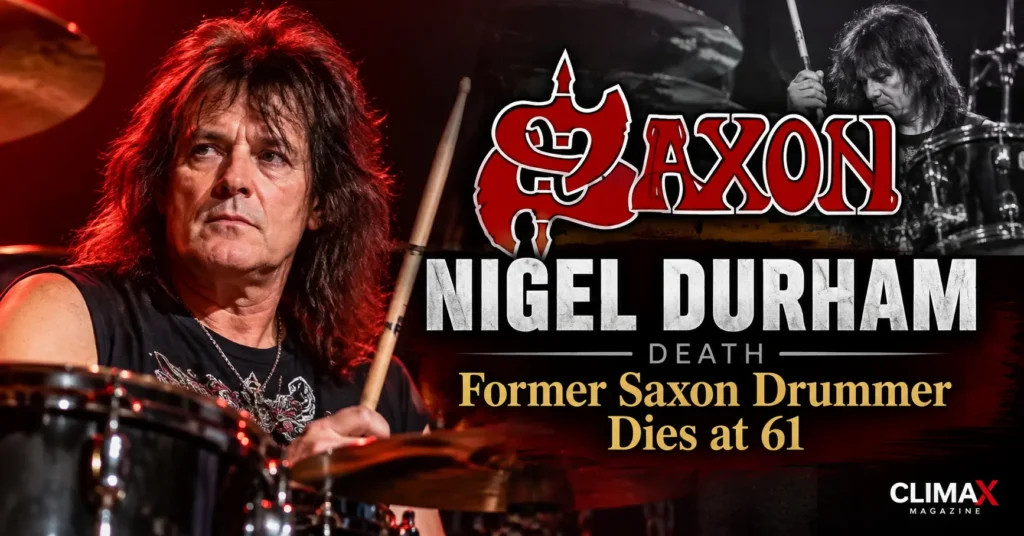
The Nigel Durham death news has drawn attention from rock and heavy metal fans worldwide. Nigel Durham, the former drummer for British heavy metal band Saxon, died at the age of 61. The band announced his death on October 24, 2026, prompting tributes from fellow musicians and fans.
Durham played with Saxon from 1987 to 1988 and performed on the band’s 1988 album Destiny. Although his time with the group was relatively short, he remained connected to the heavy metal scene through his later work with other bands.
The band has not publicly disclosed Nigel Durham’s cause of death. His passing has also brought renewed attention to an unusual event earlier in 2026, when Durham personally denied false reports claiming that he had died.
Beyond Saxon, Durham worked with Oliver/Dawson Saxon and Morpheus Rising. His musical journey and connections within the rock community have become important parts of the tributes following his death.
Nigel Durham Death Confirmed by Saxon
Saxon confirmed Nigel Durham’s death through a social media announcement on October 24, 2026. The British heavy metal band remembered him as part of the wider Saxon family and shared condolences with his loved ones.
The announcement also acknowledged Durham’s family, including his wife, Lauretta, his daughter, Gemma, and his grandchildren. The band focused on offering support to those closest to him rather than discussing the circumstances surrounding his death.
Durham joined Saxon in 1987 and played drums on Destiny, released in 1988. The album remains part of the band’s musical history and represents an important recording credit from his career.
News of his passing quickly spread among rock and metal fans. Fellow musicians also shared messages of remembrance, including Saxon drummer Nigel Glockler, who expressed affection for his former colleague and offered support to Durham’s family.
Although Durham’s time with Saxon lasted approximately a year, his musical career continued beyond the band. He later worked with other groups, maintaining his connection to the heavy metal community.
His death has encouraged fans to revisit his contributions and remember a musician whose career extended beyond his association with one well-known band.
What Was Nigel Durham’s Cause of Death?
The Nigel Durham death announcement confirmed that the former Saxon drummer had died at the age of 61. However, his cause of death has not been publicly disclosed in the available reports as of October 25, 2026. Saxon confirmed his passing but did not explain the circumstances surrounding it.
The band’s initial announcement also did not provide a specific location or date of death. Therefore, important details about what happened remain unknown.
For readers searching for Nigel Durham’s cause of death, it is important to separate confirmed information from online speculation. Without a statement from his family, representatives, or another reliable source, claims about an illness, accident, or other possible cause should not be treated as fact.
Saxon extended its condolences to Durham’s family, and fellow musicians joined fans in remembering him. However, these tributes do not provide further information about the circumstances of his death.
The confirmed details currently available are:
- Age: 61.
- Announcement date: October 24, 2026.
- Cause of death: Not publicly disclosed.
- Family: His wife, Lauretta, daughter, Gemma, grandchildren, and other relatives.
Until reliable information becomes available, the most accurate approach is to acknowledge what has been confirmed without making assumptions.
Respecting the family’s privacy is also important while details remain unavailable. If the family or band releases additional information, future reporting can clarify the circumstances without relying on rumors.
Why Nigel Durham’s Death News Is Drawing Attention
Nigel Durham’s death has attracted attention because of his connection to Saxon and the unusual history of false death reports earlier in 2026.
In April, rumors circulated online claiming that the drummer had died. These reports caused confusion among fans who followed his career and wanted to know whether the news was accurate.
On July 14, 2026, Durham addressed the situation through a Facebook post and confirmed that he was alive. His statement contradicted the earlier reports and reassured people who had become concerned.
However, Saxon’s announcement on October 24 confirmed that Durham had subsequently died. The difference between these two events is important: the earlier reports were false, while the later announcement came from his former band.
The news has also renewed interest in Durham’s musical background. Many fans associate him with Destiny, Saxon’s 1988 album, while others remember his work with Oliver/Dawson Saxon and Morpheus Rising.
For the heavy metal community, his death provides an opportunity to revisit his career and recognize his contribution to the genre. His story also highlights how quickly misinformation can spread online and why readers should look for reliable confirmation before accepting reports about someone’s death.
As tributes continue, fans can remember Durham through his recordings, his musical collaborations, and his place in Saxon’s history.
Nigel Durham’s Earlier Death Rumors Explained
The story surrounding Nigel Durham’s death became particularly confusing because false reports about his passing circulated months before Saxon confirmed the news. These earlier claims led fans to question what had happened and whether the information being shared online was reliable.
In April 2026, reports claiming that Durham had died began circulating among rock and metal followers. However, those claims did not reflect the truth at the time. Durham later addressed the rumors himself, making it clear that he was still alive.
The earlier misinformation is an important part of the timeline because it explains why news of his death in October attracted additional attention. Fans who remembered his previous denial needed to distinguish that incident from the later announcement by Saxon.
The key point is that the April reports were false, while Saxon’s October announcement confirmed Durham’s death at age 61. These were separate events, months apart, and should not be confused with one another.
The False Reports That Circulated in April 2026
In April 2026, claims about Nigel Durham’s death circulated online and caused concern among people familiar with his career. The reports suggested that the former Saxon drummer had died, but Durham subsequently made clear that the information was incorrect.
The incident demonstrated how quickly unverified celebrity death claims can spread through social media and entertainment news discussions. When one post makes a serious claim, other accounts may repeat it before anyone checks whether the information is accurate.
For fans, the reports created uncertainty about Durham’s well-being. However, the claims did not establish that anything had happened to him. His later response provided direct clarification and contradicted the rumors.
The April incident also became relevant months later. When Saxon announced Durham’s death in October, people familiar with the earlier misinformation had reason to revisit the timeline and look for reliable confirmation.
The distinction matters for accurate reporting. The earlier claims were false when they circulated, and they should not be presented as an initial confirmation of his eventual death.
Nigel Durham’s July Statement Denying the Rumors
On July 14, 2026, Nigel Durham personally addressed the death rumors through a Facebook post. His statement confirmed that he was alive and directly challenged the misinformation circulating about him.
The response gave fans a clear answer rather than leaving them to rely on conflicting online claims. It also established an important reference point for understanding the events that followed later in the year.
Durham’s statement was particularly significant because it came directly from him. Unlike an anonymous post or an unverified report, his own response provided a clear correction to the claims about his death.
However, that July statement reflected the situation at the time. It should not be interpreted as contradicting Saxon’s later announcement, which confirmed that Durham had died by October 24, 2026.
Together, the two events illustrate why dates and original statements matter when reporting breaking news. A claim can be false when first circulated, while a later announcement can confirm a genuine development.
Nigel Durham Death Timeline: April to October 2026
The following timeline separates the earlier false reports from the confirmed announcement of Nigel Durham’s death.
| Date | Event | Significance |
|---|---|---|
| April 2026 | False reports claimed that Nigel Durham had died. | The claims were incorrect. |
| July 14, 2026 | Durham addressed the rumors in a Facebook post. | He confirmed that he was alive. |
| October 24, 2026 | Saxon announced Durham’s death at age 61. | The band confirmed the later development. |
| October 25, 2026 | Coverage of his death continued. | Fans and readers sought information about his career and the circumstances of his passing. |
This sequence helps explain why the news generated renewed interest. The earlier reports had already placed Durham’s name in discussions about celebrity death rumors, but his July statement corrected the misinformation.
The October announcement was different because it came from Saxon and confirmed his death. The band’s statement also prompted renewed interest in his musical history, including his time with the group and his work on the Destiny album.
As of October 25, 2026, the cause of death had not been publicly disclosed in the reporting available for this article. Therefore, the timeline establishes the sequence of announcements without suggesting an explanation for his passing.
The central lesson is straightforward: readers should distinguish between unverified claims, direct corrections, and later announcements from reliable sources. In Durham’s case, keeping those events separate provides a clearer and more accurate account of what happened.
Who Was Nigel Durham?
Nigel Durham was a British drummer best known for his time with Saxon, a prominent band in the New Wave of British Heavy Metal. He played with the group from 1987 to 1988 before continuing his career with other rock and heavy metal acts.
His musical journey extended beyond Saxon through performances and recordings with several groups. He became particularly associated with Oliver/Dawson Saxon, formed by former Saxon members Graham Oliver and Steve Dawson. In 2013, Durham also joined the British hard rock band Morpheus Rising.
These projects allowed Durham to continue performing alongside musicians connected to the British rock and metal scene. His career illustrates how a musician’s contribution can extend beyond a single band’s lineup, encompassing different collaborations, recordings, and musical experiences.
The music industry offers many different paths for artists, from established heavy metal groups to emerging pop acts. Readers interested in another group’s journey can explore our KATSEYE members and their rise to fame guide, covering the group’s music and SNL debut.
Following news of Nigel Durham’s death at 61, fans have revisited his musical background and contributions to the bands with which he performed. Although his time with Saxon was relatively brief, his subsequent projects formed an important part of his professional history.
His career provides a broader picture of his place in British rock and heavy metal, extending beyond his best-known association with Saxon.
Nigel Durham’s Years With Saxon
Nigel Durham joined Saxon in 1987, replacing drummer Nigel Glockler during a period when the band continued developing its sound and recording new material. Durham remained with the group until 1988, contributing to an important release in its discography.
His time with Saxon coincided with the production of Destiny, the band’s ninth studio album. Released in 1988, the record included Durham’s drumming and remains the best-known recording associated with his brief tenure.
Although Durham did not remain with Saxon for an extended period, his involvement connected him to a band with an established following in the British heavy metal scene. Saxon’s music had reached audiences through its energetic performances and association with the New Wave of British Heavy Metal.
Durham’s departure did not end his career as a professional drummer. Instead, he continued working with other musicians and projects, including groups featuring former members of Saxon.
His later association with Oliver/Dawson Saxon also maintained his connection to the band’s history. That group operated separately from Saxon while drawing on the musical backgrounds of former members.
For fans researching Nigel Durham’s career, his Saxon years provide the clearest starting point. They explain his connection to Destiny and help place his later recording and performance work within the wider British rock scene.
His Contribution to the Destiny Album
Destiny was released in 1988 and marked an important point in Saxon’s recording career. Nigel Durham played drums on the album after joining the band the previous year.
The record stands out in Durham’s discography because it documents his work with Saxon during his relatively short time with the group. His participation also connects him to a specific period in the band’s evolution.
For listeners exploring the album today, Durham’s credit offers a direct link between his name and Saxon’s late-1980s output. It also helps explain why news of his death has prompted fans to revisit the band’s older recordings.
The album remains a useful starting point for anyone wanting to hear Durham’s documented work with Saxon. Rather than relying only on later tributes, listeners can explore the music itself and understand the recording for which he is best known.
Although his time with the band was brief, Destiny remains a significant part of his professional legacy.
Nigel Durham’s Work Beyond Saxon
After leaving Saxon in 1988, Nigel Durham continued his career through collaborations with other rock and heavy metal musicians. His later work included Son of a Bitch, Oliver/Dawson Saxon, and Morpheus Rising.
These projects allowed him to remain active in music while working with performers who shared connections to the British metal scene. His career therefore extended across several decades rather than ending with his departure from Saxon.
Durham’s later recording credits also demonstrate that his professional history involved more than one album or band. He contributed to recordings and live performances while continuing to develop his experience as a drummer.
Among these projects, Oliver/Dawson Saxon became a particularly notable part of his post-Saxon career. He worked with the group for approximately a decade, giving him a longer association with that band than he had enjoyed with Saxon itself.
His later move to Morpheus Rising in 2013 added another chapter to his career. The group welcomed his experience and planned to work with him on rehearsals, live shows, and new music.
Together, these projects provide a fuller picture of Durham’s musical life and help explain why his death has resonated with people beyond Saxon’s immediate fan base.
Oliver/Dawson Saxon and Later Projects
Nigel Durham began working with Son of a Bitch in 1999. The group featured former Saxon members Graham Oliver and Steve Dawson and later became known as Oliver/Dawson Saxon.
Durham served as the group’s drummer from 2000 to 2010. During this period, he contributed to recordings including Re and It’s Alive, adding to his discography beyond the original Saxon lineup.
In August 2013, Morpheus Rising announced Durham’s arrival as its full-time drummer. The British hard rock band highlighted his experience with Saxon and Oliver/Dawson Saxon when welcoming him to the lineup.
The announcement also reflected the group’s plans to work on live performances and new material. Durham remained associated with Morpheus Rising until 2016, according to published career reports.
These later projects show how Durham continued performing after his time with Saxon. They also illustrate the professional relationships that connected musicians across different British rock and metal groups.
For listeners exploring his legacy, recordings from Oliver/Dawson Saxon and Morpheus Rising offer additional ways to discover his work beyond Destiny.
Nigel Durham’s Place in British Heavy Metal
The Nigel Durham death news has prompted fans to revisit his contribution to British heavy metal. Best known as a former Saxon drummer, Durham also performed with Oliver/Dawson Saxon and Morpheus Rising, extending his musical career beyond his time with Saxon.
Saxon became a prominent act in the New Wave of British Heavy Metal, a movement that helped shape the genre during the late 1970s and early 1980s. Durham joined the band in 1987 and played on Destiny, released in 1988, leaving a documented connection to Saxon’s late-1980s lineup.
After leaving Saxon, Durham continued working with other musicians. His years with Oliver/Dawson Saxon and later involvement with Morpheus Rising added further chapters to his career.
His journey highlights how musicians contribute to a genre through different bands, recordings, and collaborations. Although Durham’s time with Saxon was relatively brief, his subsequent projects expanded his professional history within the British rock and metal scene.
Following Nigel Durham’s death at 61, fans have an opportunity to revisit his recordings and remember his work across these groups. His musical legacy extends beyond a single band or album.
Heavy metal continues to bring established acts and newer performers together at live events. Readers interested in the genre’s festival scene can explore our Aftershock 2026 lineup guide for its headliners and scheduled bands.
Remembering His Musical Contributions
One way to understand the Nigel Durham death news is to explore the recordings connected to his musical career. His work on Destiny offers a starting point for Saxon fans, while albums such as Re://Landed and It’s Alive provide additional context for his time with Oliver/Dawson Saxon.
These recordings document his work more clearly than broad descriptions of his musical legacy. They also give listeners an opportunity to explore different periods of his career and the bands with which he performed.
His experience across several groups reflects the collaborative nature of rock music. Drummers contribute to a band’s sound through rhythm, timing, and performance, working closely with guitarists, bassists, and vocalists to bring songs to life.
That collaborative spirit remains central to today’s live music scene, where artists from different genres share major stages. Readers can explore our iHeartRadio Music Festival 2026 guide for the lineup, performance dates, and viewing options.
Although Durham’s time with Saxon was relatively brief, his continued involvement in music gave his professional career a wider scope. His work across different bands demonstrates his ongoing participation in the heavy metal scene.
As fans remember him following the October 2026 announcement, his recordings remain a lasting record of his contributions. Revisiting this music offers a meaningful way to remember Nigel Durham while respecting his family’s privacy.
What Nigel Durham’s Death Means for Saxon Fans
The Nigel Durham death news marks a moment of remembrance for fans who followed Saxon’s music and the wider British heavy metal scene. Although he played with the band for only a short period, his contribution to Destiny remains part of its recording history.
For longtime listeners, revisiting the album offers a direct connection to Durham’s time with Saxon. Fans can also explore his later work with Oliver/Dawson Saxon and Morpheus Rising to understand the broader scope of his musical career.
His story also highlights how musicians continue to build careers beyond their best-known bands. Durham worked with different groups over several decades, creating connections with fellow performers and listeners along the way.
Live performances also give music fans a way to connect with artists and discover their work beyond recorded albums. For readers interested in upcoming country music shows, our Zach Bryan Tour 2027 guide covers tour dates, cities, tickets, and special guests.
Following the announcement, Saxon expressed condolences to his family, while fellow drummer Nigel Glockler and other musicians shared messages of remembrance. These tributes reflect the relationships Durham developed throughout his career.
As fans remember him, his recordings and musical collaborations offer a meaningful way to celebrate his contribution. His legacy extends beyond one album or band, reflecting years of work within the rock and heavy metal community.
Frequently Asked Questions About Nigel Durham
How old was Nigel Durham when he died?
Nigel Durham was 61 when Saxon announced his death on October 24, 2026. The British drummer was best known for his time with Saxon and his contribution to the band’s 1988 album Destiny. He later continued performing with other rock and heavy metal groups.
What was Nigel Durham’s cause of death?
Nigel Durham’s cause of death has not been publicly disclosed in the available reports as of October 25, 2026. Saxon confirmed his death but did not provide details about the circumstances. Claims about a specific illness or other cause should not be treated as fact without reliable confirmation.
When did Saxon announce Nigel Durham’s death?
Saxon announced Nigel Durham’s death on October 24, 2026, through a social media statement. The band expressed sympathy for his wife, Lauretta, his daughter, Gemma, his grandchildren, and other family members.
Which Saxon album featured Nigel Durham?
Nigel Durham played drums on Saxon’s 1988 album Destiny. He joined the band in 1987 and remained with the group until 1988. The album is one of the most notable recordings associated with his time in Saxon.
Why did Nigel Durham deny death rumors in 2026?
False reports claiming that Durham had died circulated online in April 2026. On July 14, he addressed the rumors in a Facebook post and confirmed that he was alive. Saxon later announced his death on October 24, making the distinction between the earlier false claims and the later confirmation important.
Which bands did Nigel Durham play with?
Nigel Durham played with Saxon from 1987 to 1988. He later worked with Son of a Bitch, which became known as Oliver/Dawson Saxon, and served as the latter group’s drummer from 2000 to 2010. He also played with Morpheus Rising from 2013 to 2016.
Remembering Nigel Durham’s Musical Legacy
The Nigel Durham death news at 61 has brought renewed attention to a career that extended beyond his time with Saxon. His contribution to Destiny connected him to an important chapter in the band’s history, while his later work with Oliver/Dawson Saxon and Morpheus Rising demonstrated his continued involvement in music.
The false death reports that circulated earlier in 2026 also make his story a reminder of the importance of accurate reporting. Durham personally denied those rumors in July, while Saxon’s October announcement confirmed his subsequent death.
Although the cause of death remains undisclosed, his musical career offers fans a meaningful way to remember him. His recordings, collaborations, and relationships within the heavy metal community form the lasting record of his professional life.
As listeners revisit his work, Nigel Durham’s contribution to British heavy metal remains part of the music he helped create.