
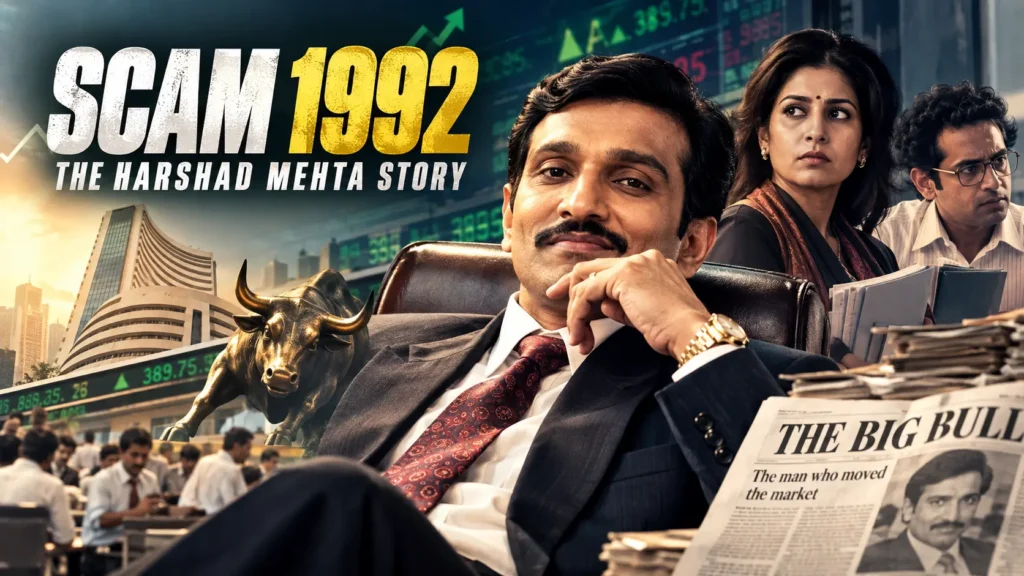
Scam 1992: The Harshad Mehta Story transforms one of India’s most closely watched financial scandals into a character-driven drama about ambition, money, journalism, and the risks of unchecked financial success. Released in 2020, the series follows Harshad Mehta as he rises from an ordinary background to become a major figure in Bombay’s stock market before his extraordinary success begins to unravel.
Alongside Harshad’s journey, the series follows financial journalist Sucheta Dalal, whose investigation becomes central to the story. Her work provides a contrasting perspective on the events, shifting the narrative from Harshad’s rapid rise to the questions surrounding the financial activities that helped build his reputation.
For viewers unfamiliar with India’s financial history, Scam 1992 offers more than a story about stocks. It introduces the people, institutions, relationships, and financial practices surrounding the 1992 securities scandal while keeping the human drama at its center. The series also recreates the atmosphere of 1980s and early-1990s Bombay, a period when India’s financial markets were undergoing significant change.
At the heart of the series is Pratik Gandhi’s portrayal of Harshad Mehta. Around him, the story brings together family members, business associates, journalists, bankers, investigators, and other market participants. That wider perspective gives Scam 1992 its distinctive identity: it is a financial story, but it is equally a story about ambition, influence, reputation, and consequences.
What Is Scam 1992 About?
Scam 1992 is a biographical financial drama based on the events surrounding the 1992 securities scam. The series follows Harshad Mehta’s journey through Bombay’s financial world, from his early struggles to his emergence as one of the market’s most influential figures.
The story begins with Harshad’s determination to improve his circumstances. He enters the financial world, learns how the market operates, and gradually develops the confidence to pursue increasingly ambitious opportunities. As his success grows, so do his wealth, reputation, and influence.
However, the series does not present Harshad’s rise as an isolated success story. His expanding financial empire affects his family, associates, and professional relationships. At the same time, his growing profile attracts attention from journalists and others trying to understand how he has achieved such extraordinary results.
Sucheta Dalal’s investigation becomes particularly important as questions surrounding financial transactions begin to surface. Her reporting introduces a second narrative perspective and helps move the story from market success toward public scrutiny.
The result is a drama that connects personal ambition with larger institutional questions. Harshad’s rise creates excitement and admiration, but the same network that enables his success eventually brings intense attention to his activities.
Because the series draws from real events, viewers should also distinguish between its historical foundation and its dramatic presentation. The show uses real people and major events while shaping them into a cohesive television narrative.
Scam 1992 Cast and Characters
The cast gives the financial story a strong human dimension. Rather than presenting the 1992 scandal only through market terminology, the series builds its narrative around personalities, relationships, and conflicting perspectives.
Pratik Gandhi leads the series as Harshad Mehta, while Shreya Dhanwanthary plays financial journalist Sucheta Dalal. Hemant Kher portrays Ashwin Mehta, Harshad’s brother, while Anjali Barot plays Jyoti Mehta.
The supporting cast expands the story beyond its two central figures. Chirag Vohra plays Bhushan Bhatt, while other actors portray bankers, investigators, journalists, family members, and people connected to the financial world surrounding Harshad.
This ensemble matters because the series constantly moves between different parts of that world. Harshad’s family experiences his growing success from a personal perspective. His professional associates see the opportunities and risks surrounding his business activities. Meanwhile, journalists and investigators approach the same events from an entirely different direction.
The performances also make complicated financial material easier to follow. Instead of relying entirely on explanations of transactions and securities, the series connects those concepts to characters with clear motivations and relationships.
At the center are Harshad and Sucheta. Their contrasting positions create much of the show’s dramatic tension. Harshad focuses on expanding his influence within the market, while Sucheta becomes increasingly interested in understanding what lies behind that success.
Pratik Gandhi as Harshad Mehta
Pratik Gandhi plays Harshad Mehta, the central figure whose rise and fall drive the series. His portrayal follows Harshad through different stages of his life, allowing the audience to see how ambition develops into confidence and how confidence can lead to increasingly high-stakes decisions.
The character does not begin as an established financial celebrity. The story first establishes his desire to move upward and his growing fascination with Bombay’s financial markets. His early experiences help explain why financial success becomes such a powerful goal.
As Harshad gains experience, his ambitions expand. Greater success brings greater wealth and visibility, while his growing reputation changes the way people around him respond to him. The character begins operating with a much larger sense of possibility.
That transformation provides much of the show’s dramatic momentum. Viewers can understand the appeal of Harshad’s ambition while also seeing the risks that accompany his increasingly aggressive pursuit of success.
Gandhi’s performance keeps the character engaging even when the story moves into complicated financial territory. Market transactions and institutional conflicts can be difficult for viewers without a background in finance, but Harshad’s personal journey provides a consistent narrative thread.
As a result, Harshad functions as more than the subject of a financial scandal. He becomes the central lens through which the series explores ambition, wealth, influence, reputation, and the consequences of operating within a rapidly changing financial environment.
Shreya Dhanwanthary as Sucheta Dalal
Shreya Dhanwanthary plays journalist Sucheta Dalal, whose investigation becomes one of the series’ most important storylines.
Dalal offers a perspective that sharply contrasts with Harshad’s. While Harshad focuses on opportunities inside the financial market, Dalal approaches the same environment through questions, evidence, and reporting. As unusual financial activity attracts attention, her investigation becomes increasingly significant.
The series uses her journalistic perspective to show how a financial story can grow into a much larger public story. What initially appears to involve complicated transactions eventually raises broader questions about institutions, accountability, and the functioning of the financial system.
Her role also gives viewers a natural way into the more technical parts of the story. Instead of requiring audiences to understand every financial mechanism immediately, the investigative narrative creates a reason to examine those mechanisms and their consequences.
The contrast between Harshad and Sucheta gives Scam 1992 much of its narrative structure. Harshad wants to build his influence and expand his financial reach, while Sucheta wants to understand what is happening beneath the surface.
That tension prevents the series from becoming only a conventional rise-and-fall biography. It becomes an investigation into the events surrounding that rise, with journalism serving as a crucial part of the story.
Other Key Scam 1992 Characters
The story extends beyond Harshad and Sucheta through a supporting cast representing his family, professional circle, and the wider financial ecosystem.
Ashwin Mehta, played by Hemant Kher, is an important part of Harshad’s personal and professional world. His presence gives the series another family perspective while connecting the story to Harshad’s business activities.
Anjali Barot plays Jyoti Mehta, bringing Harshad’s family life into greater focus. These personal relationships show that the consequences of Harshad’s financial rise extend beyond the stock market.
Chirag Vohra plays Bhushan Bhatt, another important figure within Harshad’s professional circle. Characters such as Bhushan help demonstrate how relationships, trust, and professional networks become increasingly significant as the financial stakes grow.
The series also introduces journalists, bankers, investigators, and other market participants. Together, they create the broader network surrounding Harshad’s activities.
This ensemble approach strengthens one of the show’s central ideas: a major financial scandal does not exist in isolation. It develops through connections between people, institutions, information, and money.
As Harshad’s influence expands, those connections become increasingly important. They help transform the story from one man’s pursuit of financial success into a much wider account of ambition, opportunity, scrutiny, and consequences.
The Rise of Harshad Mehta in Scam 1992
Harshad Mehta’s rise forms the central movement of Scam 1992. The series presents him as a man who sees the stock market not simply as a place to trade, but as a system full of opportunities for anyone willing to understand how it works.
His journey begins far from the image of wealth that eventually surrounds him. As he gains experience in Bombay’s financial world, he studies market behavior, builds relationships, and learns how brokers and financial institutions interact. Each new opportunity pushes him further into a world where information, timing, money, and influence can determine enormous gains.
The series makes this transformation personal. Harshad wants more than financial stability. He wants recognition, status, and the ability to operate on a much larger scale. His growing confidence becomes part of his identity, and his success attracts people who want to participate in the opportunities around him.
That ambition helps explain why his rise becomes so dramatic. The story does not portray the market as a simple path from buying a stock to selling it for a profit. Instead, it shows a complicated financial environment in which brokers, banks, securities, and short-term funding could interact in ways that were difficult for outsiders to see.
Harshad’s expanding influence eventually reaches a level where his activities can no longer remain confined to the trading floor. His name becomes associated with the extraordinary movement of shares and the changing fortunes of the market.
The same visibility that fuels his success, however, also creates the conditions for closer scrutiny.
Harshad Mehta’s Ambition and the Market Boom
The financial world depicted in Scam 1992 is one of rapid opportunity. Harshad recognizes that market movements can create enormous wealth, but he also understands that access to capital can determine how much a trader can accomplish.
As his financial network expands, he develops relationships with people who can provide access to money and securities. The series uses these relationships to demonstrate an important point: large-scale market activity depends on an ecosystem rather than a single trader working alone.
Harshad’s growing reputation also changes how other people perceive him. Success creates confidence, and confidence attracts more attention. His lifestyle becomes increasingly extravagant, reinforcing the public image of a market operator who appears capable of turning financial opportunities into extraordinary returns.
That image becomes one of the show’s most important dramatic elements. Harshad is not merely making money; he is building a reputation around the idea that he understands the market better than almost everyone else.
However, rapid growth also increases exposure. The larger the positions become, the more important the underlying flow of money and securities becomes. When those transactions depend on financial arrangements that regulators and institutions struggle to monitor effectively, the consequences can extend far beyond one investor.
SEBI records from the period acknowledge concerns about unauthorized practices involving the government-securities market and their ability to influence share prices. The regulator also emphasized the need for exchanges to monitor unusual price movements and trading volumes.
From Market Success to Growing Scrutiny
The turning point in Scam 1992 comes when Harshad’s success begins attracting questions instead of admiration.
The scale of financial activity surrounding him makes the story increasingly difficult to separate from the institutions that facilitate market transactions. Banks, brokers, securities, and settlement processes all become part of the larger picture.
This is where the series introduces a crucial shift in perspective. Until this point, Harshad’s story can appear to be a dramatic account of financial ambition. As scrutiny grows, however, the audience begins to see the weaknesses within the system that made such rapid expansion possible.
Regulatory records from 1992 show that authorities were already concerned about unauthorized practices in the government-securities market and their connection to unusual movements in share prices. SEBI’s May 1992 circular specifically referred to reported practices that enabled some brokers to influence trading and prices in the stock market.
The issue was therefore larger than the reputation of one broker. It involved the way financial transactions moved between institutions and market participants.
As investigators began examining these relationships, the distinction between legitimate market activity and questionable practices became increasingly important.
For Harshad, this scrutiny threatens the foundation of the world he has built. For journalists such as Sucheta Dalal, it creates a story that demands deeper investigation.
The financial boom that once represented opportunity now becomes evidence that something much larger may be taking place beneath the surface.
What Was the Real 1992 Stock Market Scam?
The 1992 securities scam was not simply a story about one person manipulating a few stocks. It involved transactions connected to banks, brokers, government securities, and the broader financial system.
At the center of the controversy were weaknesses in the way securities transactions were handled. Money and securities moved through financial institutions, and certain practices created opportunities for funds to be redirected into the stock market.
The importance of this structure becomes clearer when separating the stock market from the banking system. Brokers traded shares, while banks participated in transactions involving government securities and provided access to funds. The interaction between these areas created channels through which money could move.
The Reserve Bank of India issued multiple circulars in 1991 and 1992 concerning banks’ investment portfolios and transactions in securities. Later RBI regulations specifically addressed issues involving reconciliation of securities holdings, government-securities transactions, and bank receipts.
That regulatory history helps explain why the scandal became a major institutional issue rather than remaining a conventional stock-market dispute.
SEBI also documented concerns about unauthorized practices in the government-securities market and their impact on share prices. The regulator’s 1992 guidance stressed monitoring unusual price movements and trading volumes.
The scandal therefore exposed weaknesses in financial controls at a time when India’s markets were becoming increasingly active.
For viewers, this distinction matters. Scam 1992 dramatizes Harshad Mehta’s role, but the historical episode involved a much broader network of financial transactions and institutional relationships.
How the Financial System Created an Opening
To understand the scandal, it helps to imagine two connected financial worlds.
One involved government securities, which banks bought and sold as part of their investment activities. The other involved the stock market, where brokers and investors traded company shares.
Brokers could play an intermediary role between financial institutions. When banks needed help executing transactions, brokers could connect parties and facilitate deals. This arrangement could work normally when every transaction matched the underlying securities and money.
The problem arose when documentation and settlement practices failed to provide an accurate picture of where securities actually were and where money was moving.
Bank receipts, or BRs, became particularly important in the story. A bank receipt could serve as evidence connected to a securities transaction. However, weaknesses in controls created opportunities for documents to be used without the underlying securities being properly matched to them.
RBI records from the period show that regulators subsequently issued specific directions concerning bank receipts and securities transactions. The RBI’s consolidated regulatory history includes a November 1994 circular dealing specifically with bank receipts in investment transactions.
In simple terms, the weakness involved a gap between the paper trail and the actual securities and funds behind transactions.
That gap mattered because financial markets depend on trust and accurate settlement. Once money could move through transactions without the expected securities consistently backing those transactions, the system became vulnerable to misuse.
This financial mechanism is one of the most important elements for understanding the real scandal behind Scam 1992.
Harshad Mehta’s Role in the Scam
Harshad Mehta became the most recognizable individual associated with the 1992 securities scam, but the historical record shows a more complicated network of transactions and entities.
Regulatory proceedings over subsequent years continued to examine transactions involving Mehta, associated entities, brokers, and companies. SEBI records describe entities connected to the Damayanti Group as acting as fronts for Mehta in later securities-market activity, while also referring to him as a broker associated with the 1992 securities scam.
The legal and regulatory history also shows that authorities did not treat the episode as a simple dispute between Harshad and the stock exchanges. The Special Court framework created specifically for securities transactions included mechanisms for attaching properties and dealing with assets connected to notified persons. SEBI records note that Harshad Mehta and related family entities were notified under the Special Court Act in June 1992.
This wider context is important because television naturally needs a central character. Harshad provides that focus in Scam 1992, but the actual financial episode involved numerous institutions, intermediaries, transactions, and regulatory questions.
The distinction also prevents a common misunderstanding: the 1992 scandal was not merely a story of a stockbroker buying shares aggressively. It involved the interaction of securities transactions, banking practices, funding arrangements, and market activity.
That complexity is exactly what the series gradually reveals as Harshad’s extraordinary rise begins to collapse.
Scam 1992 and Sucheta Dalal’s Investigation
The investigation gives Scam 1992 a second narrative engine. Until this point, the story has largely followed Harshad Mehta’s rise through Bombay’s financial world. As questions begin to emerge, however, the focus shifts toward the journalists trying to understand what is happening behind the impressive market numbers.
If you enjoy investigative stories that uncover hidden information beneath seemingly straightforward events, True Detective offers another character-driven take on mystery, investigation, and crime.
Shreya Dhanwanthary portrays financial journalist Sucheta Dalal, who works alongside journalist Debashish Basu in the series. Their reporting becomes increasingly focused on irregularities surrounding financial transactions and the extraordinary flow of money connected to the market.
The series draws from The Scam: Who Won, Who Lost, Who Got Away, the book written by Dalal and Basu. Hansal Mehta later explained that he had read the book years before developing the television adaptation.
One of the show’s effective choices is to make the investigation feel like a process rather than a single revelation. Information arrives in pieces. Sources must be checked, documents examined, and connections established before a larger picture emerges.
That approach also gives viewers a practical way to understand a complicated financial scandal. Instead of presenting the entire case through technical explanations, the series follows journalists as they assemble the evidence.
The investigation ultimately changes the meaning of Harshad’s success. What once looked like extraordinary market skill begins to raise questions about the financial mechanisms supporting it.
How the Investigation Begins
The series opens its investigative storyline with a tip that immediately suggests something much larger than an ordinary market dispute. An SBI official approaches Sucheta Dalal with information about a massive financial irregularity, giving the journalists a starting point for their investigation. Contemporary coverage of the series describes the opening as involving a reported ₹500-crore problem.
For Dalal and Basu, the size of the figure alone is not enough. They need to establish what actually happened and determine how the money moved through the financial system.
That process becomes increasingly difficult because the transactions involve institutions, intermediaries, securities, and banking procedures that ordinary readers may not understand. The journalists therefore have to follow the paper trail while also speaking to people who can explain what the documents mean.
The series presents investigative journalism as detailed work rather than instant discovery. Sources need verification, financial records need interpretation, and seemingly unrelated pieces of information have to connect before the story becomes clear.
This approach also creates suspense without depending entirely on conventional thriller devices. Every new document or source can change the journalists’ understanding of the case.
As the investigation advances, Harshad’s name becomes increasingly difficult to separate from the financial irregularities being examined. The story begins moving beyond his public image as a successful broker and toward the question of how that success was achieved.
That shift becomes the foundation for the scandal’s eventual public exposure.
Sucheta Dalal and Debashish Basu Follow the Paper Trail
The investigative partnership between Sucheta Dalal and Debashish Basu gives the series a grounded perspective on financial journalism. Their work involves connecting individual transactions to the larger system in which they occurred.
That task requires patience. A suspicious transaction does not automatically explain an entire financial operation. The journalists need to establish where money originated, how it moved, which institutions were involved, and what documentation supported each transaction.
The Indian Express noted that the series captures the painstaking nature of investigative reporting, including checking information with sources and repeatedly putting pieces together before presenting a story.
This detail is important because financial scandals often appear confusing from the outside. Numbers can look enormous, but understanding their significance requires context. A journalist must know which transaction was legitimate, which one raised questions, and how apparently separate events connect.
The series also uses the newsroom to show the professional pressure surrounding a major investigation. Reporting a story involving powerful financial interests carries consequences, and journalists cannot rely on a dramatic accusation alone. Their credibility depends on evidence.
Dalal’s role therefore extends beyond simply discovering Harshad’s activities. She represents the process through which complex financial information becomes a public story.
That perspective balances the show’s focus on Harshad. While he builds his influence through money and market relationships, Dalal builds her case through information and verification.
Together, these opposing approaches create one of the strongest narrative contrasts in Scam 1992.
How the 1992 Scam Came to Public Attention
The scandal became a national story because the financial irregularities extended beyond ordinary stock-market trading. Investigations uncovered problems involving banks, brokers, securities transactions, and the movement of funds.
As questions surrounding Harshad Mehta became public, attention shifted toward the institutions and practices that had allowed these transactions to occur. The resulting investigations led to multiple legal cases involving bank officials and other individuals connected to the transactions.
This wider context explains why Scam 1992 presents the scandal as more than a stock-market story. The market was only one part of a larger financial network involving banks, brokers, securities, and regulatory systems.
A Changing Financial Environment
The series also places the scandal within a period of major economic change in India. During the late 1980s and early 1990s, financial markets were expanding while older systems and practices still contained significant weaknesses.
The Indian Express described the series as a portrait of an India undergoing major change, with Harshad navigating gaps between established financial practices and an evolving market.
That historical setting gives the scandal greater context. Harshad’s rise did not happen in isolation. It unfolded while financial markets, institutions, regulation, and economic expectations were changing.
The investigation ultimately brought those tensions to a much wider public audience, turning a complex financial episode into a national story.
Why the Banking Connection Matters
Understanding the banking side of the scandal is essential because the controversy did not originate entirely inside the stock exchange.
Banks participated in transactions involving government securities, while brokers could act as intermediaries in financial dealings. When the underlying securities, funds, and documentation did not remain properly aligned, the system could become vulnerable.
The investigation therefore examined not only what happened in the stock market but also how financial institutions handled transactions and funds.
Later court proceedings illustrate how seriously authorities treated some of these transactions. In one securities-scam case, a CBI court convicted four former bank officials in 2017 after finding them guilty in connection with transactions that prosecutors said improperly transferred large sums to accounts associated with Harshad Mehta.
Another case involved allegations that bank officials used false documentation to show securities transactions and issued large-value cheques without obtaining the expected securities or bank receipts.
These proceedings came years after the original scandal, but they demonstrate an important point: the financial consequences of 1992 extended well beyond the stock-market headlines.
For Scam 1992, this banking connection provides much of the underlying tension. The story is not simply about traders making aggressive bets. It is about the interaction between brokers, banks, securities, money, and documentation.
Once those links begin to fail, a problem inside one part of the system can spread quickly through the rest.
The Role of Regulators
The aftermath of the scandal also exposed the need for stronger market oversight.
SEBI’s regulatory material from May 1992 addressed concerns about unauthorized practices in the government-securities market and instructed stock exchanges to strengthen monitoring of unusual price movements and trading volumes.
The regulator’s response is important because it shows that the scandal raised structural questions rather than only questions about individual conduct.
Market surveillance matters because unusual trading activity can indicate that prices or volumes do not reflect normal market conditions. Stronger oversight can help regulators identify problems before they become systemic.
The scandal also contributed to closer attention to the relationship between brokers and financial institutions. When intermediaries have access to large flows of money or securities, controls must ensure that those transactions correspond to genuine underlying deals.
Scam 1992 uses this regulatory dimension to widen the story. Harshad may remain its central character, but the consequences of the scandal involve an entire financial ecosystem.
That distinction matters for viewers. The series dramatizes a central figure, yet the historical episode revealed weaknesses that extended beyond one person.
The investigation therefore becomes a story about accountability at several levels: individual decisions, institutional controls, professional responsibilities, and regulatory oversight.
How Scam 1992 Explains the Financial Chain
One reason the series remains accessible to viewers unfamiliar with finance is its decision to explain complex transactions through characters and situations rather than overwhelming the audience with technical terminology.
The financial chain begins with institutions that hold or transact in securities. Brokers occupy an intermediary position, connecting participants and facilitating deals. When money moves through this network, documentation should establish what securities or transactions support that movement.
The problem arises when the financial records no longer provide a reliable picture of the underlying assets.
This is where concepts such as bank receipts and ready-forward transactions become important. They may sound technical, but they matter because they help explain how funds could move through the banking system and eventually influence activity in the stock market.
The historical cases that followed the scandal demonstrate why these mechanisms attracted scrutiny. Prosecutors in later proceedings described transactions in which large amounts of money moved through banks using documentation that did not accurately represent the underlying securities activity.
For a television audience, the essential idea is straightforward: money should correspond to genuine financial transactions and securities. When controls fail, that connection can become vulnerable to manipulation.
The series gradually builds this understanding instead of presenting the entire mechanism at once.
That storytelling choice allows viewers to follow the human consequences while also learning why the financial system became central to the scandal.
Why the Financial Details Matter to the Drama
The financial details in Scam 1992 are not merely background information. They create the conditions that drive the characters’ decisions.
Harshad’s ambitions depend on his ability to move money, identify opportunities, and maintain relationships across the financial system. As his operations expand, the consequences of every transaction become larger.
The journalists face the opposite challenge. They must work backward from suspicious transactions and determine what those movements reveal about the underlying system.
This creates a natural conflict between speed and verification. Harshad wants to keep moving while opportunities remain available. The journalists need to slow down, examine evidence, and establish what actually happened.
The result is a financial thriller in which documents can become as important as dramatic confrontations.
The show’s creators have also described the story as one involving desire, ambition, aspiration, and eventual downfall. Hansal Mehta said the challenge was to tell a compelling white-collar crime story without reducing the material to a simplified treatment.
That approach explains why financial terminology remains connected to character development throughout the series.
The numbers matter because people act on them. Money creates opportunity, opportunity creates ambition, and ambition increases the risks attached to every decision.
By the time the investigation reaches its most serious stage, the audience understands that the financial mechanism and the personal story cannot be separated.
The Investigation Changes Harshad Mehta’s Story
The investigation fundamentally changes how the audience sees Harshad’s success.
Earlier, his rapid rise can appear almost inspirational. He begins with limited resources, learns the market, builds relationships, and eventually reaches a level of wealth that seems almost unimaginable.
Once journalists begin tracing the financial transactions behind that success, the same achievements acquire a different meaning.
The investigation does not erase Harshad’s intelligence or ambition. Instead, it asks what happened when those qualities operated within a system full of weaknesses and opportunities for abuse.
That complexity is one reason the series avoids turning Harshad into a simple hero or villain. The Indian Express review described the show’s approach as a balance between admiration and condemnation, presenting him as a complicated individual shaped by his circumstances, abilities, and choices.
The investigative storyline also demonstrates why public reputation can change quickly. A successful broker can become a subject of intense scrutiny once questions emerge about the methods behind that success.
For Sucheta Dalal and Debashish Basu, the goal is not simply to challenge Harshad’s reputation. Their reporting seeks to establish what happened and explain why it matters.
For Harshad, however, the investigation threatens the financial world he has built.
That tension pushes the story toward its next stage: the collapse of confidence, the consequences of the scandal, and the eventual unraveling of the man who once appeared to control the market.
Scam 1992 Ending Explained
The final stretch of Scam 1992 moves away from Harshad Mehta’s extraordinary rise and focuses on the consequences of the financial scandal. The confidence that defined his ascent begins to disappear as investigations, legal proceedings, and financial pressure close in around him.
The series does not treat the downfall as a single dramatic event. Instead, it presents it as a gradual collapse of the system Harshad built around himself. His relationships become strained, his reputation changes, and the institutions that once provided opportunities become sources of scrutiny.
One of the most important elements of the ending is Harshad’s changing relationship with the people closest to him. The final episodes bring professional pressure into his family and business relationships, making the consequences feel personal rather than purely financial.
The series ultimately moves beyond the question of how much money was involved. Its final episodes ask what happens when ambition, confidence, and financial influence collide with accountability.
The ending also reinforces the distinction between Harshad the individual and the wider financial system. His actions remain central to the story, but the scandal exposes weaknesses involving banks, brokers, market practices, and oversight.
The result is not a conventional victory for one side. Instead, the conclusion leaves viewers with the consequences of a financial system that allowed extraordinary opportunities to exist alongside serious vulnerabilities.
What Happens to Harshad Mehta?
The series follows Harshad’s decline after his financial activities come under intense scrutiny. The man who once appeared almost untouchable now faces investigations, legal consequences, financial restrictions, and the collapse of his public image.
One of the most effective aspects of the final episodes is the change in Harshad’s confidence. Earlier in the series, he often appears convinced that he can find a way around every obstacle. By the final stretch, that certainty begins to break down.
His legal troubles continue beyond the period dramatized by the central scandal. Harshad Mehta died in 2003 after being taken to a Mumbai hospital following chest pain. His death came while several legal matters connected to the securities scam remained unresolved. The series itself focuses primarily on his rise, exposure, and the immediate consequences of the scandal rather than attempting to provide a complete account of every later legal development.
That distinction matters because the television ending is designed around the dramatic collapse of Harshad’s financial empire.
The final episodes therefore work less as a conventional biography and more as the conclusion of a rise-and-fall narrative.
Harshad begins the story believing that the market can be conquered through knowledge, relationships, confidence, and access. By the end, the same system exposes the limits of that confidence.
What the Ending Says About the System
The conclusion of Scam 1992 places Harshad’s downfall within a much wider institutional story.
His actions remain central, but the scandal also reveals weaknesses in financial controls and market oversight. That broader perspective prevents the ending from becoming simply a story about one individual’s downfall.
The series shows how financial systems depend on trust between institutions, intermediaries, and market participants. When that trust breaks down, the consequences can spread rapidly.
The aftermath also demonstrates why regulatory reform became an important part of the story. SEBI’s 1992 material addressed unauthorized practices in the government-securities market and called for closer monitoring of unusual trading activity. The RBI also strengthened rules surrounding securities transactions and bank receipts in the years that followed.
For the viewer, the ending therefore carries two connected meanings.
First, Harshad’s personal rise cannot continue once the mechanisms supporting it come under investigation.
Second, the scandal exposes weaknesses that extend beyond one broker. The financial system itself must respond to what the episode revealed.
That gives the ending a larger significance. Harshad’s story reaches its dramatic low point, but the institutional consequences continue beyond him.
The series ultimately leaves viewers with a financial lesson: extraordinary market success can attract attention, but sustainable markets depend on transparent transactions, effective oversight, and accountability.
How Accurate Is Scam 1992?
Scam 1992 has a strong foundation in real events, but it remains a scripted television drama rather than a documentary.
The series is based on The Scam: Who Won, Who Lost, Who Got Away, written by financial journalists Sucheta Dalal and Debashish Basu. The adaptation focuses specifically on Harshad Mehta’s story rather than attempting to cover every aspect of the wider scandal.
That distinction explains why some events are compressed, reconstructed, or presented through dramatized conversations. Television requires a coherent narrative, while real financial scandals develop through thousands of documents, transactions, meetings, legal proceedings, and overlapping investigations.
The broad historical framework is real. Harshad Mehta became a prominent stockbroker, the 1992 securities scandal exposed major weaknesses in financial practices, and Sucheta Dalal and Debashish Basu played an important role in reporting the story.
However, viewers should not automatically treat every conversation or scene as a verbatim reconstruction of something that happened.
Director Hansal Mehta has explained that his approach to biographical storytelling was to humanize the characters rather than romanticize them. That approach is visible throughout the series, particularly in its treatment of Harshad as a complicated individual rather than a one-dimensional figure.
The best way to view Scam 1992 is therefore as a dramatized interpretation built around a documented historical foundation.
What Is Real and What Is Dramatized?
Several central elements of the series have clear historical foundations.
Harshad Mehta was a real stockbroker whose activities became central to the 1992 securities scandal. Sucheta Dalal and Debashish Basu were real financial journalists who investigated and reported on the events. The banking and securities issues surrounding the scandal also generated extensive regulatory and legal proceedings.
The series also accurately captures the broader atmosphere of a financial market undergoing major change. Contemporary reviews praised its recreation of the period and its depiction of the transition taking place in India during the late 1980s and early 1990s.
However, the show necessarily compresses time and combines complex developments into a more manageable narrative. Conversations between characters are dramatized. Some encounters serve a storytelling purpose rather than functioning as documentary evidence.
Even character presentation involves interpretation. A television actor must communicate motivations and emotions that historical documents may not fully reveal.
This does not make the series unreliable. It simply means that viewers should separate the historical framework from the dramatic reconstruction.
That distinction becomes particularly important when interpreting scenes involving private conversations, personal motivations, or exact sequences of events.
The series provides an accessible entry point into the scandal, but readers seeking the complete historical record should look beyond the drama and consult the underlying reporting, regulatory records, court proceedings, and source material.
Why Scam 1992 Works as a Financial Drama
Financial stories can easily become difficult to follow when they depend on unfamiliar terminology. Scam 1992 avoids that problem by connecting financial mechanisms to people and their motivations.
That character-first approach also connects Scam 1992 with modern crime dramas, where the central conflict often depends as much on personalities and relationships as it does on the crime itself. Fightland takes a different route through the crime-drama genre, but it similarly places its characters and their choices at the center of the story.
The audience does not encounter the market as a collection of abstract numbers. Instead, viewers see how money changes relationships, creates opportunities, increases confidence, and eventually produces fear and uncertainty.
The show’s period setting also contributes to its identity. Director Hansal Mehta has described recreating Bombay through a combination of real locations, visual effects, and production design. He wanted the world to reflect the physical appearance of the period rather than simply placing modern filmmaking techniques over an old-fashioned setting.
That attention to environment gives the financial story a recognizable social context.
The series also benefits from its gradual pacing. Harshad’s rise takes time, allowing viewers to understand the relationships and decisions that contribute to his success before the scandal reaches its most serious stage.
As a result, the financial mechanics become part of the character story.
The market creates Harshad’s opportunities. His ambition determines how far he pursues them. His relationships help him expand. The investigation challenges his public image. Finally, the consequences force him to confront the limits of the world he built.
That progression makes Scam 1992 accessible even to viewers who have little prior knowledge of stock markets or Indian financial history.
Pratik Gandhi’s Performance
Pratik Gandhi’s performance is central to the show’s impact because Harshad Mehta appears in almost every stage of the story.
Rather than presenting him as an obvious hero or villain, Gandhi plays the character as someone who believes strongly in his own abilities. That confidence makes his rise believable while also creating tension as his decisions become increasingly risky.
The performance changes subtly as Harshad’s circumstances change. Early scenes emphasize determination and curiosity. Later episodes show greater confidence, wealth, impatience, and vulnerability.
Gandhi has said that one of his biggest challenges was humanizing Harshad rather than approaching him simply as a hero or villain. He wanted audiences to experience different reactions to the character as the story progressed.
That approach fits the series’ broader strategy.
Harshad needs to remain compelling even when the audience understands that his actions have serious consequences. If he were presented as purely heroic, the scandal would lose its complexity. If he were portrayed only as a villain, his rise would become difficult to understand.
Gandhi instead gives the character layers of ambition, charm, confidence, insecurity, and fear.
The result is a performance that keeps the personal story engaging even when the financial material becomes complicated.
Hansal Mehta’s Direction and the Ensemble
Hansal Mehta’s direction gives the series room to develop both its financial story and its characters. Jai Mehta also received a co-direction credit, while the writing team adapted the material from Dalal and Basu’s book.
One of the show’s strongest choices is its refusal to make Harshad’s world entirely glamorous. The series shows wealth and ambition, but it also keeps family relationships, professional tensions, journalism, and institutional consequences in view.
The ensemble strengthens that balance.
Shreya Dhanwanthary brings a focused investigative perspective as Sucheta Dalal, while Faisal Rashid’s Debashish Basu adds another dimension to the newsroom storyline. Satish Kaushik, Rajat Kapoor, Anjali Barot, Hemant Kher, Chirag Vohra, and other performers help create a broader world around Harshad.
The period recreation is another major part of the direction. The production does not rely only on costumes to establish the era. Locations, interiors, lighting, vehicles, offices, and financial spaces all contribute to the sense of time and place.
That combination allows the show to function simultaneously as a financial drama, a character study, and a period story.
Its greatest strength lies in keeping those elements connected rather than allowing any one of them to overwhelm the others.
The Larger Themes of Scam 1992
Beyond the details of the securities scandal, Scam 1992 explores several broader themes.
Ambition sits at the center. Harshad’s desire to rise drives much of the story, but the series also shows how ambition can change as success becomes easier to achieve.
Reputation matters just as much. Harshad’s public image becomes an asset during his rise and a vulnerability once questions about his activities emerge.
Trust connects the financial and personal sides of the story. Markets depend on trust between institutions and participants, while Harshad’s personal relationships also depend on confidence in his judgment.
Information becomes another form of power. Harshad uses market knowledge to expand his position, while journalists use documents and sources to challenge the public narrative surrounding him.
Finally, the series explores the gap between opportunity and accountability. A changing financial system can create new opportunities, but those opportunities still require rules and oversight.
That tension between individual ambition, institutions, and accountability also appears in political dramas such as The Diplomat Season 4, where personal decisions unfold within larger institutional systems.
Hansal Mehta has said his approach was to humanize rather than romanticize the people at the center of his biographical stories. That philosophy helps explain why Scam 1992 allows viewers to understand Harshad without presenting his actions as something to celebrate.
The result is a story that remains focused on a historical financial scandal while also examining the human motivations that can shape such events.
Scam 1992 Episodes and Series Details
Scam 1992: The Harshad Mehta Story is a Hindi-language biographical financial drama that dramatizes the rise and fall of stockbroker Harshad Mehta against the backdrop of the 1992 securities scam.
SonyLIV lists the series as a 10-episode production and identifies it as a story based on true events. The series was released in 2020 and features Pratik Gandhi as Harshad Mehta, Shreya Dhanwanthary as Sucheta Dalal, and Hemant Kher as Ashwin Mehta.
| Detail | Information |
|---|---|
| Series | Scam 1992: The Harshad Mehta Story |
| Release year | 2020 |
| Language | Hindi |
| Episodes | 10 |
| Genre | Biographical Drama / Financial Thriller |
| Director | Hansal Mehta |
| Co-director | Jai Mehta |
| Lead actor | Pratik Gandhi |
| Central journalist character | Sucheta Dalal |
| Streaming platform | SonyLIV |
The 10-episode structure gives the story enough room to establish Harshad’s background, follow his rapid rise, explain the financial mechanisms behind the scandal, introduce the investigative journalists, and then explore the consequences.
That length also helps the series avoid compressing the entire scandal into a conventional two-hour film. The financial story develops gradually, allowing relationships and institutional details to become important parts of the narrative.
Where to Watch Scam 1992
SonyLIV is the primary official streaming platform associated with Scam 1992: The Harshad Mehta Story. SonyLIV’s series listing identifies the show and provides access to its episodes.
For viewers checking availability, the most reliable approach is to use the platform’s current listing because streaming catalogs, subscription requirements, and regional access can change over time.
The series was originally released as a SonyLIV production and has remained closely associated with the platform. SonyLIV identifies the show as a 10-episode series based on true events.
Because the target audience may include viewers outside India, regional availability should be checked directly before subscribing. Streaming rights can differ between countries, and a title available in one market may not necessarily appear in another.
For viewers interested in the historical background before watching, understanding the basic distinction between the dramatized series and the real 1992 securities scandal can also make the story easier to follow.
The show works best when approached as a scripted interpretation of documented events rather than as a documentary record of every conversation and transaction.
Scam 1992 FAQs
Is Scam 1992 based on a true story?
Yes. Scam 1992: The Harshad Mehta Story is based on real events surrounding the 1992 securities scam and the rise of stockbroker Harshad Mehta. SonyLIV describes the series as based on true events. However, it remains a scripted biographical drama, so individual conversations and some narrative sequences should be understood as dramatized representations rather than documentary recordings.
Who was Harshad Mehta?
Harshad Mehta was an Indian stockbroker who became one of the most prominent figures associated with the 1992 securities scam. His rapid rise in Bombay’s financial market made him widely known, while investigations into financial transactions involving banks, brokers, and securities eventually turned his success into a major national scandal.
How many episodes does Scam 1992 have?
Scam 1992: The Harshad Mehta Story has 10 episodes. The series uses those episodes to cover Harshad Mehta’s early ambitions, his rise in the stock market, the financial mechanisms surrounding the scandal, the investigation, and the consequences of his exposure. SonyLIV currently lists the series as a 10-episode production.
Who plays Harshad Mehta in Scam 1992?
Pratik Gandhi plays Harshad Mehta. His performance covers the character’s transformation from an ambitious newcomer in Bombay’s financial world into a highly influential market figure and, eventually, a man facing intense scrutiny and the consequences of the securities scandal.
Who plays Sucheta Dalal in Scam 1992?
Shreya Dhanwanthary plays financial journalist Sucheta Dalal. Her character becomes central to the investigative side of the story as she and journalist Debashish Basu examine irregularities surrounding the financial transactions connected to the scandal.
Is Scam 1992 a documentary?
No. Scam 1992 is a scripted biographical drama based on real events. Although the series draws on historical people, events, reporting, and financial records, it uses actors and dramatized scenes to tell the story. Viewers should therefore distinguish documented historical events from reconstructed conversations and narrative choices made for television.
Is Scam 1992 available on SonyLIV?
Yes. SonyLIV’s official listing identifies Scam 1992: The Harshad Mehta Story as a SonyLIV series and lists its 10 episodes. Availability and subscription requirements can vary by region, so viewers should check the current SonyLIV listing for their location.
Does Scam 1992 show the real stock market scam?
The series dramatizes the real events surrounding the 1992 securities scam, including Harshad Mehta’s rise, financial transactions, investigative journalism, and the consequences that followed. However, it does not reproduce the historical record scene by scene. It combines documented events with dramatic reconstruction to create a coherent television narrative.
How accurate is Scam 1992?
The series has a substantial historical foundation, but it should not be treated as a documentary. Harshad Mehta, Sucheta Dalal, Debashish Basu, the 1992 securities scandal, and the financial institutions involved were real. At the same time, television storytelling requires compressed timelines, reconstructed conversations, and character-driven scenes. The broad historical story is therefore more reliable than assuming every individual scene happened exactly as shown.
What happened to Harshad Mehta?
Harshad Mehta faced extensive legal and financial consequences after the 1992 securities scandal. He remained involved in legal proceedings for years and died in 2003 after being taken to a Mumbai hospital following chest pain. His death occurred while legal matters connected to the securities scam were still continuing.
What was the 1992 securities scam?
The 1992 securities scam involved complex transactions connecting banks, brokers, government securities, funds, and the stock market. Weaknesses in financial controls and settlement practices created opportunities for money to move through the system in ways that regulators and investigators later scrutinized. Harshad Mehta became the most recognizable individual associated with the scandal, but the historical episode involved a much wider network of institutions and transactions.
Final Thoughts on Scam 1992
Scam 1992 succeeds by turning a complicated financial scandal into an accessible human story. At its center is Harshad Mehta, whose ambition takes him from an ordinary beginning to extraordinary wealth and influence before the same financial world begins to expose the weaknesses behind his rise.
The series also understands that the scandal cannot be explained through Harshad alone. Sucheta Dalal and Debashish Basu’s investigative work adds another perspective, while the involvement of banks, brokers, regulators, and other financial institutions reveals the wider system surrounding the events.
That balance gives the series its lasting appeal. It offers enough financial detail to explain why the scandal mattered without allowing technical terminology to overwhelm the characters.
Pratik Gandhi’s portrayal keeps the personal story at the center, while the ensemble and period recreation give the narrative a convincing sense of time and place.
Most importantly, Scam 1992 works as an introduction to a complicated chapter in financial history while remaining clear about its status as a dramatization. The real scandal involved layers of transactions, institutions, investigations, and legal proceedings that extend beyond what any television series can capture.
For viewers searching for Scam 1992, the essential takeaway is therefore twofold: the series tells a compelling story about Harshad Mehta’s rise and fall, while the historical events behind it reveal how financial opportunity, weak controls, information, and ambition can intersect with far-reaching consequences.