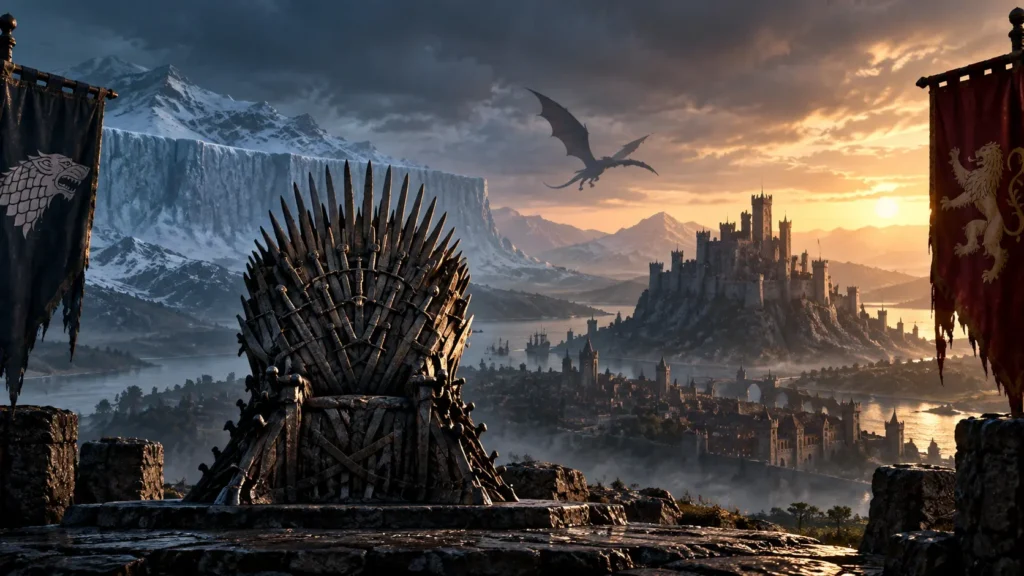
Game of Thrones is an expansive fantasy drama that combines royal politics, family rivalries, warfare, ancient mysteries, and a growing supernatural threat. Created by David Benioff and D.B. Weiss and based on George R.R. Martin’s A Song of Ice and Fire novels, the series follows a large group of characters whose lives become intertwined through the struggle for power across Westeros.
At first, the story appears to center on one question: who will control the Iron Throne? However, the conflict soon becomes much larger. While powerful families compete for political control, events beyond the Wall reveal a danger that could threaten everyone in the realm.
For new viewers, the world of Game of Thrones can seem complicated because the story moves between different regions, families, and competing interests. Understanding Westeros, its major houses, and the forces beyond its borders provides the foundation for following the larger story.
What Is Game of Thrones About?
At its core, Game of Thrones follows the struggle for control of the Seven Kingdoms of Westeros. The Iron Throne represents the highest seat of political power, but reaching it requires more than a legitimate claim. Kings, noble families, military leaders, and advisers constantly form alliances, challenge rivals, and adapt to changing circumstances.
The story begins with House Stark becoming deeply involved in royal politics after King Robert Baratheon asks Eddard Stark to serve as Hand of the King. Eddard’s arrival in King’s Landing places his family in a dangerous political environment dominated by powerful interests, particularly those connected to House Lannister.
Meanwhile, another story unfolds across the Narrow Sea. Daenerys Targaryen lives in exile while carrying the legacy of a family that once ruled Westeros. Her journey gradually transforms as she gains independence, supporters, and a growing connection to the Targaryen claim.
Far to the north, the Night’s Watch guards the Wall. Reports of strange events beyond it hint at a danger that many political leaders fail to take seriously.
As these storylines develop, the fight for the Iron Throne becomes only one part of a much larger struggle involving power, identity, loyalty, survival, and the future of Westeros.
Game of Thrones World and Setting
The world of Game of Thrones extends across several regions, with Westeros and Essos serving as the two major continents. Each area has its own cultures, political traditions, geography, and conflicts.
Westeros contains the Seven Kingdoms and serves as the main setting for the struggle over the Iron Throne. King’s Landing functions as the political center of the realm, while regions such as the North, the Riverlands, the Vale, the Westerlands, the Reach, the Stormlands, and Dorne maintain distinct identities and powerful ruling families.
Geography plays an important role in the story. Armies must travel across long distances, messages can take time to arrive, and control of castles, ports, roads, and strategic locations can influence political and military decisions.
Essos provides another major setting, particularly through Daenerys Targaryen’s journey. Her experiences there introduce cultures and political systems that differ from those of Westeros.
The far north adds another dimension. The Wall separates much of the Seven Kingdoms from the lands beyond it, where the Night’s Watch confronts dangers that initially seem distant from the political battles consuming the rest of the realm.
Together, these locations create a world where geography and politics remain closely connected.
Westeros and the Seven Kingdoms
Westeros forms the political heart of Game of Thrones. Although the realm is commonly known as the Seven Kingdoms, its regions retain distinct identities, traditions, histories, and political interests.
King’s Landing stands at the center of royal power. The Iron Throne sits there, making the capital a crucial destination for anyone seeking control of the realm. However, ruling from King’s Landing does not automatically guarantee loyalty throughout Westeros.
The North has a particularly strong regional identity. House Stark rules from Winterfell, and its members maintain traditions that often differ from those found farther south. The family’s emphasis on duty, loyalty, and honor becomes an important contrast to the political maneuvering of the capital.
Other regions also hold major strategic importance. The Westerlands are closely associated with the wealthy House Lannister, while the Riverlands frequently become a battlefield because of their central position. The Vale, Reach, Stormlands, and Dorne each bring their own interests into the wider political struggle.
This regional diversity makes Westeros difficult to control. Political decisions in one part of the realm can create consequences somewhere else, while family alliances can determine whether a kingdom gains an ally or faces a new enemy.
Essos, the Wall and Beyond
Essos lies across the Narrow Sea from Westeros and becomes especially important through Daenerys Targaryen’s storyline. Her journey takes her through different cities and societies as she builds relationships, gains supporters, and develops her own approach to leadership.
Essos also shows that the world of Game of Thrones extends well beyond the politics of King’s Landing. Its cities and cultures operate according to different traditions and ideas about power. Daenerys encounters these differences while gradually developing a stronger sense of purpose.
Far north in Westeros stands the Wall, a massive defensive structure guarded by the Night’s Watch. Its members dedicate themselves to protecting the realm’s northern frontier, largely separated from the political struggles taking place farther south.
At first, many characters treat the Night’s Watch as a distant institution with little connection to the fight for the Iron Throne. That view changes as reports of supernatural activity become increasingly difficult to ignore.
Beyond the Wall lies an environment where political calculations offer little protection. The White Walkers introduce a threat unlike the rivalries between Westerosi families, forcing the story to confront a question much larger than who should rule.
The Major Houses in Game of Thrones
Family identity forms one of the strongest foundations of Game of Thrones. Characters inherit titles, loyalties, rivalries, political responsibilities, and historical grievances through their houses. As a result, understanding the major families makes the wider story easier to follow.
House Stark rules from Winterfell and represents the North. Eddard Stark and his children become central to the opening storyline, while the Stark siblings eventually follow very different paths through the conflict.
House Lannister possesses enormous wealth and political influence. Its members play a major role in the affairs of King’s Landing, particularly as the struggle for power intensifies. Cersei, Jaime, and Tyrion Lannister each approach family, authority, and survival in distinct ways.
House Targaryen carries a different kind of political significance. The family once ruled Westeros but lost the throne before the main story begins. Daenerys and her brother Viserys grow up in exile, keeping the Targaryen claim alive even after their family’s fall.
Other houses also shape the political landscape:
- House Baratheon — closely connected to the royal succession and the opening political crisis.
- House Greyjoy — a powerful maritime family with its own ambitions for independence.
- House Tyrell — influential through wealth, territory, alliances, and marriage.
- House Martell — the ruling family of Dorne, with its own traditions and political interests.
These families ensure that Game of Thrones never becomes a simple conflict between heroes and villains. Characters repeatedly face difficult choices involving family, ambition, loyalty, political necessity, and survival.
The Main Characters in Game of Thrones
Game of Thrones does not revolve around a single traditional hero. Instead, its story follows a large ensemble whose lives gradually become connected through war, politics, family conflicts, and the threat beyond the Wall.
Jon Snow, Daenerys Targaryen, Tyrion Lannister, Arya Stark, Sansa Stark, Cersei Lannister, and Jaime Lannister become especially important as the story develops. Each character approaches power and survival differently. Some inherit political influence, while others must build their position from almost nothing.
The series also uses these characters to explore competing ideas about leadership. Some believe authority comes from birthright, others from military strength, and others from the ability to earn loyalty.
Because the characters rarely share the same goals, their decisions create unexpected consequences. An alliance formed in one storyline can affect another character hundreds of miles away. Likewise, a personal choice can eventually become a political event.
This interconnected approach gives Game of Thrones much of its narrative complexity. Rather than following one predetermined path, the story develops through the choices of characters who often have incomplete information about what is happening elsewhere.
This character-driven approach is also common in major fantasy franchises, where individual journeys often connect to larger supernatural conflicts, mythology, and questions of power. Fantasy storytelling built around supernatural forces can take many different forms across television and film.
Jon Snow
Jon Snow begins the series as a member of House Stark who feels somewhat separated from the family because of his status as Eddard Stark’s illegitimate son. Looking for a different purpose, he joins the Night’s Watch and travels north to the Wall.
His experiences there introduce him to dangers that many leaders in southern Westeros barely understand. The Night’s Watch must protect the realm while dealing with internal disagreements and difficult questions about leadership.
Jon gradually develops from an inexperienced recruit into an important military and political figure. His responsibilities become increasingly complicated as he tries to balance personal relationships, his duties, and the wider threat facing Westeros.
His family identity also becomes increasingly important. Information about his ancestry changes the way other characters understand his place in the political struggle.
Jon’s storyline eventually connects several major elements of the series: House Stark, the Night’s Watch, the threat beyond the Wall, and the Targaryen succession. That makes him a crucial link between the political and supernatural sides of the story.
Daenerys Targaryen
Daenerys Targaryen begins the series in exile with little political influence. She belongs to the Targaryen family, which once ruled Westeros, but her early life offers few signs that she will eventually become one of the realm’s most powerful figures.
Her circumstances change through marriage, travel, alliances, and the emergence of her dragons. As her influence expands, she gathers followers and develops a stronger belief in her family’s claim to rule.
Much of Daenerys’ early journey takes place in Essos. There, she encounters different cultures, systems of government, warfare, and slavery. These experiences shape her understanding of leadership and justice.
Eventually, she turns her attention toward Westeros. Her return changes the political landscape because she brings considerable military resources and dragons alongside her claim to the Targaryen legacy.
However, gaining power creates new responsibilities and difficult choices. Daenerys’ growing authority becomes increasingly important to the series’ central conflict, particularly as her ambitions collide with other claims to leadership.
Tyrion Lannister
Tyrion Lannister belongs to one of the most powerful families in Westeros, yet his position within House Lannister remains complicated. He frequently encounters prejudice and distrust, including from people within his own family.
Tyrion relies heavily on intelligence, observation, negotiation, and political awareness rather than physical strength. These abilities allow him to navigate situations where direct confrontation could be dangerous.
His importance grows as he takes on political responsibilities and becomes involved in decisions affecting powerful kingdoms. At the same time, his relationship with his family becomes increasingly strained, particularly as disagreements with his father and siblings intensify.
Tyrion’s story demonstrates that influence does not always come from military power. His ability to understand people and recognize political opportunities repeatedly helps him survive situations that place him at serious risk.
His journey eventually connects him with Daenerys and the wider struggle for control of Westeros. Through Tyrion, the series examines the difference between inherited status and the practical ability to influence political events.
Arya and Sansa Stark
Arya and Sansa Stark begin the story as sisters raised at Winterfell, but their different personalities lead them toward very different experiences.
Arya rejects many of the expectations associated with noble daughters. Her desire for independence takes her away from conventional court life and eventually into dangerous situations where survival depends on adaptability and determination.
Sansa initially dreams of the life associated with royal courts and noble traditions. Her experiences in King’s Landing gradually change that perspective. She learns to recognize manipulation, control her reactions, and understand the political motives of people around her.
Although the sisters spend significant periods apart, both experience the consequences of their family’s political downfall. Their separate journeys shape them into very different individuals.
Arya becomes associated with secrecy, observation, and direct action. Sansa increasingly relies on patience, political awareness, and careful relationships.
Their development demonstrates how the same family background can produce very different responses to adversity. Neither sister remains the person she was when the story began.
Cersei and Jaime Lannister
Cersei and Jaime Lannister share a powerful family background, but their experiences lead them in different directions.
Cersei places enormous importance on protecting her children, preserving her family’s influence, and maintaining political control. As the struggle for power intensifies, she becomes increasingly involved in the decisions that shape King’s Landing.
Jaime begins the series as a celebrated warrior whose reputation carries both prestige and controversy. His relationship with Cersei remains central to his story, but his experiences gradually force him to reconsider his ideas about loyalty, honor, and identity.
Cersei’s political journey takes her deeper into the competition for control of the capital. Jaime, meanwhile, encounters experiences that challenge the image he has built around his role as a knight and member of House Lannister.
Their parallel stories show how two members of the same family can respond very differently to power and responsibility.
How Power Works in Game of Thrones
Power in Game of Thrones rarely comes from one source. A character may have a strong claim to the throne but lack an army, while another may command substantial military forces without possessing an accepted hereditary claim.
Political power remains one of television’s most effective storytelling tools, especially in dramas built around diplomacy, competing interests, and shifting alliances. Game of Thrones takes that concept into a fantasy setting, where every political decision can have consequences for entire kingdoms.
Several factors influence political power:
- Bloodline and succession: Family ancestry can establish a claim to rule.
- Military strength: Armies can defend territory and enforce political authority.
- Wealth: Financial resources help families maintain armies and political alliances.
- Marriage: Royal and noble marriages can create powerful political connections.
- Information: Secrets and political knowledge can influence decisions.
- Loyalty: Personal relationships can determine whether leaders receive meaningful support.
These forces make Westeros politically unstable. A ruler can lose influence after a military defeat, a broken alliance, or a disputed succession.
The series repeatedly demonstrates that political authority depends on relationships as much as formal titles. Leaders must understand what other people want, determine whom they can trust, and recognize when an alliance has become a liability.
As a result, power in Westeros remains fluid. Political influence can shift quickly when circumstances change.
The Iron Throne and the Struggle for Succession
The Iron Throne represents the central seat of political authority in Westeros, making succession one of the series’ defining conflicts. Yet determining who has the strongest claim is rarely straightforward.
Different characters rely on different ideas of legitimacy. Some point to inheritance and family history. Others gain authority through conquest, political alliances, military victories, or declarations of loyalty.
When a ruler dies or loses control, competing claims can quickly destabilize the realm. Powerful houses may support different candidates, often because their own interests are connected to the outcome.
The throne also carries symbolic importance. Controlling it means controlling the political center of Westeros, but occupying the throne does not automatically create lasting stability.
As the story progresses, questions surrounding succession become even more complicated by revelations about family identity and competing claims. Bloodline, political support, and practical power begin to overlap.
The central question therefore extends beyond who has the right to rule. The series also asks whether a legitimate claim can survive without political support, military strength, or the ability to maintain order.
Alliances, Betrayals and Political Strategy
Alliances constantly reshape the political landscape of Game of Thrones. Families cooperate because they share enemies, need military support, want territory, or hope to strengthen a future claim.
However, alliances can disappear just as quickly. A marriage can create a political partnership, while a broken promise can turn former allies into enemies. As a result, every agreement carries potential consequences.
Betrayal becomes particularly powerful because many characters depend on networks of trust. When someone breaks that trust, the consequences can reach far beyond the individuals involved and affect entire families or armies.
Information also functions as a political weapon. Knowledge about ancestry, relationships, military plans, or personal motives can influence events without a battle taking place.
Successful political players therefore need more than authority. They must understand the motivations of other people and anticipate how those motivations might change.
This creates one of the defining characteristics of Game of Thrones: battles often decide immediate outcomes, but alliances, information, and political decisions determine how power develops afterward.
Game of Thrones Season 1
The first season establishes the political, familial, and supernatural conflicts that drive the entire series. The story begins in the North, where Eddard Stark and his family live at Winterfell. After King Robert Baratheon arrives and asks Eddard to become Hand of the King, the Stark family becomes involved in the dangerous politics of King’s Landing.
Eddard’s investigation into the royal family gradually raises questions about the succession and the circumstances surrounding the king’s children. At the same time, tensions between the Starks and Lannisters grow, creating a conflict that reaches far beyond the capital.
Across the Narrow Sea, Daenerys Targaryen begins a very different journey. Her marriage to Khal Drogo changes her position, while her connection to the Targaryen legacy becomes increasingly important. By the end of the season, the emergence of her dragons marks a major turning point.
Meanwhile, Jon Snow joins the Night’s Watch and travels to the Wall. His experiences introduce the growing danger beyond Westeros’ northern frontier.
The season establishes the series’ central idea: several seemingly separate struggles are developing at the same time, and their consequences will eventually collide.
Game of Thrones Seasons 2 and 3
The second and third seasons expand the conflict after the political crisis established in the opening season. With the realm divided, several competing forces attempt to establish control over Westeros.
The War for Westeros
The death of King Robert creates a succession crisis, and multiple leaders pursue their own claims to power. King’s Landing becomes the center of one major struggle, while rival armies fight across other parts of the realm.
The conflict changes the relationships between the major houses. Some families form temporary alliances, while others attempt to use the chaos to advance their own political interests.
Meanwhile, Robb Stark gains support in the North and Riverlands, creating another major power center. His campaign demonstrates how quickly a regional dispute can develop into a broader struggle over independence and authority.
Across the Narrow Sea, Daenerys continues building her position. Her journey develops separately from the wars in Westeros, but her growing resources establish the foundation for her eventual return.
At the Wall, Jon Snow encounters circumstances that make the threat beyond the Wall increasingly difficult to dismiss. His storyline gradually moves closer to the larger conflict affecting the entire realm.
Major Turning Points
The third season contains several events that dramatically alter the political landscape. Alliances that once appeared stable begin to break apart, while decisions made by individual characters produce consequences for entire families.
The Stark storyline suffers major setbacks, changing the family’s position within Westeros. Their decline demonstrates how quickly political power can disappear when alliances fail and enemies gain an advantage.
Elsewhere, Daenerys continues to build influence and demonstrates a growing ability to command followers. Her storyline moves from personal survival toward a larger political ambition.
Jon Snow’s experiences beyond the Wall also become more complicated as he encounters people whose interests do not fit neatly into the traditional divisions between Westerosi factions.
By the end of these seasons, the original political landscape has changed substantially. Characters who appeared central at the beginning have lost power, while others have established new positions from which they can influence the future of Westeros.
Game of Thrones Seasons 4 and 5
The fourth and fifth seasons continue the consequences of the earlier conflicts while opening new political and personal struggles. King’s Landing remains a center of power, but control of the capital does not resolve the wider instability across Westeros.
The Lannister position becomes increasingly complicated as internal family tensions grow and political threats emerge. Tyrion’s circumstances change dramatically, pushing him away from the environment where he previously exercised influence.
Meanwhile, the Stark family remains scattered. Arya follows her own path toward becoming more capable and independent, while Sansa faces the consequences of being connected to the political struggle.
Jon Snow’s responsibilities at the Wall increase as he attempts to manage the competing interests surrounding the Night’s Watch. His decisions create both support and opposition, showing how difficult leadership becomes when different groups expect contradictory things from the same person.
Daenerys, meanwhile, faces a different challenge. Gaining territory and followers proves easier than governing them. Her storyline shifts toward the difficulties of maintaining order while trying to establish a new form of political authority.
These seasons therefore move the series beyond simple battles for territory. Characters increasingly confront the consequences of leadership, political compromise, and the limits of power.
Game of Thrones Seasons 6 and 7
The sixth and seventh seasons accelerate the convergence of the major storylines. Characters who spent years developing separately begin moving toward the same larger conflict.
In the North, the Stark storyline gains renewed importance. Jon Snow and Sansa Stark become central to the struggle for control of the region, while the growing threat beyond the Wall becomes impossible to ignore.
Daenerys also moves closer to Westeros after spending much of the series building power across Essos. Her arrival introduces a new force into an already unstable political environment.
Meanwhile, Cersei Lannister consolidates her position in King’s Landing. Her approach to power differs sharply from that of the characters gathering in the North and across the sea.
The political conflict begins to intersect directly with the supernatural threat. The White Walkers and their army become a danger that cannot be addressed through ordinary political alliances alone.
This shift changes the priorities of the major characters. The Iron Throne remains important, but survival becomes a larger concern as the threat beyond the Wall moves closer to the heart of Westeros.
By the end of Season 7, several major characters have gathered around the same crisis, setting the stage for the final chapter.
Game of Thrones Season 8
The eighth and final season brings the major storylines together. The conflict that developed beyond the Wall now becomes an immediate threat to the people of Westeros, forcing former political rivals to confront a common enemy.
The battle against the White Walkers becomes the first major priority. Characters who spent much of the series fighting one another must decide whether cooperation is possible when the survival of the realm is at stake.
After that conflict, attention returns to the political future of Westeros. Daenerys’ claim to power, Jon Snow’s identity, and Cersei’s position create competing possibilities for the realm’s future.
The final episodes therefore move from an existential war toward a political resolution. The struggle is no longer simply about defeating an enemy army; it also concerns what kind of leadership Westeros will have afterward.
The series concludes with major changes to the political structure and the futures of its central characters. The Iron Throne, which served as the symbol of political ambition throughout the story, ultimately reaches a very different fate from what many characters originally imagined.
The ending closes the central television narrative while leaving the wider fictional world open to further stories.
Game of Thrones Ending Explained
The ending of Game of Thrones resolves the central struggle for political control while also closing the individual journeys of its major characters. After the battle against the White Walkers, the surviving leaders turn their attention back to the future of Westeros.
Daenerys Targaryen reaches King’s Landing determined to take control of the realm. Her actions during the final conflict dramatically change how other characters view her claim to power. Jon Snow faces a difficult choice because of his loyalty to Daenerys, his connection to House Stark, and the revelation about his Targaryen ancestry.
The political conflict ultimately reaches a point where the Iron Throne itself can no longer remain the foundation of Westerosi government. Daenerys dies, and the throne is destroyed shortly afterward.
The surviving leaders then face the question of how Westeros should be governed. Rather than continuing the traditional hereditary struggle over the throne, the major political figures agree to a different method for selecting the ruler.
Bran Stark becomes king of the Six Kingdoms, while the North becomes an independent kingdom under Sansa Stark. Jon Snow leaves the political center of Westeros and returns north with the Free Folk.
The ending therefore changes the political structure that had driven much of the series. The story begins with families fighting to control one throne and ends with that throne gone.
What Happens to the Major Characters?
The final episodes give the principal characters very different futures.
Jon Snow leaves Westeros’ political center after Daenerys’ death. His decision reflects the complicated position he occupies throughout the story: he has a claim connected to the Targaryen dynasty, but he ultimately does not become king.
Daenerys Targaryen dies after her campaign for control of Westeros reaches its conclusion. Her death marks the end of the Targaryen attempt to reclaim the Iron Throne during the series.
Sansa Stark becomes Queen in the North after the northern leaders choose independence from the remaining kingdoms. Her political journey takes her from Winterfell to the royal court and eventually back to leadership in her homeland.
Arya Stark chooses a different path. Rather than remaining in Westeros to participate in its political structure, she decides to explore what lies west of the known world.
Tyrion Lannister survives the final conflict and becomes an important adviser to Bran. His experience with politics and government gives him a role in shaping the new administration.
Bran Stark becomes king after the surviving leaders agree that he should rule the Six Kingdoms.
Cersei and Jaime Lannister die during the destruction of King’s Landing, bringing their long-running storylines to an end.
These outcomes leave the surviving characters in positions that differ significantly from where they began.
What Happens to Westeros?
The political structure of Westeros changes significantly after the final conflict. The most important change involves the Iron Throne itself. Instead of another ruler claiming it through hereditary succession, the throne is destroyed and the surviving leaders establish a different approach to choosing the king.
Bran Stark becomes ruler of the Six Kingdoms, while the North separates from the rest of the realm and becomes an independent kingdom under Sansa Stark.
This arrangement changes the relationship between the regions. The North no longer answers to the ruler in King’s Landing, while the remaining kingdoms continue under Bran’s leadership.
The new system also places greater emphasis on selecting a ruler through agreement among influential leaders rather than relying solely on direct hereditary succession.
However, the finale does not present a complete blueprint for the future. The series ends shortly after this political settlement, leaving many questions about how effectively the new system will operate over the long term.
The important change is therefore structural: the political order that produced years of conflict does not simply continue unchanged.
The White Walkers and the Threat Beyond the Wall
The White Walkers represent the supernatural threat developing alongside the political conflicts of Game of Thrones. They emerge from beyond the Wall and gradually become a danger to the entire realm.
For much of the series, political leaders remain focused on the Iron Throne while paying limited attention to reports from the far north. This contrast highlights one of the story’s central tensions: powerful families compete for control while a threat beyond their political concerns continues to grow.
Stories about societies confronting dangers larger than their established political systems often use mystery and survival to build tension. Silo follows a similar broad theme, as its characters gradually discover that their understanding of the world may not tell the whole story.
Jon Snow becomes one of the characters who recognizes the danger early. His experiences with the Night’s Watch and beyond the Wall give him direct knowledge of the threat.
As the White Walkers advance south and eventually breach the Wall, former rivals face a common enemy. Political divisions become less important when the survival of humanity is at stake.
The final confrontation with the Army of the Dead takes place at Winterfell. The battle brings together characters from several major storylines and marks the culmination of the supernatural conflict introduced near the beginning of the series.
After the White Walkers are defeated, the story returns to the political struggle that has shaped much of the series: determining who will decide the future of Westeros.
Major Themes in Game of Thrones
Game of Thrones uses its fantasy setting to explore several themes that remain central from the opening episode through the finale.
Power is perhaps the most obvious. Characters repeatedly compete for authority, but the series shows that political control can disappear quickly when circumstances change.
Family is equally important. House identity shapes characters’ responsibilities and influences their decisions. The Starks, Lannisters, and Targaryens all approach family loyalty differently.
The series also explores the consequences of ambition. Characters may achieve political goals only to discover that power creates new problems. Success can bring additional enemies, responsibilities, and difficult choices.
Leadership becomes another recurring theme. The story contrasts rulers who inherit authority with individuals who gain followers through personal influence, military success, or political alliances.
Questions of leadership, loyalty, conflict, and survival also appear frequently in modern action dramas, although they operate in very different settings.
Finally, identity plays a major role. Several characters struggle with the expectations attached to their family names, social positions, or personal histories.
These themes help explain why the story extends beyond a simple battle for a throne. The political conflict provides the framework, but the characters’ decisions give that conflict its human dimension.
Power Versus Legitimacy
One of the central questions in Game of Thrones is whether power and legitimacy are actually the same thing.
Several characters possess claims based on ancestry or succession. Others gain authority through military victories, alliances, or political decisions. The story repeatedly places these forms of power against one another.
The Iron Throne represents the traditional structure of Westerosi authority, but controlling it does not necessarily mean that every region accepts the ruler. Likewise, a character may have a strong hereditary claim without possessing enough political support to enforce it.
This tension becomes especially important as the story approaches its conclusion. Jon Snow’s ancestry gives him a significant connection to the Targaryen succession, yet he does not pursue the throne as a conventional claimant.
Daenerys represents another side of the issue. Her belief in her family’s claim is connected to her understanding of legitimate rule, but her actions influence how others respond to her leadership.
By the finale, Westeros moves away from the old system centered on one hereditary throne. The change suggests that political legitimacy can depend not only on ancestry but also on the willingness of powerful communities to accept a system of government.
Family, Loyalty and Betrayal
Family loyalty drives many of the most important decisions in Game of Thrones. Characters often face situations where personal relationships conflict with political responsibilities.
The Stark family demonstrates the importance of loyalty and shared identity. Even when the siblings become separated, their connection to Winterfell and to one another continues to influence their choices.
The Lannisters provide a different example. Their family possesses enormous political influence, but internal relationships are often shaped by rivalry, expectations, and competing ambitions.
The Targaryen storyline adds another dimension because family history becomes closely connected to political legitimacy. Daenerys carries the weight of her family’s former rule while trying to establish her own identity as a leader.
Betrayal often emerges when personal loyalty clashes with political necessity. Characters may promise support and later change direction when their circumstances shift.
These conflicts demonstrate why relationships matter so much in the series. Political decisions rarely affect only governments or armies. They also reshape friendships, marriages, siblings, and parent-child relationships.
Ultimately, Game of Thrones treats loyalty as something powerful but fragile. Characters may remain loyal because of love, duty, fear, or shared history, but those bonds can be tested when survival and political power are at stake.
Why Game of Thrones Became a Television Phenomenon
Game of Thrones grew into a major television phenomenon because it combined several genres within one continuous story. Political drama, fantasy, warfare, family conflict, romance, mystery, and supernatural horror all exist within the same world.
The series also built its narrative around a large ensemble. Instead of following one central character from beginning to end, it moved between families and locations, allowing different conflicts to develop at the same time.
This kind of interconnected storytelling has also become important in modern television, where creators increasingly build expansive fictional worlds that can support multiple characters, conflicts, and related stories.
Its world-building added another layer. Westeros contains distinct regions, histories, traditions, and political relationships, while Essos expands the story beyond the Seven Kingdoms. The Wall and the lands beyond it introduce a supernatural dimension that gradually becomes central to the larger narrative.
Production scale also played an important role. Large battles, detailed sets, costumes, visual effects, and extensive location work helped create a cinematic presentation for television.
Just as importantly, the series generated substantial discussion around its characters and story developments. Major events could change relationships, political alliances, and character trajectories, giving viewers reasons to continue following the larger story.
The result was a fantasy series that reached beyond conventional genre boundaries. Its combination of interconnected characters, political conflict, large-scale world-building, and long-form storytelling helped establish Game of Thrones as one of the defining television dramas of its era.
Game of Thrones Cast and Creators
The series was created by David Benioff and D.B. Weiss and adapted from George R.R. Martin’s A Song of Ice and Fire novels. Their adaptation transformed the sprawling fictional world of the books into a long-running television drama.
The ensemble cast became one of the show’s defining features. Several performers remained central throughout much of the eight-season run, while others joined or departed as the story developed.
Key cast members included:
| Actor | Major Character |
|---|---|
| Kit Harington | Jon Snow |
| Emilia Clarke | Daenerys Targaryen |
| Peter Dinklage | Tyrion Lannister |
| Lena Headey | Cersei Lannister |
| Sophie Turner | Sansa Stark |
| Maisie Williams | Arya Stark |
| Nikolaj Coster-Waldau | Jaime Lannister |
| Sean Bean | Eddard Stark |
The cast also included actors such as Mark Addy, Richard Madden, Isaac Hempstead Wright, Alfie Allen, Gwendoline Christie, and several other performers who became closely associated with the world of Westeros.
Because the story spans many families and locations, no single performer carries the entire narrative. Instead, the ensemble structure allows the series to shift between political leaders, soldiers, members of noble families, and characters living far from the centers of power.
How Many Seasons and Episodes of Game of Thrones Are There?
Game of Thrones consists of eight seasons and 73 episodes. The series premiered on HBO in April 2011 and concluded in May 2019.
The seasons vary in episode count, with the later seasons becoming shorter as the story moved toward its conclusion.
| Season | Year | Episodes |
|---|---|---|
| Season 1 | 2011 | 10 |
| Season 2 | 2012 | 10 |
| Season 3 | 2013 | 10 |
| Season 4 | 2014 | 10 |
| Season 5 | 2015 | 10 |
| Season 6 | 2016 | 10 |
| Season 7 | 2017 | 7 |
| Season 8 | 2019 | 6 |
| Total | 2011–2019 | 73 |
The eight-season structure gives the story considerable room to develop its characters and political conflicts. Early seasons spend significant time establishing families, locations, alliances, and rivalries, while the later seasons bring those storylines together.
For viewers starting the series today, watching the episodes in release order remains the straightforward way to experience the progression from the initial political conflict to the final restructuring of Westeros.
Frequently Asked Questions About Game of Thrones
What is Game of Thrones about?
Game of Thrones follows powerful families and individuals competing for political control of Westeros while a supernatural threat develops beyond the Wall. The story focuses on power, succession, family, loyalty, warfare, and survival.
How many seasons of Game of Thrones are there?
There are eight seasons of Game of Thrones. The series premiered in 2011 and concluded in 2019.
How many episodes are in Game of Thrones?
The complete series contains 73 episodes across eight seasons. The first six seasons each contain 10 episodes, while Season 7 has seven and Season 8 has six.
Who created Game of Thrones?
David Benioff and D.B. Weiss created the television adaptation. The series is based on George R.R. Martin’s A Song of Ice and Fire book series.
Who are the main characters in Game of Thrones?
Major characters include Jon Snow, Daenerys Targaryen, Tyrion Lannister, Cersei Lannister, Jaime Lannister, Arya Stark, and Sansa Stark. Eddard Stark, Bran Stark, and several other characters also play important roles.
What happens at the end of Game of Thrones?
The final episodes resolve the struggle for control of Westeros after the conflict with the White Walkers. Daenerys dies, the Iron Throne is destroyed, Bran Stark becomes king of the Six Kingdoms, and Sansa Stark leads an independent North. Jon Snow leaves the political center of Westeros.
Is Game of Thrones based on a book?
Yes. The television series is based on George R.R. Martin’s A Song of Ice and Fire fantasy novels. The television adaptation draws from Martin’s fictional world, characters, and story material while developing its own television narrative.
What is the Iron Throne?
The Iron Throne is the symbolic seat of royal authority in Westeros. Control of the throne represents control over the Seven Kingdoms and serves as the central political objective for many characters throughout the series.
Who are the White Walkers?
The White Walkers are supernatural beings associated with the lands beyond the Wall. Their growing threat becomes one of the central dangers facing Westeros and eventually forces former political rivals to confront a common enemy.
Where does Game of Thrones take place?
The story primarily takes place in Westeros, particularly the Seven Kingdoms, but important storylines also occur across Essos. The Wall and the lands beyond it provide another major setting.
Game of Thrones Legacy
The legacy of Game of Thrones extends beyond its eight-season story. The series demonstrated how a large-scale fantasy production could combine complex political storytelling with the scope of an epic adventure.
Its world contains numerous families, regions, cultures, histories, and competing interests. That complexity encouraged viewers to follow not only individual characters but also the relationships between political events occurring in distant parts of the fictional world.
The series also helped establish a model of television storytelling built around a large ensemble and long-term character development. Characters could move between locations, gain or lose political influence, form unexpected alliances, and experience major changes over several seasons.
Its conclusion closed the main television story while leaving the fictional universe open to further exploration. The world created through A Song of Ice and Fire continues to provide material for additional stories set within the same broader universe.
Ultimately, Game of Thrones remains a story about more than the Iron Throne. Its larger narrative examines what people will sacrifice for family, how power changes relationships, and how political ambitions can become insignificant when survival itself is threatened.
That combination of personal conflict, political struggle, fantasy world-building, and long-form storytelling is what gives Game of Thrones its enduring place in modern television.