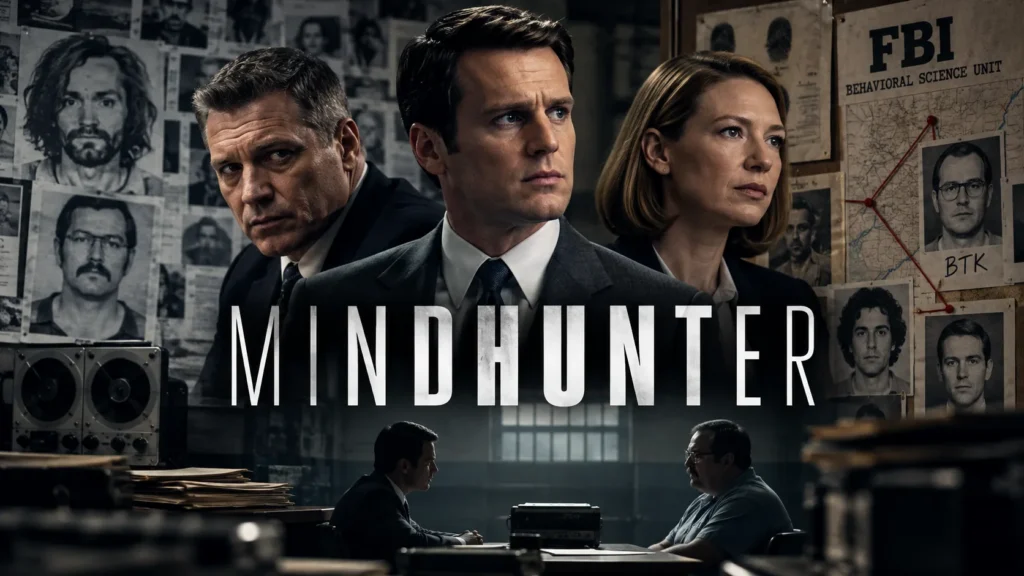
Mindhunter is a psychological crime drama about investigators who try to understand what drives serial killers rather than simply focusing on the crimes they commit. Set in the late 1970s, the series follows FBI agents Holden Ford and Bill Tench as they explore the psychology of violent offenders and develop an emerging approach to criminal profiling. Psychologist Wendy Carr later joins their work, bringing a research-focused perspective to the project.
Created by Joe Penhall, Mindhunter stars Jonathan Groff, Holt McCallany, and Anna Torv. Netflix lists two seasons of the series, released in 2017 and 2019.
Rather than relying on nonstop action, the show builds suspense through interviews, behavioral analysis, uncomfortable conversations, and gradual character development. Its most intense moments often come from watching investigators sit across from dangerous criminals and try to understand how they think.
That approach gives Mindhunter a distinctive identity. It is a crime series, but it is equally interested in psychology, investigation, institutional resistance, and the personal consequences of studying violent behavior.
What Is Mindhunter About?
At its center, Mindhunter asks a difficult question: can investigators learn enough about violent criminals to recognize patterns that might help solve future crimes?
Holden Ford becomes increasingly interested in this idea after encountering cases that challenge traditional approaches to criminal behavior. He believes that investigators can learn something valuable by speaking directly with convicted offenders and examining their motivations, fantasies, experiences, and behavioral patterns.
His work brings him together with Bill Tench, an experienced FBI agent who approaches the idea from a more practical perspective. Their contrasting personalities become an important part of the story. Holden pushes boundaries and searches for new theories, while Bill remains focused on what investigators can realistically use in the field.
The pair eventually begin interviewing imprisoned serial killers. These conversations become more than attempts to gather information about individual crimes. The investigators compare responses and search for recurring characteristics that could help them understand violent offenders as a broader category.
Wendy Carr adds another layer to the project through her psychological expertise. Her involvement helps the team approach the interviews as structured research rather than a collection of isolated conversations.
As a result, Mindhunter combines crime investigation with psychological study. The series is less interested in dramatic shootouts than in the uncomfortable process of asking dangerous people why they became who they are.
The Story of Mindhunter
The story begins with Holden Ford’s growing interest in the psychology of violent crime. His experiences lead him to question whether established investigative methods can fully explain the behavior of serial offenders.
Instead of accepting conventional assumptions, Holden starts looking for a different way to understand criminals. His curiosity eventually takes him into prisons, where he and Bill Tench conduct interviews with convicted offenders.
How Holden Ford Begins Studying Serial Killers
Holden’s approach begins with curiosity. He wants to understand what happens inside the minds of people who commit extreme acts of violence and whether their behavior contains identifiable patterns.
That interest becomes more serious when he starts working with Bill Tench. Bill brings practical FBI experience to Holden’s developing ideas, creating a partnership built around both experimentation and skepticism.
Together, they travel to prisons and speak with convicted offenders. The interviews become the foundation of their research.
Instead of concentrating only on the details of a particular crime, Holden and Bill ask broader questions. They explore childhood experiences, motivations, fantasies, relationships, attitudes toward victims, and the ways offenders understand their own actions.
These conversations gradually change the investigators’ perspective. A criminal’s behavior becomes something they can study rather than simply record.
However, the process also creates risks. Holden’s fascination with the people he interviews sometimes makes it difficult for him to maintain professional distance. The series uses that tension to show that studying violent offenders can affect the investigators themselves.
IMDb identifies Holden and Bill as FBI agents who investigate the psychology of murder and interview notorious serial killers.
Building a New Approach to Criminal Profiling
As Holden and Bill conduct more interviews, they begin looking for connections between different offenders. Their goal is to transform individual conversations into information that investigators can potentially use in other cases.
The project faces resistance because behavioral analysis represents unfamiliar territory for many people inside the FBI. The team must therefore demonstrate that studying criminal psychology can provide practical investigative value.
Wendy Carr becomes increasingly important as the project develops. Her psychological background helps the team organize their observations and consider how individual behaviors might fit into broader patterns.
This changes the nature of their work. The interviews are no longer simply conversations with convicted criminals. They become part of an attempt to build a systematic understanding of violent behavior.
Yet Mindhunter does not portray criminal profiling as an exact science. The characters disagree about interpretations, make mistakes, and sometimes allow personal assumptions to influence their conclusions.
That uncertainty makes the series more compelling. Holden, Bill, and Wendy are exploring a relatively new field, and they do not always know whether their theories will hold up in real investigations.
The deeper they go, the more complicated the work becomes. Their professional interest begins to collide with personal boundaries, creating one of the show’s central themes: understanding violent behavior can come with its own psychological cost.
Mindhunter Cast and Main Characters
The central performances drive much of Mindhunter because the series places enormous weight on dialogue and psychological tension. Jonathan Groff plays Holden Ford, Holt McCallany portrays Bill Tench, and Anna Torv plays Dr. Wendy Carr.
Rather than functioning as a conventional detective trio, the characters approach criminal behavior from different perspectives. Holden brings curiosity and ambition, Bill contributes field experience, and Wendy introduces psychological research.
Their differences create the foundation for the show’s investigative method.

Jonathan Groff as Holden Ford
Jonathan Groff’s Holden Ford serves as the main entry point into the world of behavioral analysis.
Holden approaches criminal psychology with intense curiosity. He wants to understand why serial killers behave the way they do, and that curiosity pushes him beyond traditional FBI thinking.
His willingness to ask uncomfortable questions becomes an important professional strength. However, his confidence can also become a weakness. Holden sometimes becomes so focused on understanding offenders that he risks losing the emotional distance expected from an investigator.
As the series develops, his confidence in behavioral analysis grows. He begins to believe that careful observation and psychological questioning can reveal information that conventional investigative methods might overlook.
That belief shapes his relationships with both Bill and Wendy. Holden often pushes forward before everyone around him agrees with his approach.
The character’s complexity comes from this contradiction. He is helping develop a potentially valuable investigative method, but his fascination with the subject can also affect his judgment.
Jonathan Groff’s performance gives Holden an intense, restless quality that fits the character’s desire to discover something new. IMDb credits Groff as Holden Ford throughout the series.
Holt McCallany as Bill Tench
Bill Tench provides a practical counterweight to Holden’s ambition.
As an experienced FBI agent, Bill understands the realities of criminal investigations. He is willing to explore Holden’s ideas, but he also questions theories that lack clear practical value.
That difference creates one of the show’s strongest partnerships. Bill does not simply support Holden’s research; he challenges him and forces him to consider how behavioral analysis might work outside an interview room.
Bill also represents the personal cost of the work. His professional responsibilities begin affecting his life away from the FBI, demonstrating how difficult it can be to separate disturbing investigations from everyday relationships.
Holt McCallany plays Bill with a restrained style that contrasts naturally with Holden’s more intense personality. His character often becomes the grounding force within the team, particularly when Holden’s curiosity begins to move faster than the evidence.
Through Bill, Mindhunter also explores the limits of professional detachment. Investigators can leave an interview room, but the things they hear and witness do not necessarily stay there.
McCallany is credited as Bill Tench throughout the series.
Anna Torv as Dr. Wendy Carr
Dr. Wendy Carr brings an academic and psychological perspective to the FBI project.
While Holden approaches criminal behavior through curiosity and Bill focuses on practical investigation, Wendy emphasizes research, interpretation, and structure. Her expertise helps the team examine their interview material more systematically.
Wendy’s role becomes increasingly important as the project grows. She can challenge Holden’s assumptions and encourage the team to distinguish between an interesting observation and a reliable behavioral pattern.
Her presence also expands the show’s perspective on criminal psychology. The project is not simply about talking to serial killers; it is about deciding how investigators should interpret what those conversations reveal.
Wendy therefore becomes an important intellectual counterbalance within the group. She can recognize the value of the research while remaining aware of its limitations.
Anna Torv gives the character a controlled and analytical presence that fits the show’s slower, dialogue-driven approach. Her performance also helps establish Wendy as more than an adviser to Holden and Bill; she becomes an essential part of the developing behavioral-science project.
IMDb credits Torv as Dr. Wendy Carr across the series.
Is Mindhunter Based on a True Story?
Yes. Mindhunter draws heavily from real FBI behavioral-analysis work, but the series is a dramatization rather than a documentary. Netflix describes the show as being inspired by true events, while its central characters and storylines combine historical foundations with television storytelling.
The series takes inspiration from the development of criminal profiling within the FBI during the 1970s. Agents studied violent offenders, interviewed convicted killers, and searched for behavioral patterns that could help investigators understand unsolved crimes.
However, viewers should not treat every character, conversation, or event as a literal recreation of history. The show reshapes real people and events to create a coherent dramatic narrative.
That distinction matters when watching Mindhunter. The foundation is real, but the presentation is designed for television.
The series also draws from the book Mindhunter: Inside the FBI’s Elite Serial Crime Unit, written by former FBI agent John E. Douglas and Mark Olshaker. Douglas’s career and interviews with violent offenders helped provide part of the real-world foundation behind the series.
As a result, Mindhunter sits between historical crime drama and psychological thriller. Its most important ideas come from genuine developments in criminal investigation, while the characters and dramatic situations receive creative treatment.
The Real FBI Behavioral Science Background
The real history behind Mindhunter reaches back to the early development of behavioral analysis within the FBI.
In 1972, the FBI Academy established a Behavioral Science Unit. The unit studied criminal behavior and worked to identify patterns that could help investigators understand violent offenders. The FBI later described behavioral analysis as an approach focused on behavior, experiences, and psychological characteristics that may provide investigative insights.
Agents Howard Teten and Patrick Mullany played important roles in the early development of this work. Robert Ressler later joined the unit, while John Douglas became another prominent figure in the development of criminal profiling.
The FBI records that Douglas and Ressler conducted systematic interviews with serial killers, gathering information about their backgrounds, motivations, and methods. Those interviews contributed to the development of offender profiles used in investigations.
This history closely parallels the central idea of Mindhunter: investigators can learn about violent crime by studying offenders themselves.
The television series compresses and reshapes this history through fictionalized characters, but the underlying concept reflects a genuine period of change within American law enforcement.
Which Parts of Mindhunter Are Fictionalized?
The biggest distinction between Mindhunter and a documentary is the treatment of its central characters.
Holden Ford is not simply a television version of one real FBI agent. The character draws inspiration from people involved in the development of behavioral profiling, particularly John Douglas and related figures. Bill Tench similarly reflects elements associated with real FBI agents, including Robert Ressler.
Wendy Carr also represents a dramatized character rather than a straightforward one-to-one portrayal of a single historical person.
The series combines these influences to create a compact team capable of carrying the story across different investigations.
The same principle applies to individual conversations. Some interviews reflect real encounters, while the dialogue and circumstances have been shaped for dramatic purposes.
Netflix itself describes Mindhunter as “inspired by true events,” which is an important distinction.
Therefore, the most accurate way to view the series is as historically inspired drama. Its setting, investigative ideas, offenders, and broader FBI history have real foundations, but the finished story uses fictionalization to build character arcs and dramatic tension.
The Real Serial Killers Featured in Mindhunter
One of the show’s most recognizable elements is its use of real serial killers as interview subjects.
Rather than inventing every offender, Mindhunter places fictionalized FBI investigators across from criminals whose names and crimes are part of American criminal history.
Ed Kemper, Jerry Brudos, Richard Speck, David Berkowitz, Charles Manson, and other notorious figures appear or receive attention during the series. Netflix’s episode descriptions specifically identify Ed Kemper and Richard Speck among the offenders encountered by the FBI team.
The inclusion of real criminals serves a larger storytelling purpose. Their interviews allow the show to explore how investigators gather information from people who may have very different motivations, personalities, and methods.
However, the series does not attempt to provide a complete biography of every offender.
Instead, it selects particular aspects of their behavior and conversations that connect with the development of the FBI’s behavioral-analysis project.
This approach allows Mindhunter to use historical figures without turning the series into a conventional true-crime documentary.
Ed Kemper
Ed Kemper becomes one of the most important early interview subjects in Mindhunter.
The series introduces him as an unusually articulate and cooperative prisoner, creating an unsettling contrast between his calm conversational style and the crimes associated with him. Holden becomes particularly interested in what Kemper can reveal about violent behavior.
Netflix’s episode guide identifies Kemper as the murderer Holden interviews early in Season 1.
The interviews serve several purposes within the story. First, they demonstrate how the FBI team begins gathering information directly from offenders. Second, they show how difficult it can be to interpret an offender who appears intelligent, composed, and willing to talk.
Kemper’s scenes also establish one of the series’ recurring ideas: communication itself can become a source of investigative information.
Holden is not simply trying to learn what Kemper did. He wants to understand how Kemper explains himself, how he views his crimes, and what those explanations might reveal about violent behavior more broadly.
Cameron Britton’s performance became one of the show’s most recognizable supporting performances, but the character remains grounded in a real criminal case rather than being an entirely fictional creation.
The series nevertheless dramatizes the interview material, so viewers should distinguish the television dialogue from historical transcripts.
Other Serial Killers in the Series
Mindhunter expands beyond Kemper and introduces or discusses several other real offenders.
Among the notable figures are:
| Serial Killer / Offender | Role in the Series |
|---|---|
| Ed Kemper | Major early interview subject |
| Jerry Brudos | Interview subject during the team’s early research |
| Richard Speck | Interviewed by Holden in Season 1 |
| David Berkowitz | Interview subject in Season 2 |
| Charles Manson | Appears through an interview in Season 2 |
| Wayne Williams | Central to the Atlanta storyline |
Netflix’s official episode information confirms the team’s interviews with offenders including Kemper and Richard Speck, while the FBI’s historical material documents the real behavioral-analysis work involving serial killers and later investigations such as the Atlanta murders.
The series uses these figures differently. Some appear through direct interviews, while others connect to larger investigations.
That structure lets the show examine different forms of violent behavior rather than presenting serial murder as a single psychological pattern.
The Real FBI Research Behind the Interviews
The interview scenes in Mindhunter reflect a broader effort to collect information directly from offenders.
The FBI explains that behavioral analysis developed partly through efforts to understand criminal behavior, experiences, motivations, and patterns. Agents interviewed violent offenders to gather information that could contribute to investigative profiles.
This research also involved attempts to classify behavioral characteristics. Later FBI research explored offender typologies and examined whether particular behaviors could provide useful investigative clues.
Importantly, these approaches were never presented as an infallible formula. FBI research has acknowledged that offenders can display characteristics that overlap between categories, meaning behavior does not always fit neatly into a single box.
That nuance is important when interpreting Mindhunter. The characters are developing theories, testing ideas, and sometimes discovering that real cases are more complicated than their models suggest.
The show’s interview sequences therefore work on two levels. They provide tense television drama, but they also illustrate an important historical shift in criminal investigation: the idea that studying an offender’s behavior could become a practical investigative resource.
Why the True-Story Element Matters to Mindhunter
The real-world foundation gives Mindhunter much of its distinctive atmosphere.
The series takes place during a period when behavioral analysis was still developing within American law enforcement. The FBI’s Behavioral Science Unit emerged in 1972, and later developments expanded behavioral analysis into a broader investigative discipline.
That historical timing gives the story a built-in source of conflict. Holden, Bill, and Wendy are not entering an established system with every method already proven. They are helping shape an emerging field.
Consequently, the show’s tension does not depend only on whether investigators will catch a killer. It also comes from questions about whether their theories will work, whether colleagues will accept them, and how much confidence investigators should place in behavioral evidence.
This makes the true-story foundation more than background information. It directly shapes the series’ central conflict.
Mindhunter uses real criminal cases and real developments in FBI history, but it turns them into a character-driven story about experimentation, uncertainty, and the difficult attempt to understand violent behavior.
Mindhunter Season 1 Explained
The first season establishes the foundation of the FBI’s behavioral-analysis project and introduces Holden Ford’s growing interest in the psychology of serial offenders. The story begins with Holden working as an FBI hostage negotiator before his experiences push him toward a different way of understanding violent crime.
His ideas eventually bring him together with Bill Tench, an experienced FBI agent who travels around the country training local law-enforcement agencies. Their partnership allows Holden to test his theories while Bill provides a practical investigative perspective.
The two begin interviewing imprisoned killers, including Ed Kemper. These conversations give them access to information that traditional case files cannot provide. Instead of focusing only on what offenders did, the agents explore their motivations, fantasies, childhood experiences, and attitudes toward their crimes.
As the interviews continue, the project develops into something more organized. Wendy Carr joins the team and helps transform scattered observations into a more structured research effort.
Season 1 also shows the limitations of their approach. Holden becomes increasingly fascinated by the offenders, while Bill remains concerned about the practical and personal consequences of the work.
The season ultimately functions as an origin story for behavioral analysis. What begins as an unconventional experiment gradually becomes a serious attempt to understand violent offenders through psychology and behavioral patterns.
The Formation of the Behavioral Science Project
Holden’s partnership with Bill becomes the starting point for a new investigative approach.
Bill initially views Holden’s theories with caution, but their different strengths eventually complement each other. Holden asks unconventional questions and searches for psychological explanations, while Bill understands the realities of police work and active investigations.
Their travels expose them to departments dealing with difficult violent-crime cases. These experiences strengthen Holden’s belief that investigators need more than traditional methods to understand certain offenders.
The prison interviews become the project’s most important source of information. Ed Kemper, in particular, provides Holden and Bill with an unusual opportunity to study a convicted serial killer who is willing to discuss his behavior.
As the interviews accumulate, the team begins recording information and searching for recurring characteristics. They want to determine whether individual offenders share behavioral patterns that investigators could recognize in future cases.
Wendy Carr later gives the project greater structure. Her psychological background encourages the team to approach their findings more systematically.
However, the FBI does not immediately embrace the work. Behavioral analysis is still developing, and some officials question whether conversations with convicted killers can produce reliable investigative information.
The team’s challenge is therefore larger than gathering interviews. They must prove that their unconventional research can become a useful part of criminal investigation.
Major Season 1 Developments
The interviews gradually change Holden’s understanding of violent offenders.
Ed Kemper becomes especially significant because his calm and articulate manner contrasts sharply with the crimes he committed. His behavior forces Holden to reconsider assumptions about how a serial killer should appear or communicate.
The team also interviews other offenders, including Jerry Brudos and Richard Speck. Each conversation provides different information and complicates the team’s attempt to identify consistent behavioral patterns.
Meanwhile, Holden’s confidence continues to grow. He starts applying what he has learned to active investigations and becomes increasingly convinced that behavioral analysis can help investigators narrow their focus.
That confidence creates problems. Holden sometimes pushes his theories further than the available evidence can support, while his fascination with offenders makes it harder for him to maintain professional distance.
The season also explores the psychological effect of the work. Constant exposure to disturbing crimes and offenders affects Holden and Bill in different ways. Wendy, meanwhile, remains focused on turning their experiences into a more disciplined research process.
By the end of Season 1, the project has moved far beyond Holden’s initial curiosity. The team has begun building a new investigative framework, although they still have much to learn about its strengths and limitations.
Mindhunter Season 2 Explained
Season 2 expands the behavioral-analysis project and places Holden, Bill, and Wendy in more demanding investigations.
By this point, the team’s work has attracted greater attention within the FBI. Their interviews have produced a growing body of information, allowing them to compare offenders and develop increasingly detailed theories about violent behavior.
The season continues the interview-based approach established in the first season. Holden and Bill speak with notorious criminals such as David Berkowitz and Charles Manson, giving the team additional material for their research.
However, the second season also becomes more personal. Bill faces a serious family situation that begins affecting his ability to separate his professional responsibilities from his private life.
Holden, meanwhile, becomes increasingly confident in behavioral analysis. His growing reputation gives him greater influence, but it also makes him more willing to trust his own interpretations.
The season’s central storyline eventually focuses on the Atlanta child murders, a real investigation involving the deaths of numerous children and young people.
This case gives the team a much larger test than their earlier interviews. They are no longer simply studying convicted offenders in controlled environments. They must apply their developing ideas to an active and highly complex investigation.
Season 2 therefore shifts the show’s focus from developing behavioral analysis to testing it in the real world.
The FBI Project Expands
By Season 2, Holden, Bill, and Wendy have accumulated enough interview material to move beyond the earliest experimental stage of their research.
The team now has more offenders to compare and more opportunities to identify recurring behaviors. Their work begins receiving greater institutional attention, giving them access to investigations that require more than theoretical discussion.
Holden sees this development as an opportunity. He believes behavioral analysis can help investigators narrow the possibilities in difficult cases.
Bill remains more cautious. His experience reminds him that real investigations rarely fit neatly into a psychological theory. Evidence can be incomplete, witnesses can be unreliable, and circumstances can change rapidly.
Wendy continues to emphasize careful interpretation. Her role helps distinguish between an intriguing observation and a conclusion supported by sufficient evidence.
The team’s growing influence also creates internal tension. Holden’s confidence can make collaboration difficult, particularly when he becomes convinced that his interpretation is correct.
At the same time, the series continues exploring the personal consequences of their work. The behavioral-science project is becoming more important professionally, but its disturbing subject matter increasingly follows the investigators into their private lives.
Season 2 therefore presents behavioral analysis as an emerging investigative discipline rather than simply an experiment conducted by three curious people.
The Atlanta Child Murders Storyline
The Atlanta child murders become the central investigation of Season 2.
The real case involved the killings of numerous children and young people in Atlanta between 1979 and 1981. The investigation became one of the most complex and heavily scrutinized criminal cases of the period.
In Mindhunter, Holden and Bill become involved because their behavioral-analysis work offers another way to examine the investigation.
Wayne Williams becomes the central suspect in the series’ portrayal of the case. The investigation allows the show to explore the difficult relationship between behavioral profiling and conventional police work.
The case also exposes one of profiling’s biggest challenges: investigators must work with incomplete information while avoiding assumptions that go beyond the available evidence.
Holden believes behavioral analysis can help identify patterns in the offender’s behavior. However, the complexity of the investigation demonstrates that profiling cannot replace physical evidence, forensic work, witness information, or traditional detective work.
The Atlanta storyline also gives the series a broader social dimension. The investigation involves grieving families, public pressure, competing theories, and questions about how authorities respond when victims are vulnerable.
By placing this case at the center of Season 2, Mindhunter shows both the potential value and the limitations of behavioral analysis.
The Atlanta Investigation and Holden’s Growing Confidence
The Atlanta investigation becomes an important test of Holden’s developing theories.
Earlier interviews gave Holden a controlled environment in which he could study offenders and analyze their responses. The Atlanta case is fundamentally different. It involves an active investigation, multiple victims, public pressure, competing theories, and an offender who has not simply agreed to sit down and explain his behavior.
Holden believes his understanding of criminal psychology can help investigators narrow the field. His confidence becomes increasingly visible as the investigation develops.
However, the case also demonstrates the danger of treating a behavioral theory as certainty.
Bill approaches the investigation more cautiously. His experience makes him aware that real cases contain unpredictable factors that cannot always fit a theoretical model.
Wendy’s research-oriented perspective adds another layer of caution. She understands that behavioral observations can provide useful information, but she also recognizes the importance of distinguishing evidence from interpretation.
This creates a central tension within the team. Holden wants behavioral analysis to become a powerful investigative tool, while Bill and Wendy remain more aware of its limitations.
The Atlanta storyline therefore tests the entire philosophy behind the project. The team has spent years studying offenders in order to understand violent behavior. Now they must determine how much that knowledge can actually tell them about an ongoing case.
The Role of Real Cases in Season 2
Season 2 uses real criminal cases to broaden the show’s exploration of behavioral profiling.
The Atlanta investigation provides the largest example, but the season also returns to the interview format. David Berkowitz and Charles Manson become notable subjects, giving Holden and Bill opportunities to compare different personalities and explanations for violent behavior.
These conversations continue the method established during Season 1. The investigators listen carefully, record observations, and search for similarities between offenders.
Yet the series increasingly emphasizes that similar behaviors do not necessarily mean identical motivations.
Two offenders can display comparable characteristics while having completely different backgrounds, experiences, and reasons for committing crimes. Investigators can also interpret the same behavior differently depending on the evidence surrounding a case.
That complexity prevents Mindhunter from presenting profiling as a simple formula.
The interviews provide information, but the investigators still have to evaluate that information carefully. Behavioral analysis can contribute to an investigation without becoming a substitute for evidence.
This idea becomes increasingly important as the series progresses. The team is learning that understanding a criminal’s psychology can help investigators ask better questions, but it cannot automatically provide every answer.
Season 2 consequently deepens the show’s central theme: studying criminal behavior can be valuable, but human beings rarely fit perfectly into a predetermined psychological category.
Mindhunter and David Fincher
David Fincher played a major creative role in shaping Mindhunter. Although Joe Penhall created the series, Fincher served as an executive producer and directed multiple episodes alongside Andrew Dominik and Carl Franklin.
Fincher’s influence is especially visible in the show’s controlled visual style and patient approach to suspense. Rather than rushing from one violent event to another, the series often allows scenes to unfold slowly, giving conversations and small behavioral details room to create tension.
That approach fits the subject matter. A series about criminal psychology does not need constant action to create suspense. Instead, Mindhunter can make a quiet interview feel threatening because viewers understand the person sitting across from the investigators.
Fincher’s involvement also connects the series with his broader body of crime and psychological work. However, Mindhunter remains a collaborative production rather than a project directed entirely by one filmmaker.
Netflix identifies Penhall as the creator and credits Fincher, Dominik, and Franklin among the series’ directors. Fincher also served as an executive producer alongside several other producers.
The result is a series with a distinctive identity: restrained, atmospheric, dialogue-heavy, and intensely focused on the psychology of its characters.
Why Mindhunter Feels Different From Other Crime Shows
Many crime dramas build their stories around investigations, arrests, courtroom battles, or action sequences. Mindhunter takes a different route.
Its central mystery often involves understanding behavior rather than simply identifying a suspect. The investigators want to know how offenders think, what motivates them, and whether their behavior reveals patterns that could help solve future crimes.
That shift changes the show’s rhythm.
Instead of constant action, viewers spend significant time watching interviews, reviewing information, discussing theories, and observing how the investigators react to disturbing material.
The result is a crime drama where conversation can create as much tension as violence.
Netflix itself categorizes the series around psychological, mystery, crime, and thriller elements, reflecting the show’s combination of investigative storytelling and behavioral analysis.
The approach also allows the characters to remain central. Holden’s ambition, Bill’s caution, and Wendy’s analytical perspective influence how the team interprets every case.
Rather than presenting criminal profiling as a magical solution, Mindhunter shows it developing through experimentation, disagreement, and uncertainty.
Modern crime dramas continue to explore criminal behavior from different perspectives. Fightland, for example, takes a contemporary approach to crime storytelling while focusing on its characters, conflicts, and the consequences surrounding them.
That combination gives the series its distinctive tone and helps explain why its appeal extends beyond traditional crime-show audiences.
Psychology Instead of Action
The most important difference between Mindhunter and many crime dramas is its emphasis on psychology.
The series spends considerable time allowing investigators to talk with offenders. Those conversations can last for several minutes without a chase, fight, or conventional action sequence.
Yet the scenes remain tense because the audience knows what the interview subjects have done.
The danger comes from information and personality. A criminal’s answer can reveal something disturbing, while a seemingly ordinary statement can expose a deeper pattern.
Holden is particularly interested in these moments. He wants to understand how offenders describe themselves and whether their explanations reveal common characteristics.
Bill approaches the conversations more cautiously, while Wendy examines the information through a research-oriented perspective.
This creates a layered form of suspense. The audience watches the investigators try to understand the person sitting across from them, while also wondering whether their interpretation is correct.
The approach makes Mindhunter less about spectacle and more about observation.
Even when the series discusses horrific crimes, it often keeps the violence outside the frame. The psychological aftermath becomes more important than graphic depiction.
That restraint allows the show to create an unsettling atmosphere without relying on constant shock value.
The Show’s Slow-Burn Approach
Mindhunter deliberately takes its time.
The series often allows conversations to continue beyond the point where another crime drama might cut to an action sequence. That pacing gives characters room to reveal themselves gradually.
The slow-burn structure also makes small changes feel significant. A shift in Holden’s confidence, a disagreement between team members, or a subtle change in an interview can carry major dramatic weight.
The setting reinforces this approach. Offices, prison interview rooms, cars, homes, and conference rooms become recurring spaces where information develops slowly.
The series also avoids making every investigation immediately understandable. Viewers often discover information at roughly the same pace as the characters, which creates a sense of uncertainty.
This pacing will not appeal equally to every viewer. Someone expecting constant action may find the series deliberately measured. However, viewers interested in psychological investigation get more time to examine the characters and their methods.
The result is a crime drama built around accumulation rather than speed. Individual conversations, cases, and character decisions gradually create a larger picture of the FBI’s developing behavioral-analysis work.
Mindhunter Ending Explained
Season 2 ends without resolving every storyline introduced across the series.
The Atlanta investigation reaches an important stage, while the personal and professional situations of Holden, Bill, and Wendy remain complicated.
Holden’s increasing confidence in behavioral analysis continues to shape his work. At the same time, Bill faces unresolved family issues, and Wendy’s professional path remains connected to the future of the research project.
Another major thread involves the unidentified BTK killer. The series repeatedly presents glimpses of this character outside the main FBI storyline, establishing a parallel narrative that remains unresolved by the end of Season 2.
This structure gives the finale an unusual quality. Rather than tying every storyline together, the series leaves several threads open.
The ending therefore works less like a traditional crime-show conclusion and more like a stopping point in a larger historical story.
Netflix’s official material confirms that the series currently consists of two seasons, with the second season continuing the behavioral-analysis storyline and the investigation of notorious offenders.
For viewers, the unresolved elements naturally raise questions about what could have happened next. However, those possibilities should remain separate from what the series actually establishes on screen.
What Happens at the End of Season 2?
The Season 2 finale brings several character and investigation threads to a tense point.
The Atlanta case remains central, while Holden’s confidence in his behavioral theories continues to develop. His work has given him greater recognition, but it has also created professional and personal complications.
Bill’s storyline remains deeply personal. His family situation has become increasingly difficult, and the pressure of his FBI work adds another layer to the problem.
Wendy, meanwhile, continues to navigate her position within the behavioral-science project and the personal choices surrounding her professional life.
The finale also returns attention to the mysterious BTK storyline. Earlier episodes have shown an unidentified man whose behavior resembles the historical BTK killer, creating a parallel narrative that has never fully intersected with Holden’s team.
That unresolved thread becomes one of the show’s most recognizable loose ends.
Importantly, the Season 2 ending does not provide a conventional final confrontation with BTK. Instead, the series leaves the storyline open while the main characters continue dealing with their own professional and personal challenges.
This makes the finale feel deliberately incomplete rather than conventionally conclusive.
Why the Ending Leaves Questions
The unanswered questions surrounding Mindhunter come from both the show’s storytelling and its historical scope.
The series is based on a period of criminal-investigation history that extends far beyond the events shown in its two seasons. The FBI’s behavioral-analysis work continued developing after the period covered by much of the series.
Because the television story stops before resolving every thread, viewers naturally wonder how Holden, Bill, and Wendy might have continued their work.
The BTK storyline creates an additional layer of anticipation because the audience knows the identity and historical significance of the figure being shown, while the main investigators remain unaware of the full picture.
However, an unresolved storyline should not automatically be treated as confirmation of a future season. The show itself ends with those threads open.
That distinction matters when discussing the series’ future. The existing episodes provide evidence about where the characters and historical storylines stand at the end of Season 2, but they do not establish every possible direction the story could take afterward.
The unfinished quality has therefore become part of the identity of Mindhunter. Its final season leaves viewers with questions rather than providing a neat conclusion.
Mindhunter Ratings and Critical Reception
Mindhunter developed a strong critical reputation during its two-season run.
Its reception reflects the qualities that define the series: psychological storytelling, detailed performances, atmospheric direction, restrained pacing, and an unusual approach to crime drama.
The series also attracted particular attention for performances by its central cast and supporting actors portraying real-life criminals.
Netflix described the show as critically acclaimed when announcing its second season, while contemporary coverage highlighted its approach to reinventing the crime procedural.
Rather than relying on conventional action, the series builds much of its appeal through dialogue and character psychology.
That approach helped establish Mindhunter as a distinctive crime series within Netflix’s original programming.
Its reception also reflects a broader interest in true-crime-inspired entertainment. However, the show’s focus remains more analytical than sensational. It spends considerable time examining investigators and their methods instead of simply dramatizing the crimes themselves.
For viewers researching the series today, its critical reception provides useful context, but the show’s appeal ultimately depends on whether its deliberate pacing and psychological focus match their preferences.
IMDb and Audience Reception
IMDb provides one measure of the show’s audience response.
The series has maintained a strong user rating and a substantial number of ratings on the platform. Those figures indicate sustained viewer interest, although an IMDb rating represents user opinion rather than an objective measurement of quality.
Audience ratings can also change over time as new viewers discover a series.
For Mindhunter, the broader pattern is more significant than any single number. The show has continued to attract viewers interested in crime dramas, serial-killer stories, psychological thrillers, and the history of criminal profiling.
Its audience appeal also extends beyond viewers who normally follow procedural crime series. The emphasis on character psychology and historical context gives it a different viewing experience.
IMDb’s cast and series information also reflects the show’s ensemble structure, with Jonathan Groff, Holt McCallany, Anna Torv, and Cameron Britton among its notable performers.
Taken together, the audience response helps explain why Mindhunter remains a frequently discussed Netflix crime drama despite having only two seasons.
Rotten Tomatoes Reception
Rotten Tomatoes offers another perspective by separating critic and audience measurements.
The series received strong reviews from critics, particularly for its performances, writing, direction, and unconventional approach to the crime genre. Its reception across the two seasons reflects the show’s consistent critical appeal.
However, aggregate scores should be treated as a summary of many individual opinions rather than a replacement for those reviews.
What stands out about the critical response is the repeated attention to the same qualities that define the series itself: patient storytelling, psychological depth, strong performances, and carefully controlled atmosphere.
Critics also recognized that Mindhunter does not follow the conventional rhythm of a network crime procedural.
Its emphasis on interviews and behavioral analysis gives the series a slower structure, but that structure allows the writers and actors to explore characters in greater detail.
For potential viewers, the critical response provides useful context. The show was widely recognized for its distinctive approach, while its deliberately slow pace remains an important part of the viewing experience.
Where to Watch Mindhunter
Mindhunter is a Netflix original series, and the complete two-season run is available through Netflix in supported regions. The series consists of two seasons released in 2017 and 2019, giving viewers a relatively compact story compared with many long-running crime dramas.
The show’s Netflix format also makes it easy to watch the story in chronological order. Starting with Season 1 is important because the behavioral-analysis project develops gradually, and the relationships between Holden Ford, Bill Tench, and Wendy Carr become increasingly important as the story progresses.
If you’re looking for another Netflix crime series after Mindhunter, The Gentlemen Season 2 offers a very different take on the genre, combining crime storytelling with a more stylized and darkly comedic approach.
Because the series deals with serial murder, disturbing criminal behavior, and mature psychological themes, it is intended for an adult audience.
For new viewers, watching the episodes in release order provides the clearest experience. Season 1 establishes the FBI team’s methodology, while Season 2 expands the project into larger investigations and deeper personal conflicts.
The series’ two-season structure also means that viewers can complete the available story without committing to a long-running television franchise.
How Many Seasons of Mindhunter Are There?
Mindhunter has two seasons.
The first season premiered in 2017 and introduces Holden Ford, Bill Tench, and Wendy Carr as they develop an experimental approach to understanding serial killers.
The second season arrived in 2019 and expands the team’s work into larger investigations, including the Atlanta child murders storyline. It also introduces additional real-life offenders through the team’s continuing interview research.
Season 1
Release: 2017
Episodes: 10
Season 1 establishes the behavioral-analysis project and introduces the team’s early interviews with serial killers. It focuses heavily on the development of Holden’s ideas and his partnership with Bill.
Season 2
Release: 2019
Episodes: 9
Season 2 expands the FBI project and places the characters in more complicated investigations. The Atlanta child murders become the season’s major case, while interviews with offenders such as David Berkowitz and Charles Manson continue the research established in Season 1.
Is Mindhunter Worth Watching?
Whether Mindhunter works for a particular viewer largely depends on what they expect from a crime drama.
The series is particularly suited to viewers who enjoy:
- Psychological crime stories
- Serial-killer investigations
- Historical crime dramas
- Character-driven television
- Dialogue-heavy suspense
- Criminal psychology
- Slow-burn storytelling
- FBI investigations
The show may feel less conventional for viewers who primarily want fast action, frequent chase sequences, or straightforward detective stories.
Its strongest emphasis falls on conversations, behavioral analysis, character development, and investigative uncertainty.
Another important factor is the subject matter. Mindhunter deals with disturbing crimes and real-life offenders, but it generally approaches them through investigation and psychology rather than relying on graphic violence.
The series also rewards attentive viewing. Small details in conversations and character interactions can become important later, while several storylines develop gradually rather than receiving immediate explanations.
Viewers who enjoy Netflix thrillers can also explore I Will Find You, which takes a more mystery-driven approach to suspense and storytelling. While Mindhunter develops tension through behavioral analysis and long-form conversations, I Will Find You places greater emphasis on its unfolding thriller narrative.
For viewers interested in the psychology behind criminal investigations, Mindhunter offers a very different experience from a conventional procedural.
Why Mindhunter Remains Distinctive
One reason Mindhunter continues to attract attention is its combination of historical crime, psychological analysis, and character-driven storytelling.
The series does not simply ask who committed a crime. It repeatedly asks how investigators can understand the person responsible and whether that understanding can help solve future cases.
Its real-world foundation adds another layer. The FBI’s development of behavioral analysis gives the fictional story a historical framework, while the dramatized characters allow the series to explore the emotional and professional consequences of that work.
The performances also contribute to the show’s identity. Jonathan Groff, Holt McCallany, and Anna Torv create a central team whose disagreements are as important as their cooperation.
At the same time, the portrayal of real serial killers adds historical context without turning the series into a straightforward documentary.
The combination produces a show that feels measured and investigative rather than action-driven.
That approach explains why Mindhunter can appeal to audiences interested in crime television, psychology, FBI history, and true-crime-inspired storytelling at the same time.
Frequently Asked Questions About Mindhunter
What is Mindhunter about?
Mindhunter follows FBI agents Holden Ford and Bill Tench as they study the psychology of serial killers and develop an emerging approach to criminal profiling. Psychologist Wendy Carr later becomes an important part of their research. The series combines fictionalized characters with real criminal cases and historical developments in FBI behavioral analysis.
Is Mindhunter based on a true story?
Yes. Mindhunter draws inspiration from real FBI behavioral-analysis work and real serial-killer cases. However, it is a dramatized television series rather than a documentary. Some characters combine characteristics associated with real people, while certain conversations and events receive fictionalized treatment for storytelling purposes.
How many seasons of Mindhunter are there?
There are two seasons of Mindhunter. Season 1 premiered in 2017 with 10 episodes, while Season 2 premiered in 2019 with nine episodes. Together, the two seasons form the complete released series.
Who plays Holden Ford in Mindhunter?
Jonathan Groff plays Holden Ford, one of the FBI agents at the center of the series. Holden is particularly interested in understanding the psychology and behavioral patterns of serial killers. His curiosity drives much of the team’s early research and creates both professional opportunities and personal complications.
Who plays Bill Tench?
Holt McCallany plays Bill Tench. Bill is an experienced FBI agent who works alongside Holden Ford. His practical approach provides a contrast to Holden’s more theoretical and ambitious personality. Their differences become an important part of the show’s investigative and character-driven storytelling.
Who plays Wendy Carr?
Anna Torv plays Dr. Wendy Carr. Wendy brings a psychological and academic perspective to the FBI’s behavioral-analysis project. Her role becomes increasingly important as the team moves from informal interviews toward a more structured approach to studying violent offenders.
Which serial killers appear in Mindhunter?
The series features or discusses several real-life offenders, including Ed Kemper, Jerry Brudos, Richard Speck, David Berkowitz, and Charles Manson. Wayne Williams also becomes central to the Atlanta child murders storyline. The show uses these figures within a dramatized narrative rather than presenting their stories as documentary biographies.
Is Mindhunter available on Netflix?
Mindhunter is a Netflix original series and has two released seasons. Availability can vary by country and over time, so viewers should check their local Netflix catalog for the current listing.
Is Mindhunter a documentary?
No. Mindhunter is a scripted crime drama inspired by real events and people. It incorporates real criminal cases and the historical development of FBI behavioral analysis, but it uses fictionalized characters, dramatized conversations, and reconstructed events to tell its story.
Who created Mindhunter?
Joe Penhall created Mindhunter. David Fincher also played a major creative role as an executive producer and director of multiple episodes. The series was developed from the book Mindhunter: Inside the FBI’s Elite Serial Crime Unit by John E. Douglas and Mark Olshaker.
Final Thoughts on Mindhunter
Mindhunter stands out because it approaches serial-killer stories from the perspective of investigation, psychology, and behavioral research rather than relying primarily on action.
Across two seasons, Holden Ford, Bill Tench, and Wendy Carr develop an unconventional approach to understanding violent offenders. Their interviews with real-life criminals provide the foundation for a larger investigation into how behavioral patterns might help law enforcement.
At the same time, the series makes clear that criminal profiling has limitations. The characters make mistakes, disagree about interpretations, and sometimes allow their personal assumptions to influence their work.
Its historical foundation also adds depth. The show draws from genuine developments in FBI behavioral analysis while using fictionalized characters and dramatized situations to create a compelling television narrative.
The result is a slow-burning crime drama built around questions rather than simple answers. It explores how investigators try to understand violent behavior, how that work changes them, and how difficult it can be to turn psychological theories into practical investigative tools.
For viewers interested in crime, criminal psychology, FBI history, and character-driven thrillers, Mindhunter offers a distinctive examination of how modern behavioral profiling began taking shape.