
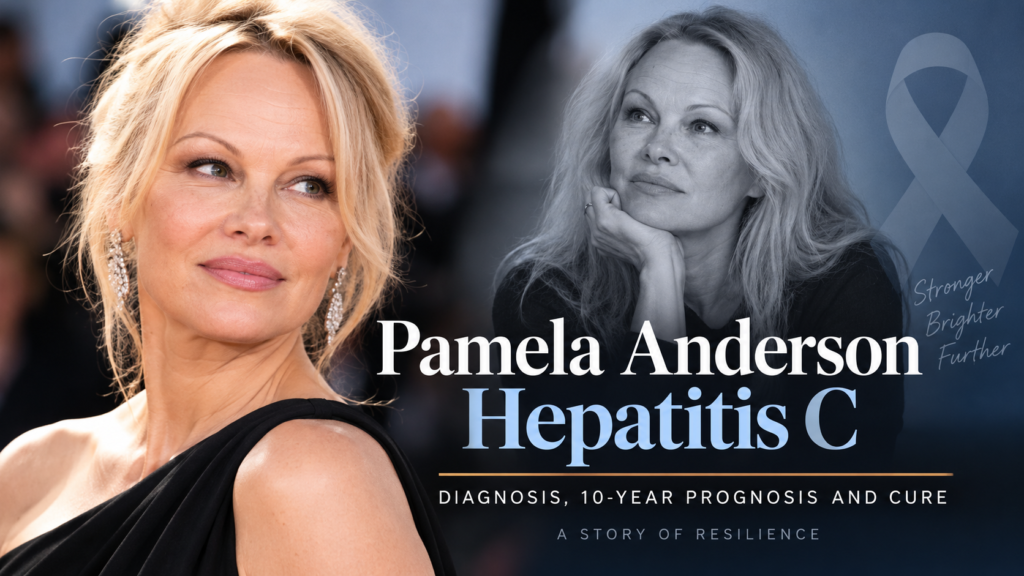
Pamela Anderson Hepatitis C has become a major topic again in 2026, more than two decades after she first revealed her diagnosis. While accepting amfAR’s Award of Courage in Venice, Anderson reflected on one of the most frightening periods of her life. She recalled being told that she might have only about 10 years to live.
For Anderson, those words changed how she viewed the future. She was raising her two sons, Brandon and Dylan, and suddenly had to face the possibility that she might not see them grow up. The diagnosis affected more than her health. It shaped her choices, relationships and outlook on life.
Her story, however, did not end with that prognosis. As hepatitis C treatment improved, Anderson eventually found an effective path forward. In 2015, she publicly announced that she had been cured.
Her experience now reflects two very different eras of hepatitis C: the fear surrounding the disease when she was diagnosed and the major treatment advances that later changed her outlook.
Pamela Anderson Hepatitis C Diagnosis: What Happened?
Anderson publicly revealed her hepatitis C diagnosis in 2002. At the time, she said she believed she had contracted the virus after sharing a tattoo needle with her then-husband, Tommy Lee.
The circumstances later became disputed. Lee rejected Anderson’s account and denied having hepatitis C. Therefore, the specific route of transmission is best presented as Anderson’s account rather than an independently confirmed fact.
The diagnosis itself, however, became a major turning point in Anderson’s life. She was dealing with a viral infection that could affect the liver and potentially cause serious complications if it became chronic and remained untreated.
The medical landscape also looked very different from today. Treatment options were more difficult, and Anderson understood her diagnosis as a potentially life-threatening condition.
That fear quickly became personal. She was thinking about mortality, her children and how much time she might have left. With Brandon and Dylan still young, the possibility of not being there for them became one of the hardest parts of the experience.
The fear did not disappear quickly. It remained part of Anderson’s story for years, even as new treatments began changing what hepatitis C could mean for patients.
Why Pamela Anderson Was Told She Had 10 Years to Live
In 2026, Anderson revisited that period while speaking at an amfAR event in Venice. She recalled a doctor telling her that she had roughly 10 years to live.
Anderson remembered the prognosis as feeling like a death sentence. Hearing a specific number attached to her future made the diagnosis feel frighteningly real.
Her sons were central to that fear. Anderson was raising two young children, so the possibility of dying early was not only about her own future. She also worried about what her absence would mean for them.
There is an important distinction, though. Anderson’s reported 10-year prognosis should not be treated as a standard life expectancy for people with hepatitis C. The infection can progress differently from person to person, and treatment has changed dramatically since her diagnosis.
The significance of the statement lies in its impact on Anderson. She believed she had limited time, and that belief influenced how she approached important decisions.
Today, she can look back from a very different place. More than two decades have passed since that frightening prediction, and she eventually received treatment that cleared the infection.
What once felt like a countdown became something else entirely: a chapter of her life that she survived.
How Hepatitis C Changed Pamela Anderson’s Life
The impact of Anderson’s diagnosis went beyond her physical health. It changed how she thought about family, relationships and the future.
She has also described the emotional burden that came with the diagnosis. In her recent reflections, Anderson spoke about shame and feelings of being damaged after learning she had hepatitis C.
Those emotions help explain why the experience still matters to her today. A successful treatment can clear an infection, but it cannot instantly erase the fear surrounding a serious diagnosis.
Motherhood made that fear even more powerful. Anderson had two young sons and had to confront the possibility that they might grow up without her.
Yet her life continued far beyond the future she once feared. She remained active professionally, raised her children and gradually built a life that extended well beyond the public image associated with her early career.
Her perspective changed with time, too. Hepatitis C became something she had lived through rather than something that defined her.
That shift gives her 2026 reflections particular weight. Anderson is not simply talking about an illness from her past. She is looking back at a moment when she feared her life might end early — and at the treatment advances that eventually changed that outcome.
The next chapter of her story begins with that medical turning point: how treatment evolved, what options became available to her and how she ultimately reached the point of announcing that she was cured.
Pamela Anderson’s Hepatitis C Treatment Journey
When Anderson was first diagnosed, hepatitis C treatment did not offer the simple path that many patients have today. Earlier therapies could involve lengthy treatment courses and significant side effects, making the decision to undergo treatment difficult.
For Anderson, the situation became even more complicated because of the uncertainty surrounding her long-term health. She knew the virus could damage her liver, yet the available options did not provide the same level of effectiveness and convenience that modern treatments offer.
As the years passed, hepatitis C medicine changed rapidly. Researchers developed direct-acting antiviral drugs that could target the virus more effectively. These medicines eventually transformed hepatitis C from an infection that could be difficult to treat into one that doctors can often cure.
That medical progress became especially important for Anderson. Instead of remaining trapped by the prognosis she had received years earlier, she eventually had access to a treatment capable of clearing the virus.
Her journey also shows why timing matters in medicine. A diagnosis can remain the same while the treatment options around it change dramatically. What seemed like a potentially devastating long-term condition in the early 2000s looked very different by the middle of the following decade.
For Anderson, that difference was life-changing. The advances in hepatitis C treatment gave her a realistic chance to put the infection behind her.
The Treatment Breakthrough That Changed Her Outlook
The biggest shift in Anderson’s hepatitis C story came from advances in antiviral medicine.
Older hepatitis C treatments relied heavily on drugs such as interferon and ribavirin. These therapies could require months of treatment and often caused difficult side effects. They also did not cure every patient.
Direct-acting antivirals changed that equation. Instead of relying on the same older treatment approach, these medicines directly target parts of the hepatitis C virus that it needs to reproduce.
The results were significant. Modern treatment can cure the vast majority of people with hepatitis C, often with an oral course lasting only a few weeks.
That progress helps explain why Anderson’s eventual outcome looked so different from the future she once feared. The medical technology available when she first received her diagnosis was not the same technology available when she pursued treatment years later.
Her story therefore sits within a much larger medical transformation. Scientists did not simply improve an existing therapy; they changed what successful hepatitis C treatment could look like for patients.
For Anderson, the breakthrough meant more than clearing a virus. It changed the meaning of the prognosis she had carried for years.
The possibility of a limited future gave way to something she had not expected when she first received her diagnosis: the chance to move forward without hepatitis C controlling her life.
When Pamela Anderson Was Cured of Hepatitis C
In 2015, Anderson announced publicly that she had been cured of hepatitis C. The news marked a dramatic turning point in a story that had begun with a frightening diagnosis more than a decade earlier.
Her announcement attracted widespread attention because hepatitis C had been such a major part of her public life. Anderson had spent years discussing the illness, its effect on her health and the uncertainty surrounding her future.
The cure also carried personal significance. Anderson no longer had to view her diagnosis through the same lens of fear that had shaped her earlier years.
She celebrated the news publicly and used her experience to encourage hope among people living with hepatitis C. Her message reflected how different the disease could look when patients had access to effective treatment.
The announcement did not erase everything she had experienced. However, it gave her a clear dividing line between the years dominated by the infection and the life she could build afterward.
By 2015, Anderson had moved from worrying about how long she might live to publicly celebrating the fact that hepatitis C was no longer controlling her future.
That reversal remains one of the most striking parts of her story.
What Her 2015 Cure Announcement Meant
Anderson’s cure announcement arrived at an important moment in the evolution of hepatitis C treatment. New antiviral therapies were giving patients far better odds of clearing the infection, and public awareness was beginning to catch up with the medical progress.
For Anderson, the announcement also challenged the idea that her diagnosis had to define the rest of her life.
Her earlier experience had been shaped by uncertainty. She had been told she could have limited time, worried about her children and carried the emotional weight of a serious diagnosis.
The 2015 announcement offered a very different message: hepatitis C was something she could overcome.
That distinction remains important when looking at her story today. Anderson did not simply “live with” hepatitis C indefinitely. She underwent treatment and later publicly said that she was cured.
Her experience also helped put a recognizable face on a disease that many people knew little about. Because Anderson had openly discussed her diagnosis, treatment and eventual cure, her story reached audiences far beyond the medical community.
More than a decade later, her experience still resonates because the medical landscape has continued to improve. Hepatitis C remains a serious infection, but effective treatment means a diagnosis no longer carries the same outlook that Anderson feared when she first learned she had the virus.
For her, the word “cured” represented more than a medical result. It meant getting back a future she once thought might be running out.
Pamela Anderson’s 2026 Venice Speech and amfAR Award
Pamela Anderson brought her hepatitis C experience back into the public conversation on September 6, 2026, when she received amfAR’s Award of Courage at the organization’s Gala Venezia during the Venice Film Festival. The event recognized Anderson alongside performance artist Marina Abramović, who received the Award of Inspiration.
During her acceptance speech, Anderson spoke openly about the diagnosis that had shaped so much of her life. She remembered being told that she had roughly 10 years to live and described the news as a death sentence at the time.

But her speech was not simply a retelling of a painful medical history. Anderson focused on what the experience had done to her emotionally and how it influenced the decisions she made while raising her children.
She also explained that the effects of the diagnosis did not disappear after she became free of the virus. The experience continued to influence how she saw herself and her past.
That made the amfAR honor particularly fitting. Anderson used the occasion to frame her story around resilience rather than victimhood. Her message was ultimately about surviving an experience that once made her fear the future and finding a way to reclaim her identity afterward.
What Pamela Anderson Said About Her Hepatitis C Experience
Anderson’s Venice speech offered one of her most personal reflections on hepatitis C. She explained that the diagnosis affected her decisions for years, particularly because her greatest fear was not dying herself but what might happen to her young children.
That distinction helps explain why the diagnosis had such a lasting impact. Anderson was not only confronting a potentially serious illness. She was also imagining the consequences of her absence from her children’s lives.
She also spoke about shame and guilt. According to her remarks, those feelings became deeply connected to how she viewed herself. Even after treatment changed her medical outlook, the emotional effects remained.
Anderson said she had not completely recovered from the experience. Her comments suggest that surviving the illness and processing what happened are two separate journeys.
At the same time, she described her work in the arts as an important part of reclaiming her identity. Acting and creative expression gave her a way to transform difficult experiences into something constructive.
Her message therefore went beyond hepatitis C itself. It was about what happens when a frightening diagnosis becomes part of someone’s identity and how a person can eventually redefine that story.
By the end of her speech, Anderson presented herself not as someone permanently defined by illness, but as someone who had survived it and grown beyond it.
Why the amfAR Recognition Matters
Anderson’s Award of Courage came from an organization best known for its work supporting HIV/AIDS research, prevention, treatment education and advocacy. amfAR has also supported research related to hepatitis C, which can occur as a co-infection among people living with HIV.
That connection gave Anderson’s appearance an added layer of meaning. Her personal story involved a virus that once carried enormous fear for her, while the organization honoring her has spent decades supporting research aimed at changing the future of infectious disease.
The 2026 gala also placed her story within a larger conversation about medical progress. Anderson’s diagnosis belonged to an earlier period of hepatitis C treatment, while her cure became possible because researchers developed more effective therapies.
The event itself was held at the Hilton Molino Stucky in Venice on September 6. Along with Anderson’s Award of Courage, the evening featured performances by Bebe Rexha and Mimi Webb and an award for Marina Abramović.
For Anderson, however, the most important part of the evening was personal. She was able to speak publicly about an experience that once made her fear she would not have a long future.
The award therefore recognized more than a celebrity career. It highlighted the resilience behind a story Anderson had carried for years.
What Pamela Anderson’s Story Says About Hepatitis C Today
Anderson’s experience also highlights how dramatically hepatitis C treatment has changed.
When she received her diagnosis, treatment was far more difficult and a cure was not available in the way it is today. Years later, new antiviral medicines transformed the outlook for people with hepatitis C.
Modern direct-acting antiviral treatments can cure more than 95% of people with hepatitis C, according to the CDC. Treatment usually involves oral medication and can often clear the infection within eight to 12 weeks.
That progress changes how Anderson’s original prognosis should be understood. Her experience reflects the medical options and information available to her at the time, not what a newly diagnosed patient should expect today.
Hepatitis C remains a serious viral infection because chronic infection can damage the liver. However, effective treatment means that a diagnosis no longer automatically points toward the kind of uncertain future Anderson feared decades ago.
Her story also demonstrates why testing and access to treatment matter. Medical breakthroughs only change outcomes when patients can actually receive them. Nivea’s public discussion of her leukemia diagnosis and treatment also shows why personal health experiences can bring greater attention to serious medical conditions.
Anderson has said that paying for her own treatment took essentially everything she had saved because the newer therapy was not yet covered by insurance. That detail adds another dimension to her story: having a cure available and being able to afford it were not necessarily the same thing.
Pamela Anderson Hepatitis C: From Fear to a Different Future
Looking back now, the contrast in Anderson’s story is striking.
She once believed she had a limited amount of time left. She worried about her children, questioned her future and carried emotional scars from the diagnosis.
Then treatment changed what was possible.
By 2015, Anderson had announced that she was free of hepatitis C. More than a decade later, she stood in Venice discussing the same illness from a very different position: as a survivor reflecting on what the experience taught her.
Her story does not suggest that a cure erases everything that came before it. Instead, it shows how a person can continue processing a difficult experience even after the immediate medical danger has passed.
That may be the most meaningful part of Anderson’s 2026 reflections. Her hepatitis C diagnosis once made her feel as though her future was shrinking. Today, she can look back on that period with the perspective of someone whose life continued far beyond the timeline she had feared.
The disease became one chapter of her life rather than its ending.
Pamela Anderson Hepatitis C Timeline
Pamela Anderson’s hepatitis C story stretches across more than two decades, from her original diagnosis to her 2015 announcement that she had been cured and her decision to revisit the experience publicly in 2026.
| Year | What happened |
|---|---|
| Late 1990s | Anderson has said she contracted hepatitis C after sharing a tattoo needle with Tommy Lee. |
| 2002 | She publicly disclosed her diagnosis and discussed the difficult treatment available at the time. |
| 2011 | Newer hepatitis C medicines began changing the treatment landscape. |
| 2015 | Anderson announced that she had been cured of hepatitis C. |
| 2026 | She reflected on the diagnosis and its lasting emotional impact while accepting amfAR’s Award of Courage in Venice. |
Anderson’s own timeline is particularly important because it shows how quickly hepatitis C treatment evolved during her years living with the virus.
In 2002, she described treatment as physically demanding and said she wanted to undergo it because she did not want to die and wanted to be there for her children.
By 2015, the situation had changed dramatically. Anderson announced that treatment had cleared the infection and expressed hope that other people with hepatitis C would eventually have better access to similar therapies.
Her 2026 reflections add another layer to the timeline: the medical crisis ended years ago, but its emotional impact remained.
What Happened to Pamela Anderson After Her Hepatitis C Cure?
Anderson’s 2015 announcement marked the end of her public struggle with active hepatitis C, but it did not mean that the experience disappeared from her life.
After years of worrying about her health, she could finally move forward without the same uncertainty surrounding the infection. Her public career continued, while her personal story increasingly became broader than her hepatitis C diagnosis.
The significance of the cure also became clearer with time. When Anderson first discussed her illness publicly, treatment was difficult and could involve serious side effects. In 2002, she described the treatment process as something resembling having the flu for an extended period, with hair loss among the potential effects.
More than a decade later, she could announce that the virus was gone.
That transition allowed Anderson to focus on other parts of her life and career. She continued acting and later became involved in projects that presented a more mature side of her public identity.
Her health history, however, remained part of her story. Anderson’s decision to speak about it again in 2026 shows that surviving a serious illness can leave an emotional legacy even after the medical problem has been resolved.
For her, being cured was not the end of the story. It was the point at which she could begin writing the next part of it.
How Pamela Anderson Reclaimed Her Story
For much of her career, Anderson was known through highly publicized images and relationships. Her hepatitis C diagnosis added another layer to that public narrative, often reducing a complicated personal experience to headlines about illness and celebrity.
Her more recent reflections show a different approach.
Instead of presenting herself primarily through what happened to her, Anderson has emphasized what she did afterward. In her 2026 Venice speech, she rejected the idea that her experience should leave her permanently positioned as a victim. Recent coverage of the speech reported that she described herself as a victor rather than a victim.
That shift is significant because it changes the focus from diagnosis to agency.
Anderson has also connected her creative work with her personal growth. Her career has continued to evolve, allowing audiences to see her in roles and projects that differ from the image that made her famous decades ago.
Her hepatitis C experience is therefore only one part of a much larger story.
The diagnosis once made her feel as though her future was being taken away. Now, she can discuss that period from the perspective of someone who survived it, built a life beyond it and chose how she wanted that chapter to be remembered.
Why Pamela Anderson’s Story Still Matters
Anderson’s hepatitis C journey remains relevant because it combines a personal story with a larger history of medical progress.
When she received her diagnosis, the treatment process could be difficult, and she feared that the infection might shorten her life. Years later, new antiviral medicines gave her a path to a cure.
Her experience also highlights a problem that goes beyond medical science: access.
In her 2026 speech, Anderson recalled the financial burden of obtaining treatment, saying it took everything she had saved.
That detail matters because a medical breakthrough only changes lives when people can actually access it. The existence of an effective treatment does not automatically guarantee that every patient can afford or receive it.
Anderson’s story also shows why public conversations about serious health conditions can be valuable. Her diagnosis became widely known because she was willing to discuss it openly. Other celebrities have also used their platforms to discuss major health challenges, including Bruce Campbell’s public discussion of his cancer diagnosis, helping bring greater attention to difficult medical topics.
More than 20 years after her diagnosis first became public, her story has taken on a different meaning.
It is no longer simply about the disease she once feared. It is about medical progress, access to treatment, resilience and the ability to move beyond a diagnosis that once seemed to determine her future.
Pamela Anderson’s Life Beyond the Diagnosis
Today, hepatitis C is no longer the central definition of Anderson’s public identity. Her career has continued to develop, and she has taken on projects that reflect a broader creative and personal evolution.
That change matters because her diagnosis once threatened to become the story that overshadowed everything else. Instead, it became one chapter within a much longer life.
Her 2026 appearance in Venice reinforced that idea. Anderson was not there simply to revisit an old illness. She was receiving an Award of Courage while discussing how the experience had shaped her and how she had learned to see herself beyond it.
The contrast with 2002 is striking. Back then, she was publicly discussing a frightening diagnosis and difficult treatment. In 2015, she announced that she was cured. In 2026, she was able to look back on the entire experience with decades of perspective.
That progression gives her story its lasting power.
Pamela Anderson’s hepatitis C journey ultimately became a story not about the amount of time she feared she had left, but about everything that happened after that fear.
Frequently Asked Questions About Pamela Anderson Hepatitis C
When was Pamela Anderson diagnosed with hepatitis C?
Pamela Anderson has described her hepatitis C diagnosis as dating to the late 1990s, while she publicly revealed the diagnosis in 2002. At the time, she faced a very different treatment landscape from the one available today. Her recent 2026 comments brought renewed attention to how seriously she viewed the diagnosis and how strongly it affected her outlook on the future.
How did Pamela Anderson get hepatitis C?
Anderson has said that she contracted hepatitis C after sharing tattoo needles with her former husband, Tommy Lee. Lee disputed her account and denied having hepatitis C. Because of that disagreement, the specific route of transmission should be described as Anderson’s reported account rather than as an independently established fact.
Hepatitis C can spread through blood-to-blood exposure, including through contaminated needles or other equipment that breaks the skin.
Was Pamela Anderson cured of hepatitis C?
Yes. Anderson announced in 2015 that she had been cured of hepatitis C. Her announcement came after years of living with the diagnosis and undergoing treatment.
Her experience also reflects how much hepatitis C medicine has advanced. Today, direct-acting antiviral medications can cure more than 95% of people with hepatitis C, usually after an 8-to-12-week course of oral treatment.
When did Pamela Anderson announce she was cured?
Anderson publicly announced her cure in 2015. The announcement marked a major turning point after more than a decade of living with the diagnosis.
She later continued to discuss the experience as an important part of her life story. Her 2026 Venice speech showed that although the infection had been cleared years earlier, the emotional impact of receiving the diagnosis remained significant.
Did Pamela Anderson really receive a 10-year prognosis?
Anderson says that her doctor told her she probably had around 10 years to live after her hepatitis C diagnosis. During her 2026 amfAR speech, she described the news as feeling like a “death sentence.”
That statement reflects her personal medical experience at the time. It should not be treated as a standard life expectancy for people diagnosed with hepatitis C. The disease can progress differently between individuals, and modern treatment can cure more than 95% of cases.
Does Pamela Anderson still have hepatitis C?
Anderson has publicly said that she was cured of hepatitis C in 2015. Her 2026 comments therefore concern her past experience with the infection and its lasting emotional effects, rather than an announcement of a current hepatitis C diagnosis.
The distinction is important because discussing a past illness does not mean a person still has an active infection.
Is hepatitis C curable today?
Yes. Hepatitis C is now considered a curable viral infection. The CDC says direct-acting antiviral treatment cures more than 95% of people with hepatitis C, generally within eight to 12 weeks.
Treatment is important because untreated chronic hepatitis C can lead to serious liver complications, including cirrhosis and liver cancer. Testing can determine whether someone has been exposed to the virus and whether an active infection remains.
What did Pamela Anderson say about hepatitis C in 2026?
At the September 2026 amfAR Gala Venezia, Anderson reflected on the fear she experienced after her diagnosis. She said she had been told she might have around 10 years to live and explained that her greatest concern was what could happen to her young children.
She also discussed the lasting emotional impact of the diagnosis and the financial burden of obtaining treatment. Anderson ultimately framed the experience as one of resilience, telling the audience that she sees herself as a victor rather than a victim.
Conclusion: Pamela Anderson’s Hepatitis C Story
Pamela Anderson’s hepatitis C journey began with a diagnosis that she once believed could determine how much time she had left. She faced fear for her health, uncertainty about her future and deep concern about raising her two sons.
But the prognosis she remembered did not become the ending of her story.
Medical advances eventually gave Anderson access to treatment that cleared the infection. In 2015, she announced that she had been cured. More than a decade later, she returned to the subject publicly in Venice while accepting amfAR’s Award of Courage.
Her story also illustrates the extraordinary change in hepatitis C treatment. Modern direct-acting antivirals can cure more than 95% of patients, usually with eight to 12 weeks of oral therapy.
Yet Anderson’s 2026 reflections show that medical recovery and emotional recovery are not always the same thing. A cure can remove the virus without erasing the memories, fears or decisions surrounding the original diagnosis.
That is ultimately what makes Pamela Anderson’s hepatitis C story more than a celebrity health headline. It is a story about fear, medical progress, access to treatment and the ability to reclaim a future that once seemed uncertain.
The diagnosis changed her life. It did not determine how her life would end.