
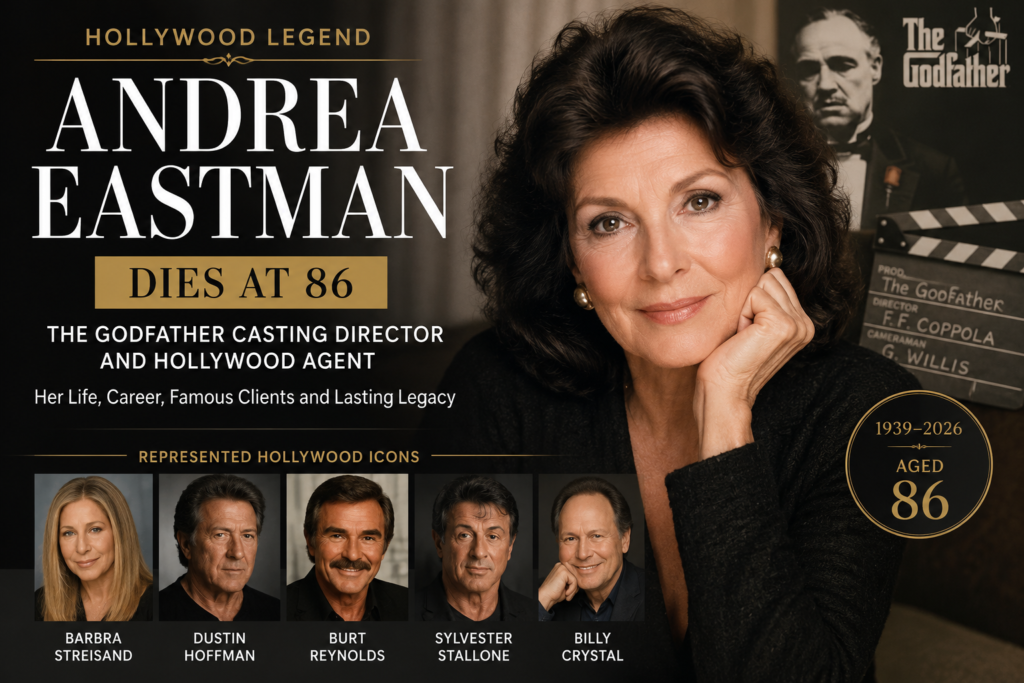
Andrea Eastman, the Hollywood casting executive and longtime talent agent whose career helped shape some of the industry’s most recognizable names, has died at 86. Eastman died at her home in Santa Barbara, California, with a career that stretched from Paramount Pictures’ casting department to the upper ranks of International Creative Management.
For many movie fans, Andrea Eastman is closely associated with The Godfather. She was part of the casting team behind Francis Ford Coppola’s 1972 classic, a film that introduced or elevated several performers who would become major Hollywood figures. Her work, however, went well beyond one celebrated movie.
Eastman also played an important role in bringing Ali MacGraw to Goodbye, Columbus and later built a formidable career representing actors and entertainers. At ICM, she became one of Hollywood’s pioneering female superagents and worked with stars including Barbra Streisand, Dustin Hoffman, Burt Reynolds and Sylvester Stallone.
Her professional story is therefore larger than a single casting credit. Eastman’s career crossed several influential areas of the entertainment business, giving her a rare perspective on how Hollywood discovered talent, built careers and turned performers into lasting stars.
Andrea Eastman Dies at 86
Andrea Eastman’s death closes a remarkable Hollywood career that lasted for decades and crossed several different eras of the entertainment industry.
What Happened to Andrea Eastman
Eastman died Wednesday at her Santa Barbara home at the age of 86, according to a family spokesperson. Reports described her as having died in her sleep. Her death was reported in late August 2026, prompting tributes from former colleagues, friends and people whose careers she had helped shape.
The news quickly drew attention because of the unusual range of her professional accomplishments. Eastman was not simply a casting executive or an agent. She moved between both sides of the talent business and developed a reputation for recognizing performers with unusual potential.
Her work on The Godfather remains one of her most widely remembered contributions. Yet her career also included major casting decisions at Paramount and years of representation work at leading Hollywood agencies.
Why Her Death Matters to Hollywood
Eastman’s importance comes from the influence she exercised behind the scenes. She helped connect performers with roles, guided established stars and became a powerful advocate for talent at a time when senior positions in Hollywood were overwhelmingly controlled by men.
That combination made her career distinctive. She could recognize an unknown performer, understand the commercial value of established stars and negotiate within a rapidly changing entertainment industry.
Her legacy consequently reaches beyond the credits attached to individual movies.
Who Was Andrea Eastman?
Andrea Eastman built a reputation as one of Hollywood’s most influential behind-the-scenes figures, although audiences rarely saw her name on screen.
Her Early Hollywood Career
Eastman emerged as a casting executive at Paramount during the period often associated with the rise of New Hollywood. The late 1960s and early 1970s brought major changes to American filmmaking, with younger directors, unconventional stories and new performers challenging the established studio system.
Eastman proved particularly skilled at identifying talent before audiences knew their names.
One early example came with Goodbye, Columbus, the 1969 film adaptation of Philip Roth’s novella. Eastman encountered Ali MacGraw when the future star was still working as a model and helped bring her into the film as Brenda Patimkin.
That decision became an early example of Eastman’s eye for performers who could make an immediate impression. MacGraw would soon become one of Hollywood’s most recognizable leading women.
Eastman’s casting work also brought her into the orbit of major filmmakers and producers. Those relationships eventually led to her involvement with The Godfather, where her judgment became part of one of cinema’s most consequential casting processes.
From Casting to Industry Powerhouse
Eastman eventually moved beyond casting and entered talent representation. That transition gave her a different kind of influence.
Instead of helping decide who would appear in a production, she began advocating for performers after they entered the industry. She worked at several agencies before rising at International Creative Management, better known as ICM.
Her advancement marked an important moment for women in Hollywood. Eastman became one of the industry’s first female superagents, reaching the senior ranks of an agency world that had historically been dominated by men.
Her career would soon include representation of some of the biggest names in American entertainment.
Andrea Eastman and The Godfather
Andrea Eastman’s connection to The Godfather represents the most recognizable chapter of her casting career.
Helping Shape the Film’s Central Cast
Released in 1972, The Godfather became a landmark of American cinema and established a cast that included Marlon Brando, Al Pacino, James Caan, Robert Duvall and Diane Keaton. Paramount’s official history credits the film with career-making performances, while the movie’s production records list Eastman among its casting personnel.
Eastman worked with producer Fred Roos and director Francis Ford Coppola during the casting process. Her contribution became particularly important as the production assembled the actors who would define the Corleone family.
Al Pacino’s casting as Michael Corleone became one of the film’s most consequential decisions. Pacino was relatively unestablished at the time, and the choice faced resistance within the studio. Coppola nevertheless continued to push for him.
Eastman’s work also connected directly to James Caan’s casting as Sonny Corleone. Caan had impressed during his screen test, and Eastman later took responsibility for securing him for the role.
The finished film demonstrated how important those choices were. Pacino’s Michael became the emotional center of the story, while Caan’s Sonny emerged as one of its most memorable supporting characters.
Why Her Casting Work Still Matters
Casting rarely receives the same public attention as directing, acting or writing. Yet The Godfather illustrates how strongly an actor’s presence can shape a film’s identity.
Eastman’s contribution was part of a larger collaborative effort involving Coppola, Roos and other casting professionals. Still, her role gives her an important place in the history of a movie whose performances became cultural touchstones.
The Academy Museum’s archival recognition of Eastman’s casting work also reflects the growing appreciation for the people behind major Hollywood productions.
Andrea Eastman’s Paramount Years
Before becoming a powerful talent representative, Eastman established herself within the studio system through casting and talent discovery.
Discovering Talent Before It Became Famous
Eastman’s reputation rested partly on her ability to recognize performers before they had established themselves as major stars. Her work with Ali MacGraw remains one of the clearest examples.
MacGraw’s casting in Goodbye, Columbus helped launch a screen career that soon expanded dramatically. Eastman similarly became associated with other important casting decisions during her Paramount years.
Her eye for emerging talent mattered because casting executives often had to make judgments before an actor’s commercial potential was obvious. A performer might have limited screen experience, while the studio had to imagine whether that person could carry a major production.
Eastman developed a reputation for making those judgments with confidence.
Beyond One Famous Movie
Her Paramount career cannot be reduced to The Godfather. Reporting on her work has also connected her to projects and performers associated with films such as Jaws, while she was credited with discovering Jaclyn Smith.
These choices help explain why Eastman’s career became so influential despite her relatively low public profile.
She worked in an era when studios exercised enormous control over movie production and casting. By identifying performers who could fit major roles, she helped influence the direction of projects before audiences ever encountered them.
That experience also prepared her for the next stage of her career. After The Godfather, Eastman left casting and entered the agency business, where she would gain an even greater role in shaping Hollywood careers.
Andrea Eastman Became a Pioneering ICM Agent
Eastman’s move from casting into talent representation gave her a new kind of influence in Hollywood. She no longer worked mainly to find the right performer for a production. Instead, she represented performers, negotiated opportunities and helped guide careers across an increasingly competitive entertainment business.
Breaking Into Hollywood’s Agency World
Eastman joined the agency side of the industry after establishing herself as a respected casting executive. Her experience gave her a useful advantage. She understood how producers, directors and studios evaluated performers because she had spent years making those decisions herself.
At International Creative Management, commonly known as ICM, that knowledge became a major part of her professional identity. She eventually rose to senior leadership and became one of the agency’s prominent female agents.
Her advancement mattered beyond her own career. Hollywood’s major agencies wielded considerable power because they connected performers with studios, filmmakers and producers. Senior agents could influence which projects reached their clients and how those opportunities developed.
Eastman earned that influence through a combination of industry relationships and an ability to understand talent. Her background in casting also meant she could look at an actor’s career from both sides of the table.
That perspective helped her become more than a representative who negotiated contracts. She became a career strategist for major performers.
Her rise also placed her among a generation of women who established themselves in senior positions within Hollywood’s traditionally male-dominated agency system.
The Stars She Represented
Eastman’s client list reflected the scale of her influence. Over the course of her agency career, she represented major figures including Barbra Streisand, Dustin Hoffman, Burt Reynolds and Sylvester Stallone.
Her work with established stars required a different skill set from her earlier casting career. A casting executive might make one important decision for a movie. An agent, by contrast, could help shape years of professional choices.
Eastman therefore had to consider the roles that could strengthen a performer’s career, the filmmakers worth working with and the opportunities that could expand an actor’s position in Hollywood.
Her reputation grew because she understood that representation involved more than securing a job. It meant protecting a client’s interests while identifying opportunities that could have long-term value.
That approach helped Eastman maintain relationships with some of the industry’s most recognizable performers. It also demonstrated why her career remained significant long after her work on The Godfather.
The Hollywood Careers Andrea Eastman Helped Shape
Eastman’s influence becomes easier to understand when viewed through the performers she represented. Rather than simply collecting famous names, her agency career placed her in the middle of important decisions involving movies, television and evolving star power.
Sylvester Stallone and the Rocky Era
Sylvester Stallone became one of the clearest examples of the kind of career Eastman could help navigate. Stallone had already written and starred in Rocky, but the film’s success created an entirely different professional landscape for him.
As his profile grew, representation became increasingly important. Stallone needed to balance acting opportunities with his interests as a writer and filmmaker. Eastman’s role as an agent placed her in that broader career conversation.
Rocky became a cultural phenomenon after its 1976 release, winning the Academy Award for Best Picture and turning Stallone into an international star. His subsequent career involved major studio projects, sequels and opportunities that extended well beyond the original film.
Eastman’s connection to Stallone illustrates an important part of her agency philosophy: successful representation required understanding what a performer could become, not merely what the performer had already achieved.
Her casting background likely made that perspective especially valuable. She had spent years identifying potential before audiences recognized it. As an agent, she could apply that same instinct to established talent.
Billy Crystal and When Harry Met Sally…
Eastman’s representation work also connected her with Billy Crystal during a period when his career expanded across television, film and comedy.
Crystal’s transition into major movie roles demonstrated how an entertainer could build a career across multiple areas of the industry. His work in When Harry Met Sally…, directed by Rob Reiner and written by Nora Ephron, became one of the defining romantic comedies of its era.
For an agent, projects like that involved more than finding another acting job. They could help establish a performer in a particular genre and introduce them to new audiences.
Eastman’s representation of Crystal therefore fits the broader pattern of her career. She worked with performers whose professional identities continued to evolve rather than remaining confined to one successful role.
Other Major Clients
Eastman’s client relationships extended across Hollywood’s acting and entertainment communities. Barbra Streisand, Dustin Hoffman and Burt Reynolds were among the major stars associated with her representation career.
These relationships reinforced her reputation as an agent capable of working with performers who already possessed substantial influence. At that level, an agent had to understand complicated negotiations, studio relationships and the long-term consequences of career decisions.
Eastman’s success came from operating inside that complex system while maintaining the talent-focused instincts she had developed during her casting years.
Andrea Eastman’s Influence Went Beyond Casting
Eastman’s professional story reveals a consistent theme: she recognized talent and understood how the entertainment business could develop it.
From Finding Actors to Guiding Careers
Casting and talent representation may appear similar from the outside, but they involve very different responsibilities. Casting asks which performer best fits a specific production. Representation asks which opportunities best serve a performer’s broader career.
Eastman worked on both sides.
Her early casting experience gave her direct knowledge of filmmakers’ expectations and studio priorities. Later, as an agent, she could use that knowledge while advocating for performers.
That combination made her unusually well positioned to understand the entertainment industry’s competing interests. She knew what producers wanted because she had worked inside the casting process. At the same time, she understood what performers needed from an agent.
A Woman in a Male-Dominated Industry
Eastman’s rise also carried significance because of the era in which it happened. Hollywood’s agency business historically offered limited access to senior power for women.
By reaching a senior position at ICM, Eastman helped demonstrate that women could become influential decision-makers within one of the industry’s most powerful institutions.
Her achievements did not depend on being visible to movie audiences. Instead, her influence came through conversations, negotiations, relationships and decisions that happened away from cameras.
That behind-the-scenes role explains why her name may be unfamiliar to casual film fans even though her career intersected with some of the most recognizable people and productions in modern Hollywood.
Andrea Eastman’s Later Life Took a Different Direction
After decades in the entertainment business, Eastman’s interests increasingly extended beyond Hollywood.
Her Love of Animals
Eastman’s later years reflected another enduring passion: animals. She became involved in animal welfare and developed a particular connection with horses.
Her work in this area added another dimension to a career already defined by advocacy. Earlier, she had advocated for actors and entertainers within Hollywood’s competitive system. Later, she used her time and influence to support animal protection.
Her involvement was not simply a private hobby. Eastman became connected with organizations and campaigns focused on the welfare of horses, including Return to Freedom.
The transition is notable because it shows how dramatically her priorities evolved. She had spent much of her professional life dealing with studios, agencies and major stars. In later years, she devoted substantial energy to a cause far removed from entertainment industry negotiations.
Her Work With Return to Freedom
Return to Freedom, an organization dedicated to protecting America’s wild horses and burros, became part of Eastman’s later advocacy work.
The organization has remembered Eastman for her support and commitment to horse welfare. Her involvement also connected her with other prominent advocates who used their public influence to draw attention to the treatment of horses.
This chapter of her life deserves attention because it prevents her legacy from becoming solely a Hollywood story.
Eastman spent decades helping shape careers and productions. Yet she ultimately became equally passionate about protecting animals and supporting causes she considered important.
That broader sense of advocacy remained part of her identity during her final years.
Andrea Eastman’s Animal Advocacy Became a Major Part of Her Legacy
Eastman’s later life moved far beyond movie sets and Hollywood agencies. Her concern for animals, especially horses, became one of the most meaningful parts of her identity. She brought the same determination and relationship-building skills that had defined her entertainment career to animal welfare causes.
Her Work to Protect Horses
Eastman’s involvement in horse advocacy grew into sustained activism. She supported efforts to protect horses from slaughter and became closely connected with Return to Freedom, the organization founded by Neda DeMayo to advocate for wild horses and burros.
According to Return to Freedom’s tribute after her death, Eastman used her Hollywood relationships to open doors for animal-welfare campaigns. In the late 1990s, she enlisted her friend Robert Redford’s support during efforts surrounding California’s horse-slaughter ban.
Her advocacy later expanded to the controversy surrounding Premarin, a drug produced using hormones collected from pregnant mares. In 2004, Eastman helped bring attention to the issue through Katie Couric and NBC’s Dateline.
These efforts showed that her influence did not disappear when she stepped away from Hollywood representation. Instead, she redirected it toward causes she cared about deeply.
Her Connection With Return to Freedom
Eastman’s relationship with Return to Freedom began through a book project involving people and their horses. She later became a committed supporter and joined the organization’s Advisory Board and Development Committee.
Her friendship with founder Neda DeMayo grew over the years. Eastman also helped strengthen the organization’s relationship with Robert Redford, who eventually joined its board.
That work reflected a consistent quality throughout Eastman’s life: she knew how to connect people, ideas and opportunities when she believed they belonged together.
Andrea Eastman and California’s Horse Protection Efforts
Eastman’s animal advocacy included direct involvement in campaigns surrounding horse slaughter and the treatment of horses.
Her Role in the Proposition 6 Effort
In the late 1990s, Eastman became involved in efforts supporting California’s Proposition 6, a ballot initiative that addressed horse slaughter for human consumption.
Return to Freedom’s account says Eastman enlisted Robert Redford’s help in the campaign. The measure became an important part of California’s history concerning horse protection, making the state one of the early jurisdictions to prohibit horse slaughter for human consumption.
For Eastman, the issue was not simply political. Her later work showed that she viewed advocacy as a practical responsibility. She used personal relationships and professional credibility to bring attention to causes that might otherwise struggle to reach a large audience.
That approach mirrored her Hollywood career. In entertainment, she connected actors with opportunities. In animal advocacy, she connected people, organizations and public attention with causes she believed deserved support.
Why Her Animal Advocacy Matters
Eastman’s animal work adds an important dimension to her biography because it shows what she chose to do after establishing herself in Hollywood.
She could have remained known primarily for casting and talent representation. Instead, she invested considerable energy in animal welfare, horse protection and advocacy.
Return to Freedom’s tribute describes her as a discerning connector who understood how relationships could advance both people and causes. That description helps explain why her influence remained valuable outside the entertainment business.
Her Hollywood career made her powerful. Her later advocacy showed how she chose to use that influence.
Andrea Eastman’s Final Years Were Marked by Health Challenges
Eastman’s final years included serious health difficulties, although public reporting provides only limited information about her private medical history.
Her Recovery After Major Heart Surgery
According to people close to Eastman, she underwent major open-heart surgery several years before her death. Her recovery became an especially difficult period, but her animals remained an important source of companionship.
One story that received attention involved her golden retriever, Trooper. Eastman credited the dog with helping her through the difficult recovery, and the relationship later inspired a children’s book.
The story offered a glimpse into a side of Eastman that was very different from her Hollywood reputation. Behind the powerful agent and casting executive was someone deeply attached to her animals.
Her love for dogs and horses remained important during her later years. Friends and advocates who knew her through animal welfare remembered that passion alongside her professional accomplishments.
Her Final Months
Eastman continued to maintain relationships with friends and former clients during her final months.
A June birthday gathering brought together people from different chapters of her life through a Zoom celebration. Former clients and longtime friends joined the occasion, reflecting the breadth of relationships she had developed during decades in Hollywood.
Return to Freedom also reported that friends arranged a final visit from her horses, Lucky and Shawnee, at her Santa Barbara home a few weeks before her death.
Those moments provide a more personal picture of her final period. Her professional achievements were extensive, but her relationships with people and animals remained central to her life.
What Was Andrea Eastman’s Cause of Death?
Reports about Eastman’s death should be separated from speculation about how she may have died.
What Has Been Confirmed
Andrea Eastman died at her home in Santa Barbara on Wednesday, August 26, 2026, at age 86. A family spokesperson confirmed her death, and multiple reports said she died in her sleep.
At the time of reporting, no official cause of death had been publicly disclosed. That distinction matters because several reports have discussed Eastman’s health and her conversations about California’s End of Life Option Act.
Those details provide context about her final years, but they do not independently establish the medical cause or circumstances of her death.
The clearest confirmed information remains that Eastman died peacefully at home at 86 after a long career in Hollywood and years of animal advocacy.
Reports About Medical Aid in Dying
Page Six reported that Eastman had discussed California’s End of Life Option Act with people close to her. The law allows eligible terminally ill adults to request medication for medical aid in dying, subject to specific legal requirements.
However, reporting that Eastman had discussed or considered the option does not prove that she used it.
No public confirmation has established that medical aid in dying played a role in her death. Therefore, the responsible description is that Eastman had spoken about the subject, while the circumstances surrounding her death beyond the family’s statement remain private.
That distinction is especially important in an obituary because readers may otherwise mistake a reported conversation for a confirmed cause of death.
Andrea Eastman’s Final Legacy Was Personal as Well as Professional
Eastman’s final years brought together many of the relationships she had built throughout her life.
Former Clients Remembered Her
Her June birthday gathering reportedly included former clients and friends from across the entertainment industry. Names connected to the celebration included Katherine Heigl, Katie Couric, Tony Danza, Billy Crystal, Marla Maples, Cindy Crawford and Dyan Cannon.
The gathering illustrated how long Eastman’s relationships lasted. Some people knew her as an agent, others as a casting executive, friend or advocate.
That range is important when considering her legacy. Hollywood agents often remain behind the scenes, even when their clients become household names. Eastman’s influence therefore appears most clearly through the careers and relationships she helped develop.
Her Animals Remained Close to Her
Her final weeks also reflected the importance of animals in her life.
Return to Freedom reported that her horses Lucky and Shawnee visited her at home shortly before her death. The organization said the horses will continue receiving care at its sanctuary.
Eastman’s dog Polo also remained an important part of her final days.
These details offer a fitting connection between the different chapters of her life. She began her career helping Hollywood recognize human talent. She ended it surrounded by many of the relationships and animals that had become deeply meaningful to her.
Her story, therefore, cannot be reduced to one film or one job title.
Andrea Eastman’s Hollywood Legacy Extends Beyond The Godfather
Andrea Eastman’s name will remain connected to The Godfather, but her career deserves a broader reading. Her influence stretched across casting, talent representation and advocacy, giving her a place in several important chapters of Hollywood history.
More Than One Landmark Film
Eastman’s work on The Godfather is perhaps the easiest part of her career for audiences to recognize. The film became one of the defining American movies of its era, and the casting choices helped establish performers who would remain important for decades.
Yet Eastman’s professional record continued long after the film’s release. She built a second career in talent representation and eventually reached a senior position at ICM.
That transition matters because it shows the range of her abilities. Casting required her to identify performers who could bring particular characters to life. Agency work required her to understand the wider entertainment business and advocate for performers over the course of their careers.
Few Hollywood professionals move between those roles at such a high level.
A Career Built Around Recognizing Talent
Eastman’s career had a consistent thread: recognizing potential.
She helped identify performers during their early stages and later represented stars who had already established themselves. Her clients included some of the biggest names in film and entertainment.
Her influence therefore operated in different ways. Sometimes she helped put an actor in front of a camera. At other times, she helped determine which opportunities could shape that actor’s future.
That behind-the-scenes influence explains why her career matters even to people who may not recognize her name immediately.
Andrea Eastman’s Influence on Hollywood’s Talent Culture
Eastman’s professional achievements also reflect how Hollywood’s talent system changed during her lifetime.
From Studio Casting to Powerful Representation
When Eastman began working in casting, major studios still held enormous influence over film production. Casting decisions could determine whether an emerging performer received an opportunity that might transform a career.
The agency business operated differently. Agents worked between talent and the studios, helping negotiate deals and identify projects. As Eastman moved into representation, she gained access to another layer of Hollywood’s decision-making process.
Her experience in casting gave her an understanding of what directors and producers looked for. Her agency career then allowed her to apply that knowledge on behalf of actors.
That combination helped distinguish her from professionals who had spent their entire careers in only one part of the business.
Breaking Barriers for Women
Eastman’s rise at ICM also carried significance for women entering Hollywood’s upper management circles.
The major talent agencies had substantial influence over the entertainment industry, yet women historically faced barriers to reaching the highest levels of those organizations. Eastman became one of the prominent women to break through those barriers.
Her success demonstrated that expertise in talent evaluation, negotiation and relationship management could translate into real institutional power.
She did not need to become a performer herself to influence Hollywood. Instead, she built authority through judgment, persistence and professional relationships.
That legacy remains relevant when looking at the broader history of women who helped shape the entertainment business from behind the camera.
Andrea Eastman’s Animal Advocacy Added a New Chapter to Her Story
Eastman’s work with animals was not an isolated interest that appeared briefly near the end of her life. It became a sustained part of her later identity.
Using Hollywood Relationships for Animal Causes
Eastman understood the value of public attention. During her Hollywood years, she had built relationships with actors, journalists, producers and other influential figures.
She later used those connections to support animal-welfare campaigns.
Her work with Return to Freedom reflected that approach. The organization advocates for wild horses and burros, and Eastman became one of its supporters and advisors.
Her friendship with Robert Redford became particularly valuable. Redford’s public profile helped bring greater visibility to horse-protection efforts, while Eastman’s organizational and entertainment-industry experience helped connect advocates with people who could amplify their message.
This was another form of talent and relationship management, but the objective had changed. Instead of advancing a movie or actor’s career, Eastman was helping draw attention to animal welfare.
A Different Kind of Professional Legacy
The shift from Hollywood representation to animal advocacy could appear surprising. However, both chapters depended on qualities that remained consistent throughout her life.
Eastman recognized people who could make a difference. She cultivated long-term relationships. She understood how to bring the right individuals together around a shared goal.
Those skills had served her in casting and talent representation. Later, they helped her contribute to causes involving horses, dogs and animal protection.
Her legacy therefore includes both the entertainment world she helped shape and the animals she worked to protect.
Andrea Eastman’s Final Years Brought Her Life Full Circle
The final stage of Eastman’s life reflected the relationships she had accumulated over decades.
Staying Connected to Friends and Former Clients
Even after leaving the center of Hollywood’s agency world, Eastman maintained friendships with people from different periods of her career.
Her reported birthday gathering demonstrated that those relationships remained strong. Former clients, colleagues and friends came together to celebrate her, bringing together people from the entertainment industry and other areas of her life.
That kind of connection says something important about Eastman’s personality and professional approach. Her relationships did not simply end when a business arrangement ended.
She continued to maintain friendships with people she had represented or worked alongside. For an agent whose career depended heavily on trust, those long-term relationships became part of her personal legacy.
Her Connection to Her Animals
Animals also remained central to Eastman’s final years.
Her horses, Lucky and Shawnee, were brought to see her at her Santa Barbara home shortly before her death, according to Return to Freedom. Her dogs also remained close companions.
These details add emotional context to an otherwise extraordinary professional biography.
Eastman spent much of her career surrounded by famous actors, filmmakers and executives. In later life, her world became quieter and more personal. Her animals and longtime friends occupied an increasingly important place in it.
That contrast does not diminish her Hollywood achievements. Instead, it shows how her priorities evolved over time.
What Andrea Eastman’s Death Means for Her Legacy
Eastman’s death at 86 marks the end of a career that crossed multiple generations of American entertainment.
A Behind-the-Scenes Figure With Lasting Influence
Movie audiences remember actors and directors because their work appears on screen. People like Eastman worked in a different part of the creative ecosystem.
Her influence came through decisions made before filming, negotiations made away from cameras and relationships built over many years.
Her association with The Godfather gives her a direct connection to one of cinema’s most celebrated productions. Her agency career provides an even wider view of her influence, linking her to major stars and projects across Hollywood.
Her later animal advocacy then expanded that legacy beyond entertainment altogether.
Remembering the Whole Career
The most accurate way to remember Andrea Eastman is not simply as a casting director from The Godfather.
She was a talent scout, casting executive, agent, advocate and relationship-builder. Each role revealed a different aspect of the same professional strength: knowing how to recognize potential and connect people with opportunities.
That combination made her career unusual.
Her death has renewed interest in the people who helped shape Hollywood without appearing in front of the camera. Eastman’s story is a reminder that major cultural moments often depend on professionals whose contributions remain largely invisible to the public.
Her name belongs in that history.
Andrea Eastman’s Place in Hollywood History
Eastman’s career also offers a useful way to understand how much influence can exist behind a movie’s final credits.
The Importance of Casting Decisions
A successful film depends on many decisions before cameras begin rolling. Casting ranks among the most consequential because performers bring personality, chemistry and interpretation to the roles written on the page.
Eastman’s work demonstrates that principle clearly.
Her involvement with The Godfather placed her within a casting process that ultimately produced one of the most influential ensembles in American film. Her earlier and later work showed that this was not an isolated success.
She spent years evaluating talent and understanding which performers could make an impression.
The Importance of Agents
Her agency career provides the other side of that equation.
Once performers establish themselves, their careers depend on choices involving scripts, directors, studios, contracts and public positioning. Agents help navigate that complicated environment.
Eastman worked at that level with major performers, giving her influence over careers rather than individual casting decisions.
Together, her casting and agency experiences provide a rare perspective on Hollywood’s talent pipeline: discovering performers, connecting them with opportunities and helping them build lasting careers.
That may ultimately be the most important part of Andrea Eastman’s professional legacy.
Andrea Eastman’s Lasting Impact
Andrea Eastman’s career left a mark on Hollywood through decisions that often happened far from the spotlight. She helped identify performers, contributed to major casting choices and later represented some of the industry’s most recognizable stars.
Her connection to The Godfather remains the most familiar part of her story. Yet her work at ICM showed that her influence extended far beyond one film. She became a powerful advocate for talent and helped guide careers during several important periods in the entertainment business.
Her later commitment to animal welfare added another dimension to that legacy. Through her work with horse-protection organizations, she continued using the relationships she had built over decades to support causes she valued.
A Legacy Built on Recognizing Talent
Eastman’s professional life followed a consistent pattern. She recognized potential and understood how the right opportunity could change a person’s future.
That instinct first appeared in casting. It later became central to her work as an agent. Her ability to understand both filmmakers and performers gave her a perspective that few people in Hollywood possessed.
Her story also reflects the changing role of women in the entertainment industry. By reaching a senior position at ICM, she established herself in a part of Hollywood where women historically faced significant barriers.
For that reason, her legacy belongs not only to the movies and stars connected to her career. It also belongs to the broader history of Hollywood professionals who helped change how the industry operated.
Frequently Asked Questions About Andrea Eastman
Who was Andrea Eastman?
Andrea Eastman was a Hollywood casting executive and talent agent whose career included work on The Godfather. She later became a senior agent at International Creative Management, or ICM, where she represented major performers. She also became an advocate for animal welfare and horse protection later in life.
How old was Andrea Eastman when she died?
Andrea Eastman was 86 when she died in August 2026. She died at her home in Santa Barbara, California. Reports said she died in her sleep.
What was Andrea Eastman’s role in The Godfather?
Eastman worked as part of the casting team for The Godfather. Her involvement included the casting process that brought together several of the film’s principal performers. Her work became especially notable because the movie’s cast later became one of the most celebrated ensembles in American cinema.
Did Andrea Eastman help cast Al Pacino?
Yes. Eastman was involved in the casting process surrounding Al Pacino’s role as Michael Corleone. Pacino faced resistance from some people involved with the production because he was not yet a major star. Director Francis Ford Coppola continued to support him, and the eventual casting became one of the film’s most consequential decisions.
Was Andrea Eastman an ICM agent?
Yes. Eastman became a senior talent agent at International Creative Management, widely known as ICM. She became one of the prominent women in Hollywood’s agency business and represented major performers during her career.
Who were some of Andrea Eastman’s famous clients?
Her clients included major Hollywood figures such as Barbra Streisand, Dustin Hoffman, Burt Reynolds and Sylvester Stallone. Her representation work extended across different areas of film and entertainment.
What was Andrea Eastman’s cause of death?
Public reports confirmed that Andrea Eastman died at her Santa Barbara home at age 86 and described her death as occurring in her sleep. However, a specific medical cause of death had not been publicly confirmed in the reporting available at the time.
Did Andrea Eastman discuss assisted dying?
Yes. Reporting said Eastman had discussed California’s End of Life Option Act with people close to her. However, those reports do not establish that she used medical aid in dying or that it caused her death. Those details should therefore remain separate from the confirmed information about her death.
Andrea Eastman’s Place in Hollywood History
Andrea Eastman’s career demonstrates how much influence a person can have without becoming a household name.
She helped shape casting decisions during one of Hollywood’s most important creative periods. Her work on The Godfather connected her to a film that changed American cinema and helped launch or strengthen the careers of several major actors.
However, Eastman did not stop there. Her move into talent representation gave her influence over the longer careers of established performers. At ICM, she worked with stars whose professional decisions reached far beyond individual movies.
That two-sided experience made her career unusual. She understood Hollywood from the perspective of both the person selecting talent and the person representing it.
Her later animal advocacy revealed another side of her character. She redirected her professional relationships toward horse protection and animal welfare, showing that her ability to bring people together could serve purposes outside entertainment.
Eastman’s story is therefore about more than The Godfather. It is about recognizing talent, building trust and using influence over many decades.
For movie fans, her name may always be linked to one of cinema’s greatest films. For people familiar with Hollywood’s business history, however, her legacy is considerably broader.
She was part of the machinery behind major movies, a powerful representative for major stars and an advocate who continued working for causes she believed in.
That combination gives Andrea Eastman a distinctive place in Hollywood history.
Andrea Eastman’s Lasting Legacy
Andrea Eastman died after a career that crossed generations of Hollywood.
She worked during the transformation of American filmmaking, contributed to the casting of The Godfather, discovered and supported emerging performers, represented established stars and eventually devoted much of her energy to animal advocacy.
Each chapter tells a different story. Together, they reveal a professional life built around relationships and judgment.
Eastman’s career also reminds audiences that Hollywood history extends well beyond the actors and directors whose names appear most prominently on movie posters. Casting executives, agents and advocates can influence the industry in ways that remain invisible to the public.
Her work helped put performers in important roles. Her agency career helped stars navigate changing opportunities. Her later advocacy gave her influence a different purpose.
That is why Andrea Eastman’s legacy deserves to be remembered as more than a footnote in The Godfather‘s history.
She was a behind-the-scenes force who spent decades recognizing talent and connecting people with opportunities. Later, she used those same strengths to support animals and causes close to her heart.
Her career ultimately reflected the breadth of Hollywood itself: creative, competitive, relationship-driven and constantly changing.
Andrea Eastman leaves behind a legacy that reaches from one of cinema’s most influential films to the people she represented and the animals she worked to protect.