
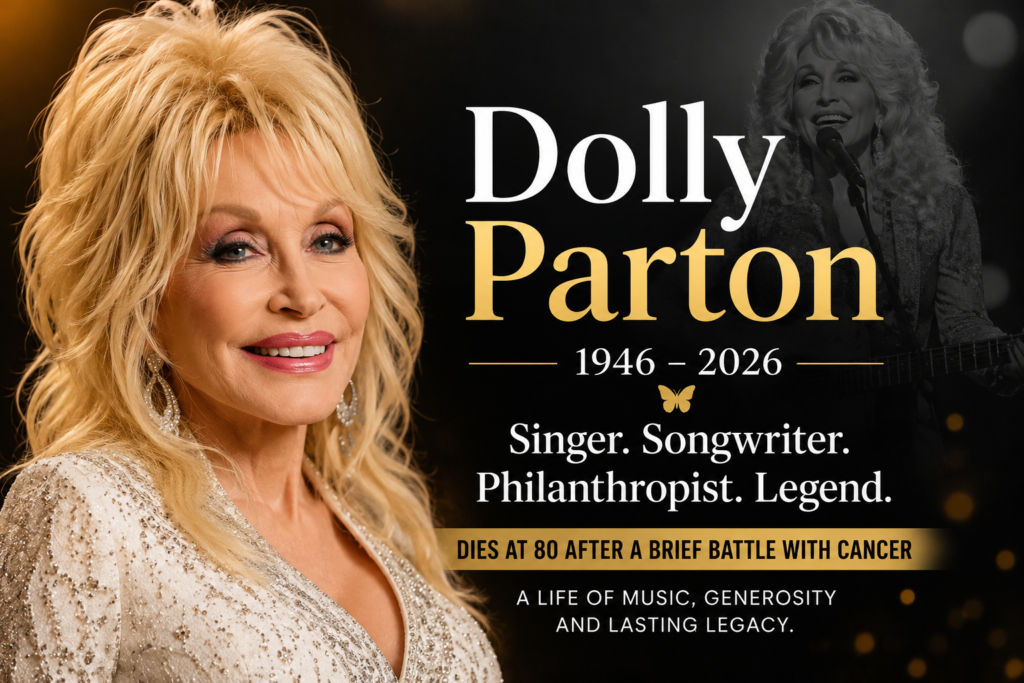
Dolly Parton, the legendary country singer, songwriter and entertainer whose career reached far beyond music, has died at 80. Parton died on August 25, 2026, after what her representatives described as a brief battle with cancer. Her death marked the end of one of the most recognizable careers in American entertainment, but it also brought renewed attention to the generosity, resilience and warmth that defined her public life.
For millions of fans, Parton was much more than the voice behind songs such as “Jolene,” “9 to 5” and “I Will Always Love You.” She became an actress, businesswoman, philanthropist and cultural figure whose influence crossed generations. Her work reached country music, Hollywood, theme parks, children’s literacy and medical research. She also maintained a remarkable ability to connect with audiences without losing the personality that made her famous.
The circumstances surrounding her final months have now added another dimension to that legacy. In a tribute following her death, her sister Stella Parton revealed that Dolly had been willing to allow doctors to try experimental drugs if there was no hope for her recovery, with the hope that what doctors learned could help other people in the future.
That revelation captures something central to the Dolly Parton story. Even while confronting her own mortality, she was reportedly thinking about what her experience might mean for someone else.
Dolly Parton, Legendary Singer, Dies at 80
Dolly Parton’s death came after a career that lasted nearly six decades and transformed her from a Tennessee songwriter into an international entertainment icon. Her representatives confirmed that she died at the Vanderbilt-Ingram Cancer Center surrounded by loved ones after a brief battle with cancer. Her family did not initially disclose the specific type of cancer.
The announcement came through her family, with nephew Bryan Seaver sharing the news publicly. The tone of the announcement reflected the complicated emotions surrounding the loss: profound sadness for those left behind, alongside pride in a life that had touched an extraordinary number of people.
Parton’s achievements were equally extraordinary. She sold more than 100 million records, earned numerous major awards and wrote thousands of songs during a career that included country hits, crossover successes and film performances. Her songs became part of the American musical vocabulary, while her distinctive personality helped her remain relevant long after her earliest recordings.
Yet statistics only explain part of Parton’s significance. Her appeal came from the combination of talent and accessibility. She could occupy the biggest stages in entertainment while continuing to present herself as someone who understood ordinary struggles, family ties, hard work and the value of helping others.
What Is Confirmed About Dolly Parton’s Death
The confirmed information is straightforward: Dolly Parton died on August 25, 2026, at age 80, following a brief battle with cancer. Her representatives confirmed the cancer diagnosis only after her death, meaning much of the public had not known the seriousness of her condition beforehand.
That distinction matters because Parton had spoken publicly about health problems in the weeks before her death without revealing the full picture. She had stepped back from some appearances and acknowledged that she was dealing with health issues while continuing to work.
Reports about other medical problems circulated around her final days, but they should not be confused with the confirmed cause of death. The cancer diagnosis is the key fact established by her representatives.
Her death therefore came as a shock to many fans. Parton had spent decades projecting energy, humor and determination, and she continued discussing work even while facing serious health challenges.
Why the News Has Resonated So Widely
Parton’s death represents the loss of an unusually broad American cultural figure. She was simultaneously a country singer, songwriter, actress, entrepreneur and philanthropist.
Her music reached audiences far outside traditional country circles. Her films introduced her personality to movie audiences, while Dollywood became a major part of her business legacy. Her Imagination Library transformed her name into a symbol of childhood literacy and giving.
That breadth helps explain the scale of the reaction. Fans did not simply lose a successful recording artist. They lost a figure whose work appeared in many parts of American life.
Her legacy also feels personal to many listeners. Parton’s songs often dealt with love, poverty, family, ambition, heartbreak and perseverance. Those themes helped make her music durable across generations.
For that reason, the conversation following her death has quickly moved beyond the circumstances of her passing. The larger question is what Dolly Parton meant to American culture—and why her influence is likely to remain powerful long after her final performance.
What Dolly Parton’s Final Health Chapter Revealed
Parton’s final health chapter became clearer only after her death. In the days before she died, she had acknowledged that she was dealing with health problems and described herself as still recovering while remaining committed to work. She had also canceled or postponed appearances because of health concerns.
Those comments now carry a different weight. At the time, fans could reasonably interpret them as another setback in a long career. The later confirmation of cancer showed that the situation was more serious than many people realized.
Parton’s approach also reflected a pattern familiar to those who followed her closely. She often emphasized optimism and work rather than dwelling publicly on personal difficulties. That approach helped protect her privacy, but it also meant that the full extent of her illness remained unknown to much of the public.
Her health story cannot be separated completely from the years immediately before her death. Parton had spoken about putting her own well-being aside while caring for her husband, Carl Dean, during his illness. Dean died in March 2025 after nearly six decades of marriage.
The combination of caregiving, grief and her own health struggles offers important context for understanding her final years.
Her Health Struggles After Caring for Carl Dean
Parton previously acknowledged that she had not always taken sufficient care of herself while focusing on Dean. After his death, she faced the emotional weight of losing the person who had shared her private life for decades.
That period also highlighted an important reality often overlooked in celebrity coverage: caregiving can push people to place their own health second. Parton’s public comments suggested that she recognized this in hindsight.
Her relationship with Dean had always operated differently from the highly publicized marriages common in entertainment. He largely avoided the spotlight, while Parton remained one of the world’s most recognizable performers. Their marriage endured through enormous changes in her career and public image.
By the time Parton discussed her health more openly in 2026, she had already experienced significant personal loss. Her comments about recovery therefore reflected more than a temporary interruption to her schedule.
They also showed the tension between two sides of her life: the performer who wanted to keep creating and the private person dealing with grief and declining health.
Parton’s final health chapter should therefore be understood carefully. The public knew she had health problems, but only after her death did the seriousness of her condition become clear.
Her Final Public Optimism
Just days before her death, Parton continued to speak in a hopeful and determined tone about her health. In an August 21 statement, she acknowledged difficult periods with her health while emphasizing that she was still healing and still working.
That message became poignant after her death. It showed how little the public knew about the severity of her situation and how strongly Parton continued to identify with her work.
She had spent much of her career presenting resilience as a practical choice rather than an abstract idea. Whether discussing her childhood, career setbacks or personal losses, she frequently returned to humor, faith, creativity and perseverance.
Her final public comments fit that pattern.
At the same time, optimism should not be mistaken for evidence that her illness was minor. The subsequent confirmation of cancer changed the context surrounding those remarks.
That distinction is important when looking back at her final days. Parton was not simply a performer making one last promotional appearance. She was a woman navigating serious health challenges while trying to maintain a connection with her work and audience.
The contrast between her public determination and the seriousness of her private condition makes those final comments especially meaningful. They also help explain why her death felt so sudden to many fans.
Parton’s willingness to keep working while facing illness became another example of the persistence that had defined her professional life for decades.
Dolly Parton’s Final Act of Generosity
One of the most striking revelations after Parton’s death came from her younger sister, Stella Parton.
In a tribute posted after Dolly’s death, Stella said her sister had recently told her that if there were no hope for her recovery, she would still allow her medical team to try experimental drugs in the hope of helping others in the future.
The statement does not establish that Parton actually received experimental treatment. Instead, it describes her willingness to consider such treatment if her situation reached a point where conventional options offered no hope.
That distinction matters. The significance of Stella’s revelation lies in the intention behind the offer.
Parton was reportedly thinking about what doctors might learn from her experience and whether that knowledge could benefit future patients. It was a deeply personal example of the same outward-looking attitude that had appeared throughout her philanthropic work.
The revelation also gives new meaning to the tributes describing Parton as generous. Her charitable reputation was not built around a single donation or campaign. It developed over decades through literacy programs, disaster relief, education, healthcare support and other causes.
Her sister’s account suggests that this instinct to help did not disappear when Parton faced her own mortality.
Instead, it remained part of the way she thought about her final chapter.
What Stella Parton Revealed
Stella Parton’s tribute offered a personal perspective that news reports about Parton’s death could not provide.
She described Dolly as consistently thoughtful and generous, then shared the private conversation about experimental drugs. According to Stella, Dolly was willing to let her doctors try an experimental approach if there was no remaining hope for her recovery, specifically because it might help other people in the future.
The revelation is especially notable because it came from a close family member rather than from Parton’s public statements.
Stella also remembered the sisters’ relationship through ordinary rituals. They regularly spoke on Tuesday mornings, sharing coffee and catching up. Those details offered a glimpse of Dolly beyond the enormous public persona.
That contrast is important. To millions of people, Dolly Parton represented glittering costumes, hit records and sold-out stages. To her sister, she was also a sibling with whom she could share a quiet morning conversation.
The experimental-treatment revelation brings those two sides together. The global celebrity and the private sister were, in this account, driven by the same instinct: to think about other people.
Stella ultimately encouraged people who want to honor Dolly to embrace kindness, generosity and support for others.
That message turns the final revelation into more than a medical detail. It becomes part of the larger story of what Parton’s family believes she stood for.
Why the Revelation Fits Her Lifelong Philanthropy
Parton’s philanthropic record makes Stella’s revelation easier to understand. She had already used her wealth, influence and public platform to support causes far beyond the entertainment industry.
Her Imagination Library became one of her signature initiatives, providing free books to children. She also supported medical research, including a $1 million donation connected to COVID-19 vaccine research, and contributed to disaster-relief efforts.
The common thread was practical help. Rather than limiting her philanthropy to publicity campaigns, Parton repeatedly supported programs designed to produce tangible benefits.
Her reported willingness to consider experimental treatment follows that same logic. Even in circumstances where she personally stood to gain little, she could see value in helping researchers learn something that might eventually benefit someone else.
That does not make the revelation a substitute for medical facts about her illness. It is a statement about her character.
Parton’s career was built on turning personal experiences into something useful for others—songs from hardship, stories from childhood and charitable programs from personal success.
Her final reported gesture fits that pattern remarkably well.
It also explains why discussions of Parton’s death have quickly moved beyond celebrity mourning. Her story invites a broader question: how can an individual use fame, resources and personal adversity to make life better for people they may never meet?
For Dolly Parton, that question appears to have remained important until the end.
The Singer’s Relationship With Carl Dean
Dolly Parton’s relationship with Carl Dean was one of the most private and enduring marriages in entertainment. They married in 1966, long before Parton became a global celebrity, and remained together for nearly six decades. While Parton built a career in front of millions of people, Dean largely stayed away from the spotlight and maintained a life far removed from celebrity culture.
That contrast became part of what made their marriage so fascinating. Parton openly discussed Dean with affection, but she rarely treated their relationship as entertainment for the public. Their marriage survived the enormous pressures that came with fame, constant touring and the demands of an international career.
Dean died in March 2025, leaving Parton to navigate a loss that affected both her private life and her health. In the months that followed, she acknowledged that she had spent so much time caring for him that she had neglected some of her own medical needs.
That admission offered a different perspective on the final chapter of Parton’s life. The singer who had spent decades caring for audiences, family members and charitable causes also found herself confronting the consequences of putting her own well-being aside.
Her comments about Dean therefore became an important part of understanding her later health struggles. They showed that behind the glamorous public image was someone dealing with grief, responsibility and the ordinary difficulties that can accompany caring for a loved one.
A Nearly Six-Decade Marriage Away From the Spotlight
Parton and Dean married in Ringgold, Georgia, in 1966. At the time, Parton’s professional ambitions were still developing, while Dean had no interest in becoming part of the entertainment industry.
That arrangement remained remarkably consistent throughout their marriage. Parton became one of the most famous performers in the world, yet Dean rarely appeared beside her at public events. He preferred privacy, and Parton respected that choice.
Their relationship therefore developed away from the normal machinery of celebrity culture. Fans could hear Parton speak warmly about her husband, but they did not routinely see the couple photographed together or turned into a public brand.
The privacy also helped protect something important to Parton: a part of life that belonged only to her.
For decades, she maintained that distinction between Dolly Parton the entertainer and the woman who returned home after the show. Dean represented the private world behind the public persona.
Their marriage was not free from challenges, but its longevity became remarkable in an industry where relationships often face intense public scrutiny.
Dean’s death in 2025 ended that private partnership. Yet his importance to Parton’s life became even more visible afterward, particularly as she described the emotional and physical effects of caring for him.
In that sense, the story of Carl Dean was never separate from the story of Dolly Parton. He was part of the foundation beneath the public career, even though he rarely stood in front of the cameras.
How Caregiving Changed Dolly’s Final Years
Parton’s own comments made clear that caregiving had affected her health. In a 2026 interview, she said she had overlooked her own medical needs while caring for Dean. She later described herself as healing physically, emotionally and spiritually after his death.
The admission gave fans a rare look at the personal cost of caregiving. Parton had spent much of her life working at an extraordinary pace, but caring for a seriously ill spouse created a different kind of responsibility—one that could not simply be postponed until after the next performance.
After Dean died, grief added another layer. Parton continued developing projects and discussing future creative ideas, but she also acknowledged that she needed time to recover.
That tension helps explain some of the changes in her final year. She canceled appearances, dealt with health setbacks and slowed some activities while continuing to work whenever she could.
Her story also illustrates why caregiver health deserves attention. People who devote themselves to a loved one can become so focused on that person’s needs that their own warning signs become easier to ignore.
Parton eventually recognized that pattern in her own life.
Her experience did not erase the devotion she had shown Dean. Instead, it revealed how deeply she had committed herself to caring for him.
The final years of her life were therefore shaped by two powerful forces: grief over losing her husband and a renewed need to care for herself.
Dolly Parton’s Friendship With Zac Brown and Fellow Artists
Dolly Parton’s influence became especially visible in the tributes from musicians who knew her personally or viewed her as a creative role model.
Zac Brown was among the artists whose relationship with Parton extended beyond admiration. The two performed together during Parton’s 2022 Rock & Roll Hall of Fame induction, and they later recorded “Butterfly” together in 2025. Following her death, Brown described Parton in deeply spiritual terms and emphasized the importance of her faith.
His reflections also point to something broader about Parton’s career. She did not simply accumulate younger admirers; she actively collaborated with artists from different generations and musical backgrounds.
That ability helped keep her relevant as the music industry changed around her. She could work with established country performers, younger singers and artists from outside traditional country music without appearing disconnected from any of them.
Other tributes followed the same pattern. Artists and actors repeatedly described Parton as generous, encouraging and unusually welcoming.
Her influence therefore operated on two levels. She shaped the sound and business of country music, but she also shaped the confidence of individual performers who came after her.
For many artists, Dolly Parton represented proof that extraordinary success did not require abandoning warmth or humility.
Why Younger Artists Connected With Dolly
Parton’s relationship with younger musicians often went beyond a simple mentor-and-student dynamic.
She had a rare ability to make emerging artists feel seen. Her collaborations demonstrated that she remained curious about new performers instead of treating her own generation as the only important one.
Lainey Wilson’s final conversations with Parton offer another example. Wilson recently recalled speaking with Parton about music, relationships and faith, describing the connection as deeply personal. Their relationship reflected how Parton’s influence could become mentorship as much as musical inspiration.
That generosity extended to artists who were still finding their place in the industry. Parton’s willingness to collaborate gave younger performers access to an artist whose name carried enormous cultural weight.
Yet the appeal was not simply professional. Parton’s personality mattered.
She combined confidence with humor and rarely appeared threatened by the success of people who followed her. Instead, she frequently celebrated other performers and encouraged them to develop their own voices.
That attitude helped create a legacy that cannot be measured only through album sales or awards.
A singer can influence another artist through a song. Dolly Parton often influenced people through the way she conducted herself.
Her example suggested that fame did not have to produce distance, and success did not have to eliminate generosity.
That may be one reason so many younger artists speak about her with the warmth normally reserved for a family member or longtime mentor.
A Legacy of Friendship, Collaboration and Mentorship
Parton’s relationships with fellow artists also reveal how widely her influence traveled.
She worked with Kenny Rogers, Willie Nelson, Kenny Loggins, Miley Cyrus and many other performers across generations and genres. Her collaborations were not simply commercial pairings; many became memorable moments because her voice and personality remained recognizable regardless of the musical setting.
Her partnership with Kenny Rogers became particularly important to country-pop history. Their recording of “Islands in the Stream” became one of the defining crossover songs of the 1980s, while their friendship continued beyond their work together.
Parton also maintained connections with artists who approached her music from entirely different directions. Younger musicians covered her songs, invited her into new collaborations and cited her as an influence.
That openness helped make her catalog unusually adaptable.
A Parton song could exist as a country recording, a pop hit, a film soundtrack or a new interpretation by another generation. The songwriting remained strong enough to survive changes in production style and audience expectations.
Her friendships reinforced that durability.
When artists spoke about Parton after her death, they frequently emphasized not only her talent but also her character. Trisha Yearwood described her as a source of light and encouraged people to continue the values Parton represented. Other performers highlighted her compassion, humor and generosity.
That combination may explain why Parton’s death has produced such a broad response across entertainment.
She belonged to country music, but her influence never stayed inside one genre.
How the Singer Built an Extraordinary Music Career
Dolly Parton’s music career began with roots that were both humble and deeply personal. Born in 1946 in the Great Smoky Mountains region of Tennessee, she grew up in a large family with limited financial resources. Music became an early form of expression, and songwriting eventually became the foundation of everything she built.
Parton has described writing songs from childhood, long before she had access to the professional machinery of Nashville. That instinct remained central throughout her career. She did not simply interpret material written by other people; she developed a reputation as one of country music’s most prolific songwriters.
Her professional breakthrough accelerated after she joined Porter Wagoner’s television program in the 1960s. The exposure introduced her to a national audience and helped establish her as a distinctive performer. Her solo career then expanded rapidly.
Over the following decades, Parton moved between traditional country, pop, bluegrass, gospel and adult contemporary music without losing her identity. Her voice remained recognizable, but her songwriting gave her career unusual durability.
By the time she died, Parton had accumulated an enormous body of work. She had written thousands of songs, released a vast catalog of recordings and earned major awards across the music industry.
Yet numbers alone do not explain her importance. Parton’s songs often transformed ordinary experiences into memorable stories. Poverty, jealousy, ambition, loneliness, faith, family and working life became subjects that audiences could immediately understand.
That storytelling ability became the foundation of her lasting success.
From Tennessee Roots to Country Superstardom
Parton’s early environment shaped the themes that would appear throughout her songwriting. Her childhood in rural Tennessee gave her firsthand knowledge of financial hardship, family responsibility and the importance of community.
She began performing publicly while still young and eventually moved toward Nashville, where she pursued professional songwriting and recording opportunities.
Her first full-length album, Hello, I’m Dolly, arrived in 1967. The album helped introduce her as a solo performer and attracted the attention of Porter Wagoner, who brought her into his television and touring operation.
That partnership became an important turning point. Wagoner’s show gave Parton national exposure while allowing her songwriting and performing personality to develop in front of a large audience.
Her success eventually made a solo career inevitable. Parton left Wagoner’s professional orbit in the early 1970s and began building an identity that no longer depended on another star.
The move required confidence. She had to prove that the woman audiences knew from television could carry a career on her own.
She did more than prove it. She became one of the defining figures in country music.
Her rise also demonstrated a skill that would remain important throughout her life: Parton understood how to turn personal stories into material with universal appeal.
The Songs That Made Dolly Parton Iconic
Parton’s catalog contains songs that became cultural landmarks rather than simple chart successes.
“Jolene” remains one of her most recognizable recordings, built around a direct plea to another woman not to take the singer’s partner. Its emotional simplicity gives the song unusual power, while its melody makes it immediately recognizable.
“I Will Always Love You” demonstrates another side of Parton’s songwriting. She originally wrote and recorded the song herself before Whitney Houston’s later version transformed it into an international pop phenomenon. The song’s continued life through different generations illustrates the strength of Parton’s underlying composition.
“Coat of Many Colors” drew directly from her childhood and turned an inexpensive handmade coat into a story about family pride and dignity. The song became one of the clearest examples of how Parton could transform poverty into emotional richness rather than shame.
“9 to 5” reached an entirely different audience. Written for the 1980 film of the same name, the song captured workplace frustration and became Parton’s first No. 1 pop single.
Together, these songs show the range of her writing. She could move from intimate heartbreak to childhood memories and social commentary without losing her distinctive voice.
That versatility helped make Parton more than a country star. She became a songwriter whose work could cross genres, generations and national borders.
Dolly Parton’s Move From Music Into Film and Television
Parton’s entertainment career expanded dramatically once Hollywood recognized that her personality could carry a film as effectively as it carried a concert stage.
Her breakthrough movie role came in 9 to 5, released in 1980. Starring alongside Jane Fonda and Lily Tomlin, Parton played a secretary caught in an exploitative workplace. The film became a major success, while her original theme song connected her music career directly to her acting career.
The experience also demonstrated how naturally Parton could move between entertainment formats. She was not simply a singer appearing in a movie. Her humor, timing and musical identity became part of the film’s appeal.
She followed 9 to 5 with roles that expanded her range. The Best Little Whorehouse in Texas allowed her to combine comedy and music, while Steel Magnolias gave her a more dramatic setting and introduced her to another generation of movie audiences.
Television also remained important. Parton hosted variety programming, appeared in specials and eventually became the central figure in projects built around her music and personal brand.
Her screen work reinforced something that was already evident in her music: Parton understood storytelling.
Whether she was singing about a difficult childhood or playing a character facing adversity, she could communicate emotion without losing her distinctive sense of humor.
That quality helped her avoid being trapped within a single entertainment category.
From 9 to 5 to Steel Magnolias
9 to 5 represented the perfect meeting point between Parton’s songwriting and acting.
The film followed three women confronting workplace sexism, and Parton’s title song gave the movie a musical identity that reached far beyond the theater.
Parton later appeared in Steel Magnolias, where she played Truvy Jones, a beauty-shop owner whose establishment becomes a meeting place for women in a small Southern community. The film allowed her to demonstrate that her screen appeal did not depend entirely on musical performance.
Her acting style remained unmistakably her own. She brought humor, warmth and Southern charm to her roles, but she could also participate in emotionally serious stories.
That balance became part of her broader entertainment identity.
Parton’s film appearances also helped introduce her music to people who might not normally listen to country radio. Conversely, movie audiences became more familiar with her songwriting and stage persona.
This cross-pollination strengthened her brand without making it feel artificial.
She understood that audiences could encounter the same person in several different settings and still find something new.
That ability became increasingly valuable as her career expanded into television, publishing, theme parks and other businesses.
Parton was never content to remain only a recording artist.
Her entertainment career instead became a connected ecosystem in which songs could become films, films could inspire new audiences, and her personality could move comfortably from the recording studio to the screen.
Dolly Parton’s Business Empire and Dollywood
Parton’s success outside music may be one of the most underestimated parts of her legacy.
She built a business portfolio around her name while maintaining control over important parts of her creative work. Her strategy differed from the traditional celebrity endorsement model. Rather than simply licensing her image, she became deeply involved in ventures that reflected her personality and connection to Tennessee.
The most visible example is Dollywood, the theme park in Pigeon Forge, Tennessee. The park became a major tourism destination and one of the most recognizable attractions associated with a music celebrity.
Dollywood also became an extension of Parton’s storytelling. Its identity is closely tied to the Appalachian culture, family entertainment and regional traditions that influenced her childhood.
Her business interests expanded beyond the theme park. Over time, Parton’s name became associated with entertainment productions, merchandise, hospitality ventures, food and beverage projects, books and other consumer products.
The scale of that empire reflected a crucial part of her personality: she understood the value of her name but also understood the importance of building things that could continue operating beyond a single performance.
Her ownership and business decisions also helped protect the financial value of her songwriting and creative catalog.
Parton was therefore not simply successful because people bought her records. She created multiple revenue streams around intellectual property, tourism, entertainment and her personal brand.
That entrepreneurial side deserves to stand alongside her musical achievements when evaluating the full scope of her career.
Why Dollywood Became Part of Her Legacy
Dollywood became more than a theme park bearing Parton’s name.
For visitors, it offered rides and entertainment. For Parton, it also represented a connection to the region that shaped her identity.
The park incorporated Appalachian themes, music, food, craftsmanship and family-oriented attractions. That combination helped distinguish it from generic amusement destinations.
Parton’s involvement also gave the business an unusually personal identity. Visitors were not simply buying tickets to a park; they were entering a world associated with one of America’s most recognizable entertainers.
The success of Dollywood demonstrated that Parton’s appeal could translate into a physical destination.
That mattered because celebrity businesses often struggle when the personality behind them becomes less relevant. Dollywood developed an identity strong enough to function as a major attraction in its own right while remaining connected to Parton’s name.
The business also created an important bridge between her entertainment career and her philanthropic philosophy. Parton repeatedly emphasized the importance of jobs, community and opportunities in the region where she grew up.
Her relationship with Tennessee therefore remained more than nostalgic.
It became part of her economic and cultural legacy.
The significance of Dollywood also lies in what it says about Parton’s instincts as an entrepreneur. She understood that people were attracted not only to her songs but to the world she represented.
She turned that insight into a long-lasting business.
As a result, her legacy now exists in concert halls, record collections, movie libraries and a physical destination visited by millions of people.
The Singer Who Became a Cultural Brand
Parton’s transformation from country singer into a global cultural brand developed over decades of storytelling, recognizable style and careful control of her public identity.
Her appearance became instantly recognizable, but she rarely allowed the image to overshadow her work. Behind the rhinestones and humor was a disciplined businesswoman who understood the importance of consistency.
That consistency helped Parton move into industries far beyond recorded music. A project carrying her name could involve a song, movie, book, television special, theme-park attraction or charitable campaign while still feeling connected to the same identity.
Authenticity also played a major role in her success. Even as her fame expanded, Parton continued referencing her Appalachian upbringing and family background. Those connections helped audiences see the person behind the celebrity image.
Her career became an unusual example of celebrity branding across multiple generations. Rather than relying solely on nostalgia, she continued developing new projects and collaborating with younger performers.
In 2026, shortly before her death, Parton’s career remained connected to new music, the Threads: My Songs in Symphony project and a Broadway musical based on her life and work.
The breadth of those projects shows why her legacy extends beyond the records that made her famous. Music, storytelling, entrepreneurship and philanthropy became interconnected parts of the Parton brand.
Dolly Parton ultimately became a recognizable American cultural institution. She was a singer, but her career demonstrated that an artist could build something much larger than a music career alone.
Dolly Parton’s Philanthropy and Imagination Library
Dolly Parton’s philanthropic legacy may ultimately prove as influential as her music. For decades, the singer used her wealth, fame and personal experiences to support children, families, education, healthcare and communities facing hardship.
Her approach to giving was closely connected to her upbringing in rural Tennessee. Parton grew up in poverty and often spoke about the lessons she learned from her parents, particularly her father’s inability to read and write. Those experiences eventually inspired one of the most ambitious literacy programs associated with any entertainer.
Parton’s charitable work was not limited to writing checks. She created organizations, developed long-term programs and frequently connected her giving to specific communities.
The Dollywood Foundation, established in 1988, became an important part of that effort. It supported education in her home region before the creation of the Imagination Library expanded her focus toward early childhood literacy.
Over the years, Parton also supported medical research, disaster relief and children’s healthcare. She donated $1 million to Vanderbilt University research during the COVID-19 pandemic, and that support became connected to research that contributed to development of the Moderna vaccine.
Her giving therefore reflected several themes that appeared throughout her career: education, opportunity, practical assistance and the belief that success should create opportunities for people who did not have the same advantages.
That philosophy made philanthropy an essential part of the Dolly Parton story rather than a side project attached to her celebrity.
The Imagination Library
Dolly Parton’s Imagination Library began in 1995 as a local effort to give children in her home county of Sevier County, Tennessee, a free book every month.
The idea was simple. Children from birth through age five would receive high-quality, age-appropriate books at no cost to their families. Parton wanted children to experience the excitement of receiving a book of their own while also encouraging parents and caregivers to read with them.
The program was inspired by her father’s inability to read and write. Parton considered him one of the smartest people she knew, and his experience helped shape her belief that literacy could change a child’s future.
What began as a local program eventually expanded internationally.
By August 2026, the Imagination Library had delivered more than 300 million books across the United States, Canada, the United Kingdom, Australia and the Republic of Ireland. Recent reporting puts the figure above 300 million, demonstrating the enormous scale the program reached during Parton’s lifetime.
The program’s importance is not simply measured by the number of books distributed. Its enduring idea is that access to books should not depend on a family’s income.
That principle turned Parton’s childhood experience into an international literacy mission.
Why Literacy Became One of Her Greatest Causes
Parton’s commitment to literacy was deeply personal.
She knew what it meant to grow up without many of the resources that children in wealthier households could take for granted. Books became symbolic of opportunity, imagination and a different future.
The Imagination Library translated that belief into a practical system. Rather than asking families to visit a particular institution or prove financial need, the program sends books directly to eligible children.
That simplicity became one of its greatest strengths.
The program also encouraged something beyond technical reading ability: the experience of parents and children sharing stories together. A book arriving at the front door could become a recurring family ritual.
That made Parton’s philanthropy unusually intimate. Her name was not only attached to a large charitable organization; her work entered homes in the form of something children could hold, read and eventually remember.
The scale continued growing after the program expanded beyond Tennessee. By 2026, children in five countries were receiving books through the initiative, while local partners helped fund and operate programs in their communities.
Parton’s literary legacy also extended into her own writing. She published children’s books and later collaborated with James Patterson on the novel Run, Rose, Run, demonstrating that her relationship with storytelling was not limited to songwriting.
The Imagination Library therefore represents a natural extension of the woman who spent her career turning stories into songs.
For Parton, storytelling was not merely entertainment.
It was a way to give people something to imagine.
Giving Beyond Literacy
Parton’s charitable work reached far beyond books. She supported healthcare institutions, medical research, disaster victims and educational initiatives, often focusing on communities facing immediate challenges.
Following the devastating 2016 wildfires in the Great Smoky Mountains region of Tennessee, Parton established the My People Fund. The program provided $1,000 per month to families who had lost their homes, eventually distributing millions of dollars to affected residents.
Her disaster-relief efforts continued in later years. Parton also donated $1 million toward relief efforts following Hurricane Helene in 2024.
Healthcare became another important part of her philanthropic work. During the COVID-19 pandemic, she donated $1 million to Vanderbilt University Medical Center to support research into treatments and vaccines. Parton later received her COVID-19 vaccination at Vanderbilt and encouraged eligible people to get vaccinated.
Additional support went toward children’s healthcare, education, animal welfare and community initiatives. These efforts demonstrated that her charitable interests were not limited to a single cause.
A practical philosophy connected much of Parton’s giving. When people faced a specific problem, she often looked for a direct way to help.
Her philanthropy could mean providing money to a family rebuilding after a disaster, supporting medical researchers or creating opportunities for children. This approach made her charitable work tangible and accessible to the public.
Rather than treating generosity as an abstract idea, Parton turned it into programs that could produce measurable benefits for communities and individuals.
Medical Research and the $1 Million Vaccine Gift
Parton’s contribution to COVID-19 vaccine research became one of the most significant examples of her philanthropy.
In April 2020, she donated $1 million to Vanderbilt University Medical Center to support research into COVID-19 treatments and vaccines. The contribution came during a critical period when scientists were urgently searching for ways to combat the virus.
The Dolly Parton COVID-19 Research Fund became associated with research that supported the development of the Moderna vaccine. Parton’s contribution subsequently received widespread attention because of its connection to pandemic research.
In March 2021, she received her own COVID-19 vaccination at Vanderbilt. The moment also gave her an opportunity to encourage eligible people to follow public-health guidance and receive the vaccine.
Her donation demonstrated a willingness to support scientific research even when its eventual outcome was uncertain. The contribution also showed how celebrity philanthropy could bring public attention to important work outside entertainment.
Parton’s gift did not make her a scientist or mean that she controlled the research. Its significance came from providing financial support for researchers working on a major global health challenge.
The donation also offers an interesting connection to the later revelation from her sister about Parton’s willingness to consider experimental treatment near the end of her life. In both situations, the underlying idea involved medical knowledge potentially helping people beyond one individual.
For Parton, philanthropy repeatedly combined personal generosity with the possibility of creating broader public benefits.
Disaster Relief and Community Support
Parton’s connection to disaster relief was especially strong because many of the communities she supported were close to home.
The 2016 Tennessee wildfires were a defining example. The fires devastated parts of the Great Smoky Mountains region, killing 14 people and displacing thousands. Parton’s response was immediate and personal.
Through the My People Fund, she provided $1,000 monthly payments to families who had lost homes. The program eventually distributed roughly $12.5 million to the affected community.
The significance of the effort went beyond its financial value.
Parton understood that people recovering from a disaster often need flexible assistance. A family rebuilding a home may have expenses that do not fit neatly into a conventional charitable program.
Giving families direct financial support allowed them to decide what they needed most.
She followed similar principles in later disaster-relief efforts, including support for communities affected by Hurricane Helene.
Her hometown connection also mattered. Parton’s philanthropy repeatedly returned to Tennessee, the region that shaped her identity and supplied many of the stories behind her music.
That relationship gave her charitable work a sense of continuity.
The woman who became a global celebrity never completely separated herself from the communities that existed before the fame.
Instead, she used her success to send resources back.
That may be one reason her philanthropy resonated so strongly. It was not simply about helping strangers. It was also about remembering where she came from.
Why Her Generosity Became Part of Her Identity
Parton’s generosity eventually became inseparable from the public understanding of who she was.
She was famous for elaborate costumes and enormous entertainment success, but many people came to associate her just as strongly with books, children’s programs and charitable giving.
That transformation was not accidental.
She consistently connected her philanthropy to personal experiences. Her father’s illiteracy inspired the Imagination Library. Her connection to Tennessee shaped her disaster-relief efforts. Her relationships with medical professionals helped lead to significant research support.
Her giving therefore had stories behind it.
Those stories made the philanthropy easier to understand and remember.
Parton’s approach also demonstrated that charitable work does not have to be solemn to be meaningful. She brought humor, warmth and personality to causes that could otherwise feel distant.
That may be why children receiving books through the Imagination Library became such a powerful symbol of her legacy.
The program did not ask them to know who Dolly Parton was before receiving the gift. They simply opened the mailbox and found a book.
Over time, some of those children would learn about the woman whose name appeared on it.
Others might never become Dolly Parton fans.
That was not the point.
The point was that they had something to read.
In that sense, Parton’s philanthropy succeeded without requiring people to admire the celebrity behind it.
She built systems that could continue helping people even when she was no longer there to personally deliver the message.
That is the mark of a durable philanthropic legacy.
Dolly Parton’s Broader Cultural Influence
Parton’s influence eventually moved far beyond music and charity. She became a cultural figure associated with optimism, Appalachian identity, entrepreneurship, generosity and resilience.
Her public image was distinctive, but the values behind it remained remarkably consistent. Throughout her career, Parton spoke openly about her childhood, family and the lessons she learned while growing up in Tennessee.
That authenticity helped her connect with audiences who might never have considered themselves country-music fans. Her appeal also crossed generations and cultural boundaries, allowing her music and charitable work to reach a remarkably diverse audience.
Parton’s support for education, healthcare and community causes further expanded her influence. Her public legacy has also included support for marginalized communities, racial justice and LGBTQ+ causes, making it difficult to define her impact solely through entertainment.
Rather than presenting philanthropy as something reserved for wealthy people, Parton often framed generosity as a simple responsibility to help others. Her humor and approachable personality made that message feel personal rather than distant.
Millions of people knew her through songs and movies, while others encountered her work through Dollywood or a children’s book delivered through the Imagination Library.
This combination of entertainment, business and philanthropy made Parton’s influence unusually broad. Her legacy became part of everyday life for many people, creating an impact that may endure long after her music career has ended.
What Dolly Parton Leaves Behind
Dolly Parton’s legacy is unusually difficult to place in a single category because her career affected so many parts of American culture. She was a country singer, songwriter, actress, entrepreneur and philanthropist, but each role strengthened the others.
Her music gave her a global audience. Her films expanded that audience. Dollywood turned her name into a physical destination, while the Imagination Library connected her directly with millions of children and families.
Her influence also continued late into her life. Parton was still developing music, stage productions and other creative projects when she died. That means her death did not necessarily mark the immediate end of everything bearing her creative imprint.
One example is Dolly: An Original Musical, the Broadway project built around her life and music. The production had been in development before her death, making it part of the larger body of work that will continue to introduce her story to audiences.
Her catalog will also continue through recordings, covers, performances and new interpretations.
That may be one of the strongest indicators of Parton’s cultural durability. Her work does not depend entirely on her being present to perform it.
Other singers can record her songs. Actors can perform her stories. Children can continue receiving her books.
The work can continue speaking for itself.
An Influence That Crosses Generations
Parton’s appeal never belonged exclusively to one generation.
Older listeners knew her from the early country recordings and television appearances. Younger audiences encountered her through films, collaborations, streaming platforms, social media and artists who covered her songs.
That cross-generational reach is particularly visible in the continuing popularity of “Jolene” and “I Will Always Love You.” New performers repeatedly reinterpret her compositions, introducing them to audiences who were born decades after the original recordings.
Her influence also extends beyond music.
Entrepreneurs can study the way she developed Dollywood and protected her brand. Philanthropists can examine the long-term structure of the Imagination Library. Writers can study how she turned personal memories into universally recognizable stories.
For younger artists, her career offers another lesson: success does not require abandoning the qualities that made an artist distinctive.
Parton never attempted to hide her Appalachian background. She turned it into part of her identity and eventually into a source of pride for audiences around the world.
She also remained remarkably comfortable with reinvention.
Country singer, pop-crossover performer, movie actress, television personality, businesswoman and philanthropist were not separate versions of Dolly Parton. They became parts of the same public identity.
That versatility is why her influence is likely to continue.
Every generation can discover a different part of her.
A Legacy Built on Giving, Not Just Fame
Dolly Parton’s philanthropic career changed the way celebrity generosity could be understood. Rather than simply donating money after achieving success, she built long-term institutions designed to continue helping people.
The Imagination Library remains the clearest example. More than 300 million books have been distributed through the program across five countries. Her work through the Dollywood Foundation, along with medical research contributions and disaster-relief efforts, further demonstrates the breadth of her charitable legacy.
Consistency became one of the defining features of Parton’s philanthropy. A major donation can provide immediate assistance, but sustained giving over decades can create a deeper community impact.
Parton combined both approaches throughout her career. She made significant contributions during emergencies while supporting programs designed to operate year after year. As a result, much of her charitable work has a structure capable of continuing beyond her lifetime.
Established programs, community partnerships and charitable organizations connected to her work can continue serving people without requiring her personal involvement.
That distinction separates a temporary charitable gesture from a lasting philanthropic legacy. Parton created something designed to outlive her celebrity.
Her name may remain connected to these initiatives, but their impact does not depend on every recipient knowing her music. A child needs a book, a family needs support after a disaster and a researcher needs resources to continue important work.
Through these efforts, the singer created a legacy that reaches far beyond fame and entertainment.
A Legacy Built on Giving, Not Just Fame
Dolly Parton’s philanthropic career changed the way celebrity generosity could be understood. Rather than simply donating money after achieving success, she built long-term institutions designed to continue helping people.
The Imagination Library remains the clearest example. More than 300 million books have been distributed through the program across five countries. Her work through the Dollywood Foundation, along with medical research contributions and disaster-relief efforts, further demonstrates the breadth of her charitable legacy.
Consistency became one of the defining features of Parton’s philanthropy. A major donation can provide immediate assistance, but sustained giving over decades can create a deeper community impact.
Parton combined both approaches throughout her career. She made significant contributions during emergencies while supporting programs designed to operate year after year. As a result, much of her charitable work has a structure capable of continuing beyond her lifetime.
Established programs, community partnerships and charitable organizations connected to her work can continue serving people without requiring her personal involvement.
That distinction separates a temporary charitable gesture from a lasting philanthropic legacy. Parton created something designed to outlive her celebrity.
Her name may remain connected to these initiatives, but their impact does not depend on every recipient knowing her music. A child needs a book, a family needs support after a disaster and a researcher needs resources to continue important work.
Through these efforts, the singer created a legacy that reaches far beyond fame and entertainment.
Why Dolly Parton’s Legacy Goes Beyond Music
Dolly Parton’s importance cannot be measured only through records sold, awards won or songs written. Her deeper contribution was cultural, showing how an artist could rise from poverty, embrace an unmistakable identity and build a career across entertainment and public life.
She also challenged traditional ideas about what a country singer could become. Parton moved beyond Nashville to become a Hollywood actress, businesswoman, theme-park founder and internationally recognized philanthropist while remaining closely connected to country music’s storytelling traditions.
That combination made her career remarkably difficult to imitate. Her humor played an equally important role. Parton understood how to laugh at celebrity culture, including her own appearance and public image, without allowing those jokes to diminish her authority.
Her generosity strengthened that influence. The Imagination Library showed how a simple idea could develop into a major literacy initiative, while her disaster-relief efforts demonstrated the value of direct community support. Contributions to medical research further showed how celebrity wealth could be used for purposes beyond entertainment.
Even her reported willingness to consider experimental treatment for the potential benefit of other patients reflects the broader philosophy associated with her life: helping others whenever possible.
Parton’s legacy therefore rests on both talent and character. She built extraordinary wealth while staying connected to the people and places that shaped her, including her Tennessee roots and private life with Carl Dean.
That balance helped transform Dolly Parton from a famous musician into a lasting cultural figure whose influence reaches far beyond music.
Frequently Asked Questions About the Singer Dolly Parton
How old was Dolly Parton when she died?
Dolly Parton was 80 years old when she died on August 25, 2026. She was born on January 19, 1946, in Sevier County, Tennessee. Her career ultimately lasted nearly six decades and made her one of the most recognizable singers and entertainers in the world.
When did Dolly Parton die?
Dolly Parton died on August 25, 2026. Her representatives said she died after a brief battle with cancer. The news was announced by her family, while additional details about her final health chapter emerged through statements from relatives and recent interviews.
What was reported about Dolly Parton’s health?
Parton had acknowledged health problems shortly before her death and said she was recovering while continuing to work. She had also spoken about neglecting her own health while caring for her husband, Carl Dean, during his illness. After her death, representatives confirmed that she had been battling cancer.
What did Dolly Parton’s sister reveal about her final act?
Her sister Stella Parton revealed that Dolly had been willing to let doctors try experimental drugs if there was no hope for her recovery. According to Stella, the motivation was that doctors might learn something that could help other patients. The statement does not establish that experimental treatment was actually administered.
Who was Dolly Parton’s husband?
Dolly Parton’s husband was Carl Dean, whom she married in 1966. Dean strongly preferred privacy and rarely appeared in the public spotlight. The couple remained married for nearly 60 years before Dean died in March 2025.
How long were Dolly Parton and Carl Dean married?
Parton and Carl Dean were married for nearly six decades, from 1966 until Dean’s death in March 2025. Their long marriage was notable partly because Dean maintained an intensely private life despite Parton’s enormous fame.
What is Dolly Parton best known for?
Dolly Parton is best known as a singer and songwriter behind classics including “Jolene,” “I Will Always Love You,” “9 to 5” and “Coat of Many Colors.” She was also known for acting, Dollywood, the Imagination Library and extensive philanthropic work.
What is Dolly Parton’s biggest philanthropic legacy?
The Dolly Parton Imagination Library is arguably her most enduring philanthropic project. Founded in 1995, the program provides free books to young children. By 2026, it had distributed more than 300 million books across participating countries, making childhood literacy a central part of Parton’s lasting legacy.
Dolly Parton’s Lasting Legacy
Dolly Parton’s death closes one of the most remarkable chapters in modern American entertainment, but her influence will continue through the work she created and the people she inspired.
The singer leaves behind thousands of songs, memorable performances, films, businesses and charitable institutions. Her most meaningful legacy, however, extends far beyond entertainment statistics.
Children continue to benefit from the Imagination Library, while families have received support through her disaster-relief efforts. Her generosity also contributed to medical research and educational initiatives.
Musicians from multiple generations continue recording her songs, keeping her songwriting alive for new audiences. Meanwhile, Dollywood preserves an important connection to the Appalachian culture that shaped her childhood.
Her final reported act of generosity adds another dimension to that legacy. According to her sister, Parton was willing to consider experimental treatment if it could potentially help other patients. The revelation reflects the generosity that had characterized much of her life.
Parton achieved extraordinary fame without abandoning her Tennessee roots. Through music, philanthropy, business and storytelling, she created opportunities that extended far beyond her own career.
Dolly Parton was a singer, but her life’s work became much larger than music. Her songs will continue to be recorded, her stories performed and her books delivered to children.
Her legacy will live on through the music she wrote, the lives she touched and the institutions she helped build.