
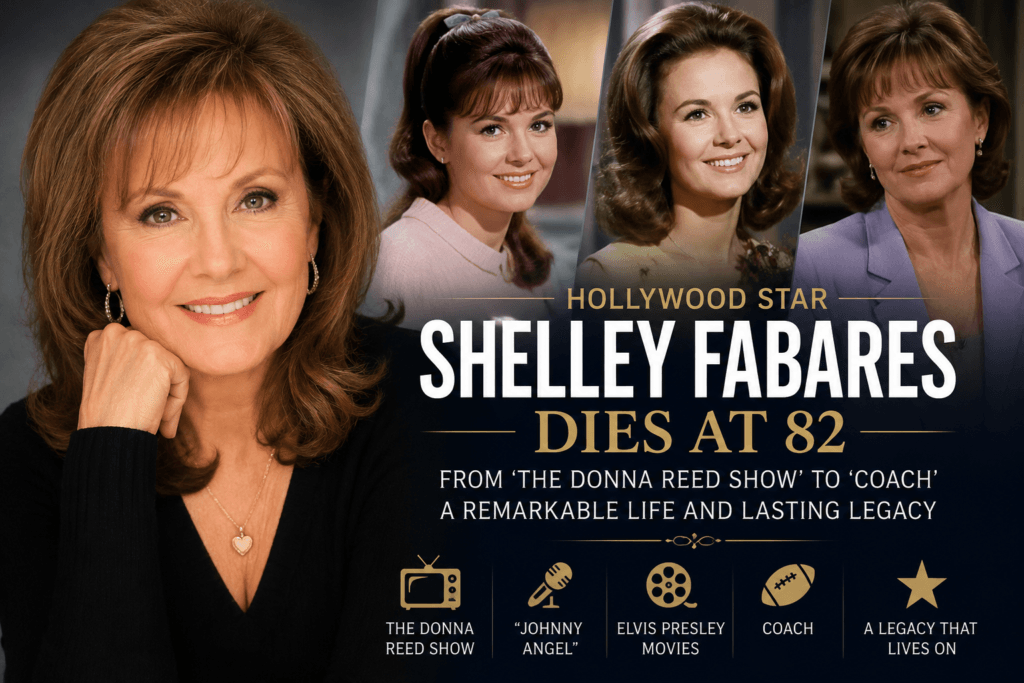
Shelley Fabares, the actress and singer whose career stretched from classic 1950s television to the long-running sitcom Coach, has died at 82. Her family confirmed that she died Saturday in Los Angeles. No cause of death was provided.
For many viewers, Fabares remained closely associated with Mary Stone on The Donna Reed Show. However, her career reached far beyond that early television success. She recorded the hit song “Johnny Angel,” appeared alongside Elvis Presley in three films, took on dramatic roles, and later found another major television audience as Christine Armstrong on Coach.
Her career also included One Day at a Time, Brian’s Song and numerous other television and film appearances. Across several decades, Fabares successfully moved from child performer to teen idol and then to an established adult actress.
Shelley Fabares Dies at 82: What We Know
Shelley Fabares died in Los Angeles at the age of 82, according to a statement from her family reported by The Associated Press. The family described her as a source of love, strength, laughter and comfort to the people around her. They did not disclose a cause of death.
Her death also adds to a growing number of recent entertainment losses that have prompted renewed interest in the careers and legacies of longtime performers, including Christy Knowings.
The news marks the end of a career that began when Fabares was still a child and continued for decades. She became widely known during the late 1950s as Mary Stone on The Donna Reed Show, one of television’s recognizable family sitcoms of that era.
Her success did not remain limited to television. During her teenage years, she also established herself as a recording artist. Her version of “Johnny Angel” became a major pop hit, adding a music career to her growing reputation as a young star.
Fabares later expanded her acting range. She worked with major performers, appeared in films with Elvis Presley and took on more mature television roles. By the 1980s and 1990s, she had built a second major chapter of her career through Coach, where she played Christine Armstrong opposite Craig T. Nelson.
That longevity helps explain why news of her death resonates across different generations. Older viewers may remember her from The Donna Reed Show, while others know her primarily from Coach or her later television appearances.
Her career was therefore not defined by a single role. Instead, Shelley Fabares became an example of a performer who successfully adapted as American television and popular culture changed.
Who Was Shelley Fabares?
Shelley Fabares was an American actress and singer who began performing professionally as a child. Born in Santa Monica, California, in 1944, she received her first television credit at age 10 with an appearance on The Loretta Young Show.
That early opportunity opened the door to a steady stream of television and film work. Before reaching her best-known role, Fabares appeared in projects involving performers such as Paul Newman, Frank Sinatra, Eva Marie Saint, Rosalind Russell and Rock Hudson. Her early credits included The Girl Rush, Never Say Goodbye, Annette and an episode of The Twilight Zone.
Her breakthrough came in 1958 when she joined The Donna Reed Show as Mary Stone. She remained part of the regular cast through 1963. The role made her a familiar face to American television audiences and established her as a major young star.
Fabares then moved into music and film while continuing to act. Her recording of “Johnny Angel” became one of her signature achievements, while her appearances in three Elvis Presley movies expanded her profile beyond television.
Later, she demonstrated that her early fame was not simply a product of teenage popularity. Roles in Brian’s Song, One Day at a Time and eventually Coach showed her ability to continue working successfully as she moved into different stages of adulthood.
Her career ultimately covered more than five decades of American entertainment.
Shelley Fabares and The Donna Reed Show
The Donna Reed Show became the defining breakthrough of Shelley Fabares’ early career. She joined the series in 1958 as Mary Stone, the daughter of Donna Reed’s character, and remained with the show until 1963.
The series placed Fabares in the middle of a television family that became familiar to audiences across the United States. As Mary, she represented the teenage perspective within the show’s family-centered stories.
The role arrived during an important period in American television. Family sitcoms were becoming a major part of prime-time programming, and young performers on successful shows could quickly become household names. Fabares benefited from that environment while developing her own identity as a performer.
Her years on the show also gave her valuable experience at a remarkably young age. In later comments, Fabares credited Donna Reed with having a profound influence on her. She viewed those teenage years as particularly important in shaping her personally and professionally.
The show’s success also created opportunities outside acting. While she was still associated with The Donna Reed Show, Fabares began recording music and established herself as a pop singer.
That combination of television exposure and music success made her one of the recognizable young entertainment personalities of the early 1960s.
Yet The Donna Reed Show was only the first major stage of her career. After leaving the series, Fabares continued pursuing film, music and television rather than relying solely on the image she had created as Mary Stone.
Shelley Fabares’ Music Career and “Johnny Angel”
Shelley Fabares added another dimension to her young-star image when she entered the recording world during the height of her television popularity. Her biggest musical success came with “Johnny Angel,” a song that became closely associated with her name and helped turn her into a major teen idol of the early 1960s.
Released while she was still appearing on The Donna Reed Show, the recording connected strongly with the show’s young audience. Its success showed that Fabares could attract attention beyond the television screen and gave her a second career path while she was still in her teens.
“Johnny Angel” remains one of the most recognizable recordings from Fabares’ career. The song reached No. 1 on the Billboard Hot 100 in 1962, giving her a significant achievement during an era when young television stars increasingly crossed into popular music.
The success also demonstrated how entertainment careers worked differently during the early television era. A performer who became popular on a family sitcom could quickly build an audience through records, magazines, movies and personal appearances.
For Fabares, music became an important part of her identity during this period. However, she never allowed her recording success to replace acting. Instead, she continued developing both sides of her career before eventually concentrating more heavily on television and film.
Her music career therefore represents an important part of the Shelley Fabares story, but it was only one chapter in a much longer entertainment journey.
The Success of “Johnny Angel”
“Johnny Angel” became the defining musical achievement of Shelley Fabares’ early career. The recording reached the top position on the Billboard Hot 100 in 1962, making her one of the television performers who successfully translated screen popularity into mainstream music success.
The timing mattered. Fabares already had a strong following through The Donna Reed Show, where viewers had watched her grow from a young performer into a recognizable teenage star. The record gave those viewers another way to connect with her.
The song also helped strengthen her image as a teen idol. At the time, television and popular music increasingly overlapped, and young stars could build audiences across several forms of entertainment. Fabares became part of that broader pop-culture movement.
Yet the record’s success did not define the rest of her career. Unlike performers who became permanently associated with their music, Fabares continued pursuing acting opportunities. She moved into films, television dramas and later sitcoms, gradually leaving behind the image of a teenage recording star.
That transition became important to her long-term success. “Johnny Angel” remained a memorable part of her legacy, but Fabares eventually proved that her abilities extended well beyond one hit song.
For audiences discovering her career today, the recording provides an interesting reminder of just how broad her early popularity had become.
Her Elvis Presley Movie Career
Shelley Fabares expanded her film career during the 1960s by appearing opposite Elvis Presley in three movies. Those films were Girl Happy, Spinout and Clambake, giving Fabares a connection to one of the biggest entertainment figures of the era.
Her first Presley film, Girl Happy, arrived in 1965. Fabares played Valerie alongside Presley, who starred as a musician working during spring break. The movie combined music, comedy and romance in a style that reflected the commercial formula of many Presley films.
Fabares returned to the screen with Presley in Spinout in 1966. She played Cynthia, adding another romantic-comedy role to her growing film résumé.
Their third collaboration came with Clambake, released in 1967. Fabares played the romantic lead opposite Presley in the musical comedy.
Working with Presley gave Fabares another major platform during an already successful period. She was no longer known only as the teenager from The Donna Reed Show. Her film appearances showed that she could move into mainstream movie entertainment while maintaining her television career.
The three Presley films also remain an important part of her screen legacy because they place her within a distinctive period of American popular culture. Presley dominated the music and movie landscape, while Fabares represented the generation of young performers who moved comfortably between television, records and cinema.
Although she appeared in many other projects, those three films remain among the most recognizable movie credits associated with her name.
Shelley Fabares Beyond Teen Stardom
As Fabares moved into adulthood, she faced the challenge that many performers who become famous as teenagers eventually encounter: proving that their careers can continue after their original image fades.
Rather than relying on nostalgia, Fabares gradually broadened the kinds of roles she accepted. Her later work included television dramas, made-for-television movies and sitcoms that allowed her to move beyond the wholesome teenage image established by The Donna Reed Show.
One significant example was Brian’s Song, the acclaimed television film centered on Chicago Bears football players Gale Sayers and Brian Piccolo. Fabares appeared in the production as Beverly Fawcett, contributing to a project that carried a much more dramatic tone than her earlier sitcom work.
She also appeared in One Day at a Time, another successful television series that gave her an opportunity to work within a contemporary family-comedy setting.
These projects helped establish a pattern that would continue throughout her career. Fabares could move between comedy and drama without becoming permanently tied to the roles that had first made her famous.
That ability became particularly valuable when she eventually joined Coach. By then, she had already spent decades working in entertainment and had experienced several distinct phases of American television.
Her career was therefore not simply a story of an early star maintaining visibility. It was a story of reinvention, with each stage adding something different to the public image she had established as Mary Stone.
Brian’s Song and Her Dramatic Work
Brian’s Song represented an important change in tone for Shelley Fabares. The television film focused on the friendship between Chicago Bears players Brian Piccolo and Gale Sayers and became known for its emotional storytelling.
Fabares played Beverly Fawcett in the production. The role placed her in a dramatic project rather than the family sitcom environment that had defined much of her early fame.
This kind of work mattered because it demonstrated that audiences could see Fabares in more serious material. She had already spent years building a reputation through television and music, but dramatic projects allowed her to develop a different professional identity.
Her television career continued to expand through the 1970s and 1980s. During this period, she appeared in a variety of programs and television movies while gradually building the résumé that would lead to her most prominent later sitcom role.
Fabares’ ability to remain active across changing television eras became one of the strongest characteristics of her career. She did not disappear after the decline of her teenage-star period. Instead, she adapted to new formats and audiences.
That adaptability eventually became especially important when she joined Coach, where she would become familiar to an entirely new generation of television viewers.
One Day at a Time and Another Television Chapter
Before Coach, Shelley Fabares continued expanding her television résumé with appearances on established series, including One Day at a Time.
The sitcom, created by Whitney Blake and Allan Manings, focused on a divorced mother raising her two daughters. Its stories addressed family relationships and changing social expectations, giving performers opportunities to work with more contemporary material than many earlier family sitcoms.
Fabares appeared as Francine Webster, a role that added another chapter to her television career.
Her participation in programs such as One Day at a Time reflected the broader evolution of her work. She was no longer simply the young actress audiences had known from the late 1950s. By this stage, she had become a seasoned television performer who could step into different ensemble casts and formats.
That experience prepared her for Coach, the sitcom that would ultimately give her one of her most enduring adult roles.
By the time Fabares arrived on Coach, she had already spent decades working in television. She had experienced the pressures of childhood fame, teenage popularity, music success, Hollywood films and dramatic acting.
Her later success was therefore built on a long foundation rather than a sudden career revival.
Shelley Fabares on Coach
When Shelley Fabares joined Coach in 1989, she entered a new phase of her career. The NBC sitcom starred Craig T. Nelson as Hayden Fox, a college football coach whose professional ambitions often collided with his personal life. Fabares played Christine Armstrong, a successful television news anchor who became Hayden’s love interest and eventually his wife.
The role gave Fabares the opportunity to portray an accomplished adult woman with her own professional identity. That detail mattered because Christine was not simply defined by her relationship with Hayden. She had a demanding career, strong opinions and an independent personality.
Fabares remained with the series through its run from 1989 to 1997. Her presence helped anchor the show’s relationship stories while the comedy continued to revolve around Hayden’s coaching career.
The role also introduced Fabares to viewers who had grown up long after The Donna Reed Show. In that sense, Coach became more than another television credit. It gave her a second major period of recognition and demonstrated her ability to remain relevant across different generations.
The Television Academy lists Fabares as a two-time Emmy nominee for her performance as Christine Armstrong.
Playing Christine Armstrong
Christine Armstrong was one of the strongest adult characters Shelley Fabares played during her later television career. She worked as a television news anchor, giving the character a professional identity that existed independently from Hayden Fox.
That setup allowed the series to explore a relationship between two people with demanding careers. Christine’s work mattered to her, while Hayden’s coaching responsibilities often consumed his attention. Their relationship therefore created stories about balancing ambition, family and personal commitments.
Fabares brought a calm and grounded presence to the character. She could play the comedy without turning Christine into a one-dimensional sitcom figure.
Her performance also reflected how television roles for women had changed since the era of The Donna Reed Show. Mary Stone had been introduced primarily through a family sitcom, while Christine Armstrong was an established professional navigating both work and relationships.
That contrast became an important part of Fabares’ career evolution. She moved from playing the daughter in a classic family series to portraying a mature woman with her own ambitions.
Working With Craig T. Nelson
Fabares’ chemistry with Craig T. Nelson became central to Coach. Nelson played Hayden Fox, while Fabares portrayed Christine, creating the show’s principal romantic relationship.
Their characters had different personalities and priorities, which gave the series plenty of material for both humor and conflict. Hayden’s intense dedication to football often clashed with Christine’s professional ambitions and expectations.
That contrast helped make their relationship feel more developed than a simple sitcom romance. The characters had to negotiate careers, marriage and the demands of everyday life.
Fabares also benefited from working within a strong ensemble that included Jerry Van Dyke and Bill Fagerbakke. The combination of workplace comedy and family relationships allowed her character to operate in several storylines.
After years of playing younger characters, Fabares had reached a stage where her experience could become part of the performance. She understood television comedy and could bring that experience to a long-running ensemble series.
Why Coach Became a Career Milestone
Coach became a major milestone because it gave Shelley Fabares a prominent role nearly three decades after her breakthrough on The Donna Reed Show.
The series also proved that her career could evolve rather than simply depend on nostalgia. Viewers who knew her as Mary Stone could remember her early work, while younger audiences could encounter her through Christine Armstrong.
Fabares’ two Emmy nominations provide the clearest recognition of the role’s importance. The Television Academy records her nominations for Outstanding Supporting Actress in a Comedy Series in both 1993 and 1994.
Although she did not win either nomination, the recognition placed her among the leading supporting performers in television comedy during those years.
Her Coach years ultimately became one of the longest and most visible chapters of her adult career.
Shelley Fabares’ Emmy Recognition
Shelley Fabares’ work on Coach earned her two Primetime Emmy nominations. Both came in the Outstanding Supporting Actress in a Comedy Series category, recognizing her performance as Christine Armstrong.
The nominations arrived in consecutive years, reflecting the consistency of her work rather than a single isolated appearance.
Her 1993 Emmy Nomination
At the 45th Emmy Awards in 1993, Fabares was nominated for Outstanding Supporting Actress in a Comedy Series for Coach. The category included performers such as Rhea Perlman, Laurie Metcalf, Sara Gilbert and Julia Louis-Dreyfus. Laurie Metcalf won the award for Roseanne.
Fabares’ nomination confirmed that her later television work had earned serious industry recognition.
It also represented an interesting point in her career. She had already been a professional performer for decades, yet the nomination came for a role that introduced her to audiences in a completely different stage of life.
Her 1994 Emmy Nomination
Fabares received another nomination the following year at the 46th Emmy Awards. Once again, she was recognized for Outstanding Supporting Actress in a Comedy Series for playing Christine Armstrong on Coach. Laurie Metcalf again won the category for Roseanne.
The Television Academy’s official biography lists exactly two Emmy nominations for Fabares, both for Coach in 1993 and 1994.
Together, the nominations stand as evidence of the strength of her later television career. They also helped distinguish Fabares from the teen-star image that had defined her earliest years in entertainment.
Shelley Fabares and Mike Farrell
Shelley Fabares’ personal life was closely connected with actor Mike Farrell, best known for his work as B.J. Hunnicutt on MASH*. The couple married in 1984 and remained together for the rest of Fabares’ life.
Their relationship became especially important during some of the most difficult periods of Fabares’ later life.
Their Marriage
Fabares had previously been married to record producer Lou Adler. She later married Farrell, and the two built a long-lasting partnership while continuing their respective careers.
Farrell understood the demands of entertainment work, which gave the couple a shared professional background. Fabares continued acting while Farrell pursued acting, directing, producing and advocacy work.
Their marriage lasted for more than four decades, making Farrell an important part of Fabares’ personal story.
Their Life Together
The couple’s relationship became particularly significant when Fabares faced serious health challenges. In 1999, doctors discovered progressive liver failure after she went to an emergency room with an esophageal bleed. She eventually received a liver transplant in October 2000 after spending 22 months on the waiting list.
Farrell remained closely involved throughout that difficult period. In later comments, Fabares expressed gratitude for his support during her recovery.
Their partnership therefore extended beyond Hollywood appearances. It became an important source of stability during a major medical crisis and remained part of the story of Fabares’ later years.
Shelley Fabares’ Later Career and Public Life
After Coach ended in 1997, Fabares continued working, although she gradually became less visible as an on-screen performer.
Voice Acting and Television Work
One notable later role came through animation. Fabares provided the voice of Martha Kent in Superman: The Animated Series, allowing her to remain connected to television while moving into voice performance.
She also continued appearing in television projects and later took on work behind the scenes. Her long experience in the entertainment industry gave her opportunities beyond traditional acting roles.
Advocacy and Life Beyond Acting
Fabares also became associated with Alzheimer’s awareness and other charitable causes. Her advocacy reflected a more personal side of her public life and showed how her influence eventually extended beyond entertainment.
Her career had already demonstrated remarkable longevity. By the time she stepped back from regular acting, she had worked across television sitcoms, dramas, feature films, music and voice acting.
That range became one of the defining characteristics of Shelley Fabares’ professional legacy.
Shelley Fabares’ Health Journey
Shelley Fabares’ later life included a serious health crisis that changed her personal and professional journey. In 1999, doctors discovered that she had progressive liver failure after she went to an emergency room with an esophageal bleed. The diagnosis eventually led to a liver transplant in 2000.
The Liver Transplant
Fabares spent 22 months on the transplant waiting list before receiving a new liver in October 2000. The procedure marked one of the most difficult periods of her life, but she ultimately recovered and continued to speak about the importance of organ donation.
Her health problems also affected the pace of her entertainment career. After decades of regular television and film work, she gradually stepped away from acting and spent more time focusing on her personal life and health.
The transplant became an important part of her later story because it demonstrated a different kind of resilience from the professional determination that had defined her career. Fabares had already navigated the pressures of childhood fame, changing audiences and decades of work. Her health journey added another major challenge.
Recovery and Support From Mike Farrell
Mike Farrell remained an important source of support during Fabares’ health crisis. Their long marriage provided stability while she waited for a transplant and recovered afterward.
Fabares later spoke positively about the role of organ donation and encouraged greater awareness of transplantation. Her experience gave the subject a personal dimension that went beyond her public career.
The liver transplant did not erase the challenges she faced, but it gave Fabares additional years and allowed her to continue living outside the intense demands of Hollywood.
Shelley Fabares and Alzheimer’s Awareness
Fabares also became involved in Alzheimer’s awareness after experiencing the disease’s effects within her family. Her advocacy reflected a more personal side of her public life, particularly as she moved away from regular acting.
A Personal Connection
Fabares’ connection to Alzheimer’s awareness was linked to her family experiences. Instead of treating the subject only as a public issue, she used her visibility to help draw attention to families dealing with memory loss and caregiving.
That work became another part of her legacy outside entertainment. Fabares had spent much of her early life in front of cameras, but her later public activities increasingly focused on issues that affected people’s everyday lives.
Life After Hollywood’s Spotlight
As her acting appearances became less frequent, Fabares maintained a quieter public profile. She no longer needed to remain constantly visible to audiences to preserve the significance of her career.
Her long professional history already spoke for itself. She had worked in television from childhood, recorded a major pop hit, appeared in Hollywood films, earned Emmy recognition and remained active across several generations of television.
Her later advocacy added another dimension to that record. It showed that her public identity eventually extended beyond the roles that had made her famous.
Shelley Fabares’ Later Years
Fabares’ later years were considerably quieter than the period when she was one of America’s most recognizable television personalities.
Stepping Away From Regular Acting
After the conclusion of Coach in 1997, Fabares continued occasional television and voice work but did not pursue the same volume of acting roles that had characterized earlier decades.
That gradual withdrawal was understandable after such a long career. By then, she had already worked professionally for more than 40 years.
Her decision to live more privately also meant that newer generations sometimes knew her mainly through reruns and classic television programming. Yet those reruns continued to introduce her work to audiences who had not watched her original programs when they first aired.
Like Fabares, other established performers have also chosen quieter lives after decades in the entertainment industry, including Stockard Channing.
A Career Spanning Generations
Few performers from the classic television era managed to remain recognizable across such different periods of American entertainment.
Fabares first became famous when television centered heavily on family sitcoms. She later worked during the rise of television movies, dramatic programs and major network sitcoms. Her career eventually reached viewers through animation and syndicated reruns.
That continuity helped make her career unusual. She did not depend on one moment of fame. Instead, different projects became important to different generations.
That cross-generational appeal can also be seen in the careers of television performers such as Dean Butler, remembered for Little House on the Prairie.
Shelley Fabares’ Lasting Legacy
Shelley Fabares leaves behind a career that cannot be reduced to a single character or song. Her legacy stretches across television, music, film and several generations of American popular culture.
From Mary Stone to Christine Armstrong
Mary Stone on The Donna Reed Show made Fabares famous as a teenager. Decades later, Christine Armstrong on Coach gave her a prominent adult television role.
The contrast between those characters illustrates the breadth of her career. She successfully moved from playing the daughter in a classic family sitcom to portraying an established professional woman in a successful network comedy.
A Career Beyond Nostalgia
Fabares’ work remains significant because she continued to evolve after her initial success. “Johnny Angel” gave her a No. 1 pop hit, while her Elvis Presley films placed her alongside one of the biggest stars in entertainment history.
Her decades-long career reflects the kind of lasting entertainment legacy also seen in artists such as Phil Collins, whose career continues to attract interest decades after his breakthrough.
Her dramatic work, Emmy nominations and later television appearances added further depth.
Rather than simply returning to the roles that made her famous, Fabares continued finding new places within the entertainment industry.
Why Shelley Fabares Still Matters
The lasting interest in Shelley Fabares reflects the unusual range of her career. She belonged to several different eras of entertainment without becoming completely defined by any one of them.
A Link Between Classic and Modern Television
For viewers who discovered her through The Donna Reed Show, Fabares represented the golden age of American family television. For another generation, Coach became the defining reference point.
That generational connection is one of the strongest parts of her legacy. Her work remained accessible through reruns, television archives and later distribution platforms.
More Than a Teen Idol
Fabares’ early fame could easily have become the entire story of her career. Instead, she continued working long after her teenage years and developed a résumé that included comedy, drama, music, feature films and voice acting.
Her ability to adapt ultimately became more important than her early image. Her story also fits into the broader history of performers whose careers continued to resonate long after their breakthrough years, such as Michael Wright.
That is why Shelley Fabares’ career remains notable. She was not simply a star from an earlier era. She was a performer who repeatedly found ways to remain relevant as the entertainment industry changed around her.
Shelley Fabares’ Movies and TV Shows: Key Career Highlights
Shelley Fabares built a remarkably broad entertainment résumé over more than five decades. Her best-known work began on television, but her career eventually covered music, feature films, dramatic productions, sitcoms and voice acting.
The Donna Reed Show
Fabares became nationally recognized as Mary Stone on The Donna Reed Show. The role established her as a teenage television star and remains one of the performances most closely associated with her name.
Coach
Decades later, Fabares reached another generation through Coach. As Christine Armstrong, she played a television news anchor and the romantic partner of Craig T. Nelson’s Hayden Fox.
Elvis Presley Films
Fabares appeared opposite Elvis Presley in three films: Girl Happy, Spinout and Clambake. These movies became notable parts of her 1960s film career.
Other Notable Work
Her résumé also included Brian’s Song, One Day at a Time and later voice work as Martha Kent in Superman: The Animated Series. Together, these projects demonstrate how often she moved between different types of entertainment.
Frequently Asked Questions About Shelley Fabares
How old was Shelley Fabares when she died?
Shelley Fabares was 82 years old when she died in Los Angeles in August 2026. Her family confirmed her death but did not publicly disclose a cause of death.
What was Shelley Fabares best known for?
She was best known for playing Mary Stone on The Donna Reed Show and Christine Armstrong on Coach. She was also recognized for her recording of “Johnny Angel” and her three films with Elvis Presley.
What happened to Shelley Fabares?
Fabares died at 82 in Los Angeles. Her family confirmed the death and described her as an important source of love and support to those around her. No cause of death was announced publicly at the time of the confirmation.
Was Shelley Fabares married to Mike Farrell?
Yes. Shelley Fabares married actor Mike Farrell in 1984. They remained married for more than four decades, until her death in 2026. Farrell was also an important source of support during her serious health problems.
Did Shelley Fabares sing “Johnny Angel”?
Yes. Fabares recorded “Johnny Angel,” which became a major pop hit in 1962 and reached No. 1 on the Billboard Hot 100. The song remains one of the most recognizable achievements from her early career.
How many Elvis Presley movies did Shelley Fabares appear in?
Fabares appeared in three Elvis Presley movies: Girl Happy in 1965, Spinout in 1966 and Clambake in 1967.
What role did Shelley Fabares play on Coach?
Fabares played Christine Armstrong, a television news anchor who became involved romantically with Craig T. Nelson’s character, Hayden Fox. She remained a major part of the series during its run and received two Emmy nominations for the role.
Did Shelley Fabares win an Emmy for Coach?
No. Fabares received two Primetime Emmy nominations for Outstanding Supporting Actress in a Comedy Series for Coach, in 1993 and 1994, but she did not win either time.
Shelley Fabares’ Enduring Place in Television History
Shelley Fabares’ career stands out because it continued to evolve long after her first breakthrough. She entered television as a child performer, became a teenage star on The Donna Reed Show, recorded a major pop hit and then moved into Hollywood films.
A Career That Crossed Generations
Her transition to Coach became especially important. Nearly 30 years after she first became famous as Mary Stone, Fabares had another major television role as Christine Armstrong.
That longevity allowed different generations to connect with her work. Some audiences remembered her from classic family television, while others knew her from Coach or later projects.
More Than One Defining Role
Fabares’ legacy also rests on her willingness to move beyond one successful image. She did not remain confined to teenage roles. Instead, she worked in drama, comedy, film, music and animation.
Her two Emmy nominations for Coach further demonstrated the strength of her later television work.
Ultimately, Shelley Fabares’ career tells the story of a performer who adapted to changing audiences without losing the qualities that first made her recognizable. From Mary Stone and “Johnny Angel” to Christine Armstrong and beyond, her work became part of several distinct chapters in American entertainment.
Her death closes a long career, but the roles and recordings that defined it remain accessible to audiences who discovered her decades ago as well as those encountering her work for the first time today.